


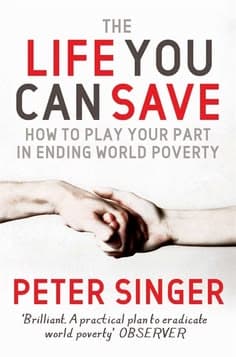
The Life You Can Save: Acting Now to End World Poverty

Singer's book revives and popularizes his 1972 drowning-child thought experiment to argue that affluent individuals are morally obligated to donate substantial portions of their income to effective aid organizations. The central mechanism is a simple analogy: if you would ruin a pair of shoes to save a drowning toddler, you should be willing to sacrifice comparable luxuries to save children dying of preventable poverty-related causes. Singer then addresses psychological and practical barriers to giving, proposes a graduated standard of donation, and outlines a seven-point plan mixing personal philanthropy, local activism, and political pressure to redirect foreign aid toward the poorest.
Key Insights
✦What is the central argument of The Life You Can Save, and what does it reject?
Singer argues that affluent individuals in developed countries are morally obligated to donate a significant portion of their income to organizations that can demonstrably save lives in extreme poverty. The argument proceeds through the drowning-child analogy: since you would obviously save a child from a shallow pond at the cost of ruined shoes, you should be willing to sacrifice equivalent luxuries to save children dying of preventable causes abroad, because distance and nationality do not morally matter. The book rejects the assumption that giving is a matter of charity or supererogation. It also rejects the view that individual consumption choices are morally insulated from global consequences, and it dismisses common objections such as the idea that one's own earnings are exclusively one's own to spend.
✦What specific framework did the book introduce or popularize, and how is it used today?
The Life You Can Save popularized the framework of effective altruism for a general audience, though the term itself was coined later. The book's distinctive contribution is the combination of a demanding utilitarian moral principle with a practical, evidence-based approach to charitable giving. Singer argues not just that one should give, but that one should give to organizations that can demonstrate cost-effective impact—a framework that later crystallized in the effective altruism movement. The book also proposed a graduated donation standard, suggesting that the wealthy should give substantially more than the middle class, rather than a single flat percentage. This standard, and the drowning-child argument underpinning it, remain central to contemporary debates about donor obligations.
✦How did critics respond to the book's argument, and who are the named critics?
Paul Collier, author of The Bottom Billion, reviewed the book critically in The Guardian. Collier conceded that Singer is right that there are uses of money that would save lives without significantly affecting one's own quality of life, but argued that the argument leads to endless guilt and that the fairer solution is taxation rather than individual charity. Collier also defended 'propinquity'—the stronger concern people feel for those close to them—as a precious asset rather than selfishness, and argued that handing over money can be demeaning to recipients and that political action on trade and governance is more dignified and effective. The philosopher Travis Timmerman has also challenged the drowning-child analogy, arguing that a more fully described case reveals the sacrifice Singer demands is not comparable to ruining a pair of shoes [citation:4][citation:9].
✦How does the book relate to Singer's earlier essay 'Famine, Affluence, and Morality'?
The Life You Can Save is a popular expansion and updating of the argument Singer first made in his 1972 essay 'Famine, Affluence, and Morality.' The drowning-child thought experiment originated in that essay, and the book restates it for a broader audience while adding empirical material about aid effectiveness, psychological barriers to giving, and practical advice on charitable selection. The book also responds to decades of philosophical criticism and real-world developments in development economics. Singer's later work, including The Most Good You Can Do (2015), extends the effective altruism framework further, but The Life You Can Save remains the accessible entry point to his demanding moral position [citation:7][citation:10].
✦What changed in the tenth-anniversary edition, and why does it matter for interpreting the book?
The tenth-anniversary edition, published in 2019, updates the original argument with new material reflecting a decade of progress in global poverty reduction and the growth of the effective altruism movement. It includes a foreword by Mike Schur, creator of The Good Place, an afterword by Charlie Bresler of The Life You Can Save organization, updated case studies of effective charities, and revised calls to action. Singer also recounts how the first edition affected readers and the people they helped. The edition matters because it shows Singer treating the book not as a fixed text but as a living intervention, adjusting its empirical claims and practical recommendations in light of new evidence while retaining the core moral argument [citation:5][citation:11].
✦Is the drowning-child analogy a fair representation of the donor's situation?
Critics have argued that it is not. The philosopher Travis Timmerman has developed a more detailed variation in which a person must repeatedly sacrifice for drowning children on an ongoing basis, arguing that once the full costs are described, commonsense morality permits some indulgence in goods less important than a child's life, which would falsify the strong obligation Singer derives from the original pond case. Leif Wenar has argued that Singer's principle ignores the risk that donations may cause harm to others, since real-world giving involves intermediaries and unintended consequences that the pond scenario omits. Singer's defenders respond that one can choose charities with low risk of harm, and that the existence of some risk does not dissolve the obligation to help when the expected benefit is large [citation:4][citation:12].
✦How does the book's approach differ from Paul Collier's argument in The Bottom Billion?
Collier's The Bottom Billion (2007) argues that the primary responsibility for addressing global poverty lies with governments and international policy—trade, security, governance, and aid reform—rather than individual charity. Collier contends that ordinary citizens have a duty to be informed and to pressure their governments, but that the fair and effective mechanism for redistribution is taxation, not voluntary donation. Singer's book focuses on individual moral obligation and private philanthropy, treating personal giving as a direct response to suffering that cannot wait for political solutions. Collier acknowledges the moral force of Singer's argument but worries that it privatizes responsibility and distracts from structural change. The disagreement is not about whether poverty matters but about the proper locus of moral agency [citation:9].
Wealthy Psyche is an intellectual archive. We do not host, distribute, or sell book copies — physical or digital. We provide structured knowledge to help you think better, faster.