


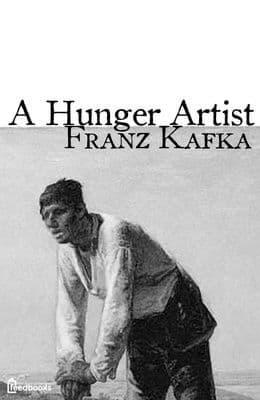
A Hunger Artist
Kafka's A Hunger Artist traces the decline of a professional faster whose art—public starvation—loses its audience to changing tastes. The story's central mechanism is the artist's body as a sign: he transforms himself into a spectacle of refusal, but the meaning of that spectacle depends entirely on spectators who eventually stop watching. Its distinctive claim is that the hunger artist's fasting is not spiritual transcendence but a confession of impossibility—he fasted because he could never find food he liked. The panther that replaces him in the cage embodies the vitality the artist rejected, closing the story with an image of life's indifference to his sacrifice.
Key Insights
✦What is the central mechanism of A Hunger Artist, and what does it reject?
The story's mechanism is the hunger artist's body as a sign that requires an audience to mean anything. He fasts for forty days at a time, watched by rotating teams of butchers, displayed in a cage with a clock and straw. The public's suspicion that he cheats, his fury at the arbitrary time limit, and his dissatisfaction with the impresario's theatrical framing all depend on spectators who are watching. What A Hunger Artist rejects is the interpretation, common among critics who read the story as religious allegory, that the artist's fasting represents spiritual transcendence or saintly asceticism. His final confession—that he fasted only because he could never find food he liked—undercuts any reading that treats his starvation as a path to meaning. The story's horror is that his art was never about anything except itself.
✦How does the story's publication history relate to Kafka's death and his literary estate?
A Hunger Artist was first published in Die neue Rundschau in 1922, and it became the title piece of the collection Ein Hungerkünstler, the last book Kafka prepared for publication . Kafka corrected the proofs during his final illness, but the book was printed by Verlag Die Schmiede after his death, appearing in 1924 . The collection contains four stories: 'First Sorrow,' 'A Little Woman,' 'A Hunger Artist,' and 'Josephine the Singer, or the Mouse Folk' . This publication context matters because the story is not an isolated work but the centerpiece of a collection Kafka arranged as a coherent sequence, and its placement alongside 'Josephine'—another story about a performer whose audience abandons her—suggests that Kafka intended the two to be read together.
✦How do critical interpretations of the story divide, and what is at stake in that division?
The sharpest division is between allegorical readings and those that resist allegory. Many critics treat the story as an allegory of the misunderstood artist, the saintly ascetic, or the alienated Jew, finding in the hunger artist's suffering a figure for spiritual or artistic transcendence . Other critics insist that the story's power lies precisely in its refusal to yield a stable meaning. A 2004 study by Efraim Sicher argues that the parable's keys may have been lost, and that redemption in the story comes too late, if at all . A 2022 comparative study by Baier reads the hunger artist's body as a 'somacentric' sign, an attempt to communicate meaning through flesh rather than language, and examines why that attempt ultimately fails . These divisions matter because they determine whether the story is a tragedy of misunderstood genius or a critique of the very idea that suffering produces meaning.
✦What is the significance of the panther at the end of the story?
The panther is the story's final image and its most brutal rebuke to the hunger artist's values. After the artist's death, the circus replaces him with a young panther who devours the food he likes, delights the crowd, and radiates vitality. The spectators who once ignored the starving man now crowd around the animal's cage because 'the panther, who was always brought the food he liked, took so much joy in life' . The contrast is absolute: the artist refused food as a sign of his art, while the panther eats with gusto and becomes an attraction. The ending suggests that the public does not want transcendence or refusal; it wants life, appetite, and immediacy. The panther does not mourn the artist or understand his sacrifice. It simply lives, and the crowd prefers that.
✦How does A Hunger Artist relate to Kafka's other stories about bodies and punishment, such as In the Penal Colony and The Metamorphosis?
All three stories center on a body that has become a site of meaning, but they approach this theme differently. In The Metamorphosis, Gregor's insect body is a passive fact that exposes his family's instrumental love. In In the Penal Colony, the torture apparatus inscribes the law directly onto the condemned man's skin, making the body a surface for legal writing. In A Hunger Artist, the protagonist actively transforms his own body into a sign by refusing food, but the meaning of that sign depends on spectators who eventually abandon him. A 2022 study in Symposium reads the two stories together, arguing that both propose 'somacentric signification'—the use of the body as a sign—as a solution to the limits of language, and both expose the failure of that solution . The hunger artist starves himself into a sign, and the sign is read by no one.
✦What is the textual history of the story's translation and what problems does it pose?
The first English translation was by Willa and Edwin Muir, published in 1948 by Schocken Books as part of The Penal Colony: Stories and Short Pieces. This translation became the standard English version for decades but has been criticized for smoothing Kafka's prose and for occasional inaccuracies. More recent translations include those by Ian Johnston, Stanley Corngold, and Michael Hofmann, each of which makes different choices about how to render Kafka's German syntax and his use of ambiguous terms. The story's title itself has been translated as 'A Fasting Artist' and 'A Starvation Artist,' choices that foreground different aspects of the protagonist's practice . A 2024 Cambridge article discusses a 'man-eater' variant to the story, a textual fragment whose status remains uncertain: it is neither authorially ratified nor invalidated, and its existence complicates any claim about the story's final form .
Wealthy Psyche is an intellectual archive. We do not host, distribute, or sell book copies — physical or digital. We provide structured knowledge to help you think better, faster.