


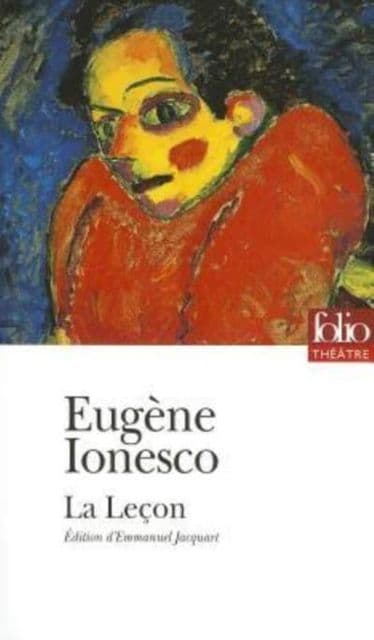
The Lesson (La Leçon)
The Lesson is a one-act play in which an elderly professor's private tutoring session with a young pupil escalates from nervous pedagogy into linguistic parody, psychological domination, and finally murder. Its central argument is enacted rather than stated: language, the medium of education and communication, is exposed as an instrument of power that can be weaponized to annihilate the other person. The play's distinctive mechanism is the inversion of authority—the pupil begins wilful and lively, the professor timid and apologetic, but as the lesson proceeds the professor grows despotic while the pupil is reduced to a passive object, culminating in the knife.
Key Insights
✦What is the central mechanism of power in The Lesson, and how does it operate?
The play's power mechanism is language itself, specifically the professor's escalating command of linguistic discourse. At the start, the pupil is physically vibrant and wilful while the professor is nervous and deferential. As he lectures on pseudo-linguistics and arithmetic, his speech becomes increasingly prolix and authoritative, while her vitality drains away—first as a toothache, then as full-body pain, then as a kind of aphasia . The turning point is not an argument but a shift in the ratio of speech. The professor's words proliferate, hers diminish. When he reaches the word 'knife,' language has become pure force, and the murder is the logical conclusion of a lesson in which only one voice was permitted to exist .
✦Why does Ionesco use the teacher-student relationship rather than a political or military setting?
The pedagogical setting allows Ionesco to expose authoritarianism at its most intimate and seemingly benign. The professor is not a dictator but a tutor; the pupil is not a citizen but a guest. Yet the structure of the lesson—one person possesses knowledge, the other must receive it—mirrors the structure of political domination. A 2023 Italian thesis argues that The Lesson is the first work in which Ionesco addresses the theme of authoritarianism and the human instinct to overpower the weak, a theme that becomes explicitly political in Rhinoceros . By locating coercion in education, Ionesco suggests that the roots of totalitarianism lie not only in ideology but in everyday relationships where one person claims the right to speak for another.
✦What is the significance of the maid's role, and why does the play end with her greeting a new pupil?
The maid functions as a chorus and a witness. She warns the professor about his health and about the danger of philology, but she is ignored . After the murder, she rebukes him and reveals that this is not his first victim—the pupil is the fortieth . Her final action, greeting a new pupil as the play ends, transforms the murder from a singular event into a ritual repetition. The play's structure is circular: the lesson will begin again, the professor will kill again, and the maid will clean up again. This circularity is the play's most chilling political claim: violence normalized through repetition becomes invisible, a routine that no one stops because it has always happened.
✦How did Ionesco's own experience inform the play, and what does that reveal about its satire of education?
Ionesco stated that the initial impulse for The Lesson came from his daughter's arithmetic textbook, which made him think a play could be written from the simplest elements of arithmetic . He also drew on his own experience giving private French lessons in Bucharest at eighteen or nineteen to pay rent . This biographical context matters because the play's satire is not abstract. It targets the actual experience of tutoring—the asymmetrical intimacy, the boredom, the resentment, the strange thrill of authority—rather than education as a concept. Ionesco described his state while writing as half-frightened and half-amused, a suspicion that language itself might be a kind of trap .
✦How does The Lesson relate to Ionesco's other early plays, particularly The Bald Soprano?
Both plays belong to Ionesco's first phase and share a preoccupation with the failure of language. The Bald Soprano dissolves conversation into cliché and non sequitur; The Lesson dissolves it into power. The two plays have been performed together at the Théâtre de la Huchette since 1957, and this pairing is instructive . Where The Bald Soprano shows language breaking down into meaningless exchange, The Lesson shows language becoming too effective—so effective that it can kill. The professor's discourse is not empty; it is lethal. Together, the plays suggest that the problem with language is not only that it fails to communicate but that it can also be used to dominate, and that these two failures are connected.
✦What is the textual and translation history of The Lesson, and why does it matter for interpretation?
The play was first performed in February 1951 at the Théâtre de Poche in Paris, directed by Marcel Cuvelier, who also played the professor . The first edition appeared in 1953, and the first English translation, by Donald Watson, was published in 1958 . The translation history matters because the play's climax depends on the specific word 'knife'—a word whose sonic and semantic properties differ across languages. A production that translates the play must decide whether to preserve the French 'couteau' or substitute the target-language equivalent, and this choice affects the rhythm and shock of the final sequence. The play is short—an hour or less—and its brevity is essential to its effect: the escalation from nervousness to murder must feel compressed, almost inevitable.
Wealthy Psyche is an intellectual archive. We do not host, distribute, or sell book copies — physical or digital. We provide structured knowledge to help you think better, faster.