


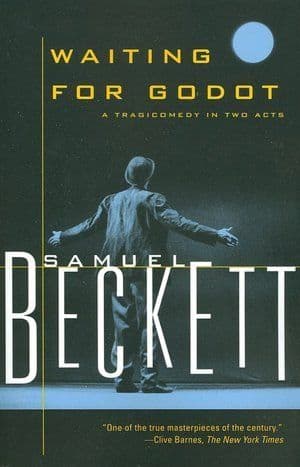
Waiting for Godot
Waiting for Godot is a two-act play in which two tramps, Vladimir and Estragon, wait beside a bare tree for a figure named Godot who never arrives, while passing the time through conversation, games, and encounters with the domineering Pozzo and his enslaved Lucky. Its central mechanism is the repetition of an unresolved wait: each act reenacts the first with minor variations, and the boy who announces Godot's delay each evening insists he has never seen the pair before. The play's distinctive claim is that waiting itself—not the arrival of what is awaited—constitutes the substance of a life, and the famous final exchange, in which the men agree to leave but do not move, makes stillness the play's only action.
Key Insights
✦What is the central mechanism of Waiting for Godot, and what does it reject?
The play's mechanism is the repetition of an unresolved wait. Vladimir and Estragon wait for Godot, who sends a boy each evening to say he will not come today but will come tomorrow. The second act repeats the first with minor variations: the tree has grown a few leaves, Pozzo is blind, Lucky is mute, and the boy again denies having seen the pair before. What Waiting for Godot rejects is the assumption that a play must have a plot, a climax, or a resolution. Nothing happens, twice. The play's dramatic energy comes not from the arrival of Godot but from the men's efforts to fill the time—their games, their arguments, their thoughts of suicide. Waiting is not an interruption of life; it is the form life takes .
✦Who or what is Godot, and why has Beckett refused to explain?
Godot is never identified, and Beckett consistently refused to say who or what he represents. When asked, he reportedly said that if he had known, he would have written it in the play. Critics have proposed that Godot is God, death, meaning, a benefactor, or simply the object of an empty habit of waiting. The name itself is ambiguous—it could be a diminutive of 'God' or an ordinary French surname. Beckett's refusal to explain is not evasion but the condition of the play's meaning. If Godot were identified, the wait would have a determinate object and could be judged as successful or failed. Because Godot remains unnamed, the wait becomes a figure for any and all waiting, and the play's question shifts from 'Will Godot come?' to 'What are we doing while we wait?' .
✦How did the play's premiere in Paris shape its reception and its later reputation?
Waiting for Godot premiered in French as En attendant Godot at the Théâtre de Babylone in Paris on January 5, 1953, directed by Roger Blin . The production was modest—the theatre was small, the set was bare—but it attracted attention from critics and intellectuals, including Jean Anouilh, who reportedly called it 'a music-hall sketch of Pascal's Pensées as played by the Fratellini clowns' . The English-language premiere followed in 1955 at the Arts Theatre in London, where it was initially received with puzzlement by some critics but quickly became a sensation. The play's reputation grew through the 1950s, and it is now widely regarded as the defining work of the Theatre of the Absurd and one of the most important plays of the twentieth century.
✦What is the significance of the relationship between Vladimir and Estragon, and how does it compare with other Beckett pairs?
Vladimir and Estragon are bound together by habit, need, and a shared inability to leave. Their relationship is one of mutual dependence and mutual irritation: they bicker, they consider parting, they embrace, they go on. Estragon is forgetful and physical; Vladimir is more intellectual and tries to impose a narrative on their situation. Beckett's later pairs—Hamm and Clov in Endgame, the two women in Come and Go—develop this dynamic of interdependence in different registers. A scholarly study notes that Vladimir and Estragon's relationship is 'the play's only stable structure,' a partnership that makes the emptiness bearable without overcoming it . Their final exchange, in which they agree to go but do not move, is the play's most famous image of the gap between intention and action.
✦How does the play's English translation differ from the French original?
Beckett wrote Waiting for Godot in French between 1948 and 1949, and then translated it into English himself. The English version, published by Grove Press in 1954, is not a literal translation but a re-creation. Beckett made substantial changes: he added jokes, altered rhythms, and adjusted cultural references. A study of the bilingual text notes that the English version is 'more colloquial and more overtly comic' than the French, and that some of the play's most quoted lines exist only in English . The French text is sparer and more abstract; the English text is more concrete and more theatrical. This difference reflects Beckett's practice of self-translation as a form of revision, and it means that the two versions are, in a sense, distinct works.
✦How has the play been interpreted politically, and why did Beckett resist these readings?
The play has been interpreted through many political lenses: as a commentary on Cold War paralysis, as an allegory of French resistance and waiting for liberation, as a critique of colonialism in the Pozzo-Lucky relationship. Beckett generally resisted these readings, insisting that the play was not about politics but about the human condition. However, his resistance was not absolute. In a 1953 letter to Roger Blin, he noted that the play's 'power of fermentation' was 'a little difficult to understand' and that audiences would find their own meanings . The play's formal structure—the repetition, the emptiness, the dependence—lends itself to political allegory without requiring it. What Beckett refused was the reduction of the play to a single message.
Wealthy Psyche is an intellectual archive. We do not host, distribute, or sell book copies — physical or digital. We provide structured knowledge to help you think better, faster.