


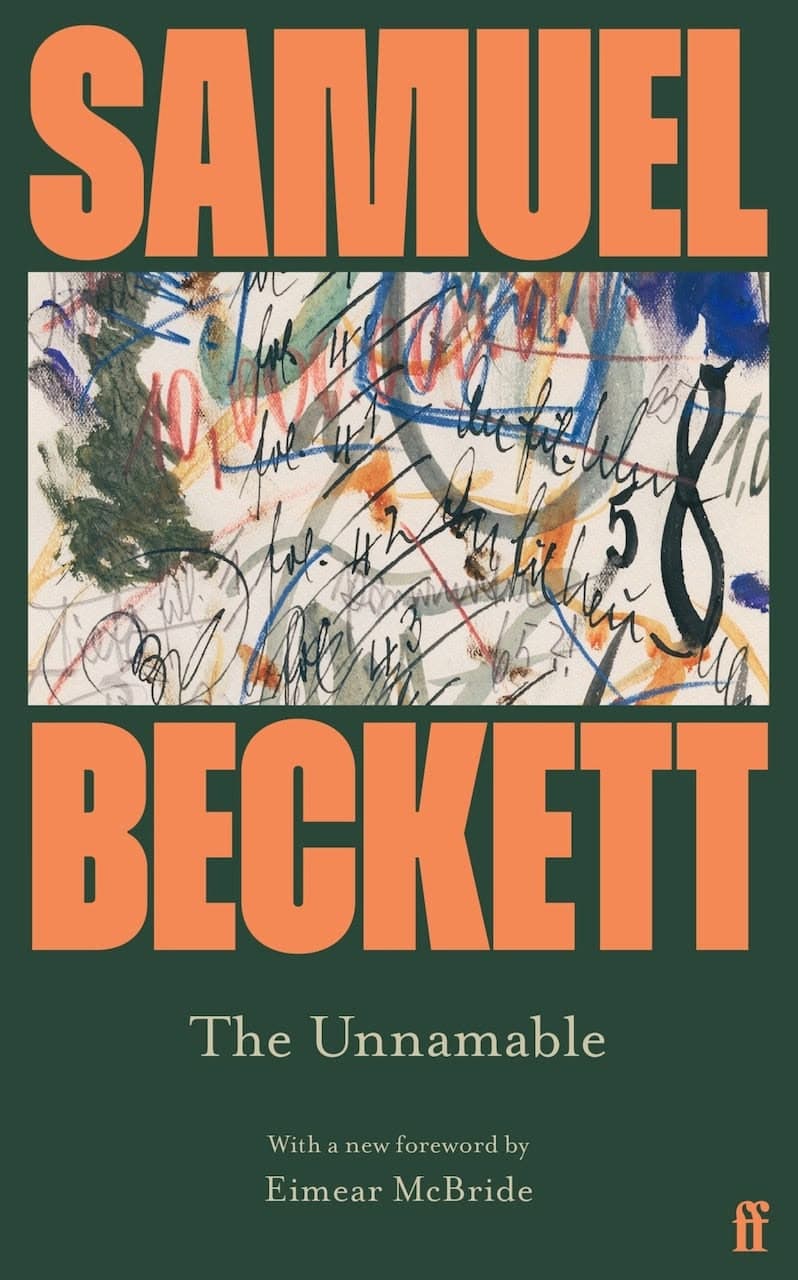
The Unnamable
The Unnamable is the final volume of Beckett's trilogy, a single unbroken monologue in which a disembodied narrator—variously called Mahood, Basil, and Worm—attempts to speak himself into existence while denying that any of these identities are his. Its central mechanism is linguistic self-cancellation: every assertion is immediately retracted, every story revealed as a lie, and the narrator's only certainty is that he is made of words that are not his own. The novel's distinctive claim is that there is no self behind the voice, only the compulsion to go on speaking, ending with the famous formulation that one must go on even though one cannot.
Key Insights
✦What is the central mechanism of The Unnamable, and what does it reject?
The novel's mechanism is linguistic self-cancellation. The narrator, who has no fixed name or body, begins with questions—'Where now? Who now? When now?'—and then spends the entire novel undermining every answer he proposes. He adopts identities (Mahood, Basil, Worm) only to deny that they are his. He tells stories about a jar in a restaurant window or a family called the Saposcats, then retracts them as fabrications. What The Unnamable rejects is the premise that a narrative requires a narrator, a self, or a stable point of view. The voice does not express a person; it is a compulsion to speak that has no source beyond itself. Beckett's trilogy proceeds by collapse, and this final volume collapses the novel itself into a voice that cannot stop .
✦Why did Beckett write the novel in French and then translate it himself, and how does that affect the text?
Beckett wrote L'Innommable in French between 1949 and 1950, following the practice he had adopted after the war of writing in French to achieve a kind of linguistic impoverishment and discipline. He then translated it into English himself, publishing it with Grove Press in 1958 . The self-translation is not a neutral act. Beckett's English versions of his French works are often described as 'translations' only in a loose sense; they are rewritings in which he adjusts rhythm, idiom, and even content. The Beckett Digital Manuscript Project documents the complex chronology of the English text, revealing that Beckett worked from both a manuscript and a typescript in producing the final version . The novel's opening questions appear in a different order in the French and English versions, a small but telling indication that the two texts are parallel creations rather than original and copy.
✦What is the significance of the novel's final sentence, and how has it been interpreted?
The final sentence—'I can't go on, I'll go on'—is among the most quoted lines in twentieth-century literature . Its significance lies in its grammatical paradox: it pairs an admission of impossibility with a declaration of continuation. The narrator cannot go on, yet he will. The line can be read as a statement about the novel itself: the monologue has reached its end, but the voice that produced it cannot be silenced. It can also be read as Beckett's comment on the human condition as he understood it—a compulsion to persist without justification or hope. The line is not triumphant. It is a bare statement of fact, and its power comes from the way it refuses either despair or consolation. The novel ends in the silence the narrator has been approaching, but the silence is not achieved; it is only named.
✦How does The Unnamable relate to the earlier novels in Beckett's trilogy, Molloy and Malone Dies?
The three novels form a sequence of progressive dissolution. Molloy has a relatively coherent plot and two narrators; Malone Dies is a single narrator in a room, telling stories to pass the time before death; The Unnamable has no plot, no room, and no identifiable narrator, only a voice. The narrator of The Unnamable claims authorship of the characters in the earlier novels, suggesting that Molloy, Moran, Malone, and the rest were all his inventions or aliases . This claim retroactively transforms the trilogy into a single project of self-erasure. Benjamin Kunkel's description is apt: 'the trilogy proceeds by way of collapse,' with each narrator revealed as 'the alias, and each story the alibi, of its successor' until only the disembodied voice remains . The Unnamable is not a sequel but a negation of what came before.
✦What are the major critical approaches to the novel, and what do they disagree about?
Critical approaches divide sharply over whether the novel has any positive content or is purely corrosive. Some scholars read it as a skeptical therapy, a text designed to cure the reader of the desire for meaning by demonstrating the futility of narrative . Others argue that the novel's rhetoric of self-correction (epanorthosis) produces not meaning but pathos—shame and guilt elicited by the narrator's failure to get things right . A third approach emphasizes the novel's spiritual dimension, reading the narrator's search for silence as a negative theology, an approach to the divine through the via negativa . These readings are not mutually exclusive, but they lead to different conclusions about whether The Unnamable is a work of despair, a work of discipline, or a work of strange consolation. The disagreement is itself a sign of the novel's resistance to summary.
✦What is the manuscript history of The Unnamable, and what does it reveal about Beckett's composition process?
The Beckett Digital Manuscript Project provides a detailed chronology of the novel's composition and translation. The French text was written in 1949–1950, and the English translation was produced over several years, with a complex sequence of drafts. The extant documents include three notebooks (EN1, EN2, EN3) and two typescripts (ET1 and ET2). The chronology is complicated by the fact that Beckett revised the first typescript before completing the manuscript, so the expected order of composition does not hold for the opening pages . The manuscript reveals Beckett's working method: he did not translate sequentially but moved back and forth between versions, revising both the French and English texts in tandem. The novel's instability—its refusal to settle into a single authoritative form—is thus not only a theme but a fact of its textual history.
Wealthy Psyche is an intellectual archive. We do not host, distribute, or sell book copies — physical or digital. We provide structured knowledge to help you think better, faster.