


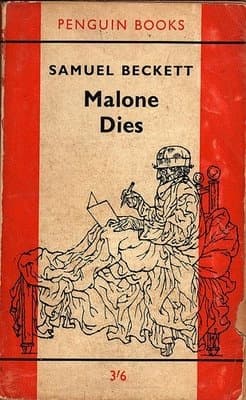
Malone Dies

Malone Dies is the second novel of Beckett's trilogy, a first-person narrative spoken by a dying man confined to a bed, who fills the time before death by telling himself stories about a boy named Sapo who becomes a man named Macmann. Its central mechanism is the erosion of the boundary between the narrator and his inventions: Malone's stories falter, are abandoned, and are taken up again, while his own voice increasingly merges with that of his character. The novel's distinctive claim is that storytelling is not a consolation but a symptom of the inability to die, a compulsion that persists even as the body fails and the self dissolves.
Key Insights
✦What is the central mechanism of Malone Dies, and what does it reject?
The novel's mechanism is the erosion of the boundary between the narrator and his inventions. Malone, an old man lying naked in a bed in an institution, fills the time before death by telling stories about Sapo, a boy who becomes Macmann, a man. But Malone repeatedly interrupts, abandons, and revises these stories, and his own voice increasingly merges with Macmann's. What Malone Dies rejects is the assumption that storytelling provides consolation or meaning. Malone does not tell stories to make sense of his life; he tells them because he cannot stop. The novel ends not with a completed narrative but with Malone's death, and the writing stops mid-sentence, as if the compulsion to speak has finally been extinguished along with the speaker .
✦How did Beckett's decision to write in French shape the novel's style and its English translation?
Malone Dies was written first in French, as Malone meurt, in 1948, and Beckett translated it into English himself, with the English edition appearing in 1956 . Beckett turned to French after the war because, as he explained, English 'because of its very richness holds out the temptation to rhetoric and virtuosity,' while the 'relative asceticism of French seemed more appropriate to the expression of being, undeveloped, unsupported somewhere in the depths of the microcosm' . This choice produced a sparer, more stripped-down prose. But the English translation is not a neutral copy: Beckett's self-translation involved substantial rewriting, and scholars have documented numerous revisions between the French and English versions . The novel we read in English is therefore a parallel creation, shaped by the same aesthetic of impoverishment that motivated the turn to French.
✦What is the significance of Malone's 'inventory,' and how has Gilles Deleuze interpreted it?
Malone announces that his mission is 'making an inventory'—a catalogue of his few possessions and of the stories he tells. The inventory is both a practical task (accounting for what remains to him) and a formal principle (the novel is structured as a series of items, stories, and accounts). Gilles Deleuze seized on a line from the novel—'Everything divides into itself'—and developed it into the central theme of his essay 'The Exhausted,' where he argues that Malone's inventory is a form of writing that plays with 'inclusive disjunction' and constitutes an 'art of exhausting' . For Deleuze, exhausting is not mere fatigue but a deliberate dismantling of the self and its possibilities. Malone's inventory is thus not a record of what he has but a technique for disposing of what remains, including his own identity.
✦How does Malone Dies relate to the other novels in Beckett's trilogy?
Malone Dies is the middle volume of the trilogy, following Molloy and preceding The Unnamable. The progression is one of progressive restriction and dissolution. Molloy has two narrators and a journey; Malone Dies has a single narrator confined to a bed, whose stories are increasingly interrupted and abandoned; The Unnamable has no identifiable narrator at all, only a voice . Beckett did not originally plan the three books as a trilogy; the decision to group them came later, and Malone Dies was at one point titled L'Absent . The novel's relationship to Molloy is one of reduction: where Molloy still had the vestiges of plot and character, Malone Dies strips these away, leaving only the act of narration itself as the novel's subject.
✦What did contemporary reviewers make of Malone Dies when it first appeared in English?
The New York Times review of the 1956 English edition was struck by the novel's radical reduction of literary form. The reviewer wrote that in Malone Dies 'we can hardly be sure of much more than that Malone, whoever he is, is dying and at the end is dead; the rest is nightmare.' The review noted that Malone tells himself 'a few stories' while dying, but that 'the names change, the figures blur, they may be different persons or the same person, or figments of Malone's own personality.' The reviewer concluded that the literary form 'only partly achieved in Godot' was 'here carried much further' . This early reception recognized what would become the critical consensus: Malone Dies is a novel that dismantles the novel, and its power lies in its refusal to offer the consolations of plot, character, or resolution.
✦What is the significance of the novel's final scene, in which Lemuel takes the inmates on an excursion?
The final section of the novel shifts from Malone's deathbed narration to a more external, almost cinematic account of Lemuel, the attendant, taking Macmann and other inmates on a boat trip to an island. Lemuel has been described as a figure of the author, 'guilty of a kind of literary murder-suicide,' who deals his characters 'a few smart blows on the skull' before murdering them . The excursion ends with Lemuel raising a hammer over Macmann, and the narrative breaks off. This ending is deliberately ambiguous: it is unclear whether Lemuel kills Macmann, whether the scene is one of Malone's stories, or whether Malone himself has died. The novel's refusal to resolve this ambiguity is consistent with its central claim: death is not an experience that can be narrated, and the end of a story is not a conclusion but a cessation .
Wealthy Psyche is an intellectual archive. We do not host, distribute, or sell book copies — physical or digital. We provide structured knowledge to help you think better, faster.