


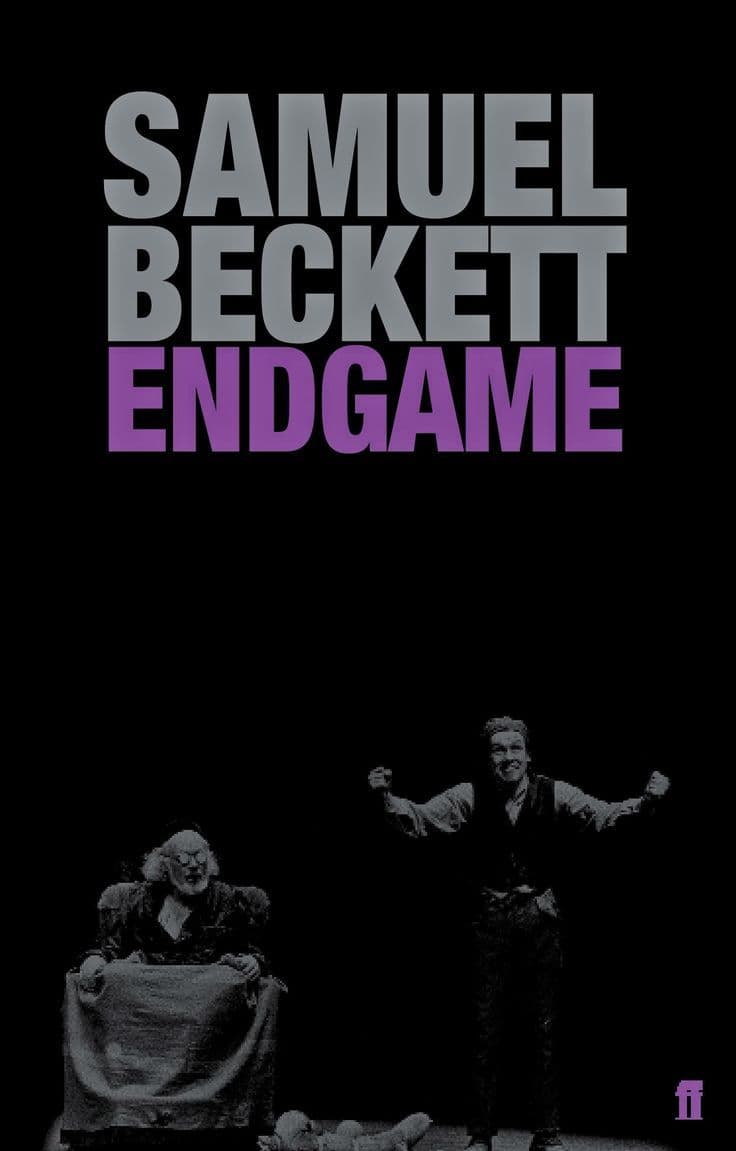
Endgame

Endgame is a one-act play set in a bare room where Hamm, blind and chair-bound, and Clov, his servant who cannot sit, play out a daily routine of mutual dependence and mutual resentment while Hamm's legless parents, Nagg and Nell, live in dustbins. Its central mechanism is the refusal of ending: the characters believe they are in the final phase, yet every attempt to conclude—Hamm's chronicle, Clov's departure, the final tableau—is deferred or undone. The play's distinctive claim is that endings are not events but stories we cannot stop telling, and the famous final image of Clov dressed for departure but motionless leaves the endgame unfinished.
Key Insights
✦What is the central mechanism of Endgame, and what does it reject?
The play's mechanism is the refusal of ending. Hamm and Clov believe they are in the final phase—Hamm says 'it's finished, we're finished'—yet the play consists of a daily routine that repeats without conclusion. Clov repeatedly announces his intention to leave, but never does. Hamm begins to tell his chronicle but never finishes it. The final tableau shows Clov dressed for departure, standing motionless with his eyes fixed on Hamm, while the handkerchief falls from Hamm's face. What Endgame rejects is the assumption that an ending is an event that can be achieved. The play's title is ironic: it names what the characters cannot accomplish. The endgame is a phase that goes on indefinitely, and the play ends not with a conclusion but with a tableau that could be repeated .
✦How does the relationship between Hamm and Clov function, and why is it described as a master-servant dynamic?
Hamm and Clov are bound together by mutual need and mutual hatred. Hamm cannot stand or move his chair; Clov can walk but cannot sit. Hamm depends on Clov for food, medicine, and movement; Clov depends on Hamm for his position, his purpose, and the key to the kitchen. The relationship is feudal in structure—Hamm is the master, Clov the servant—but it is also familial, with hints that Clov may be Hamm's son. A scholarly study describes the dynamic as one of 'mutual dependence and mutual resentment,' in which each is trapped by the other's need . Clov's repeated threats to leave are empty because he has nowhere to go; Hamm's commands are hollow because Clov obeys them grudgingly. The play's drama lies in the tension between the desire to escape and the inability to do so.
✦What is the significance of Nagg and Nell in the dustbins, and how do they relate to Hamm's story?
Nagg and Nell are Hamm's parents, legless and confined to dustbins. They serve as comic relief, memory-bearers, and reminders of Hamm's origins. Nell dies during the play, and Nagg is left alone. Their presence in dustbins literalizes the play's theme of obsolescence: they are discarded, yet they persist. Hamm's chronicle, which he begins but never completes, may be a story about them or about Clov or about himself. A 2023 study notes that the dustbins 'serve as a grotesque image of the family as a container of waste,' and that Nagg and Nell's memories of the past are the only traces of a world outside the room . Their presence deepens the play's claustrophobia: even the past is stored in a bin.
✦Why did Beckett write Endgame in French, and how did that choice affect the play's language?
Beckett wrote Endgame in French as Fin de partie in 1955–1956, and then translated it into English himself, with the English edition published by Faber and Faber in 1958 . He had begun writing in French after the war to escape what he saw as the rhetorical richness of English, which he felt led him toward 'virtuosity' rather than the bare expression of being. The French text of Endgame is sparer and more compressed than the English translation, which Beckett enriched with idiomatic expressions and additional wordplay. A study of the bilingual texts notes that the English version contains 'more jokes, more puns, and more verbal invention' than the French, suggesting that Beckett used the translation process to reintroduce elements of linguistic play that the French had eliminated . The two versions are therefore distinct works, each with its own texture.
✦What is the significance of the play's final tableau, and how have critics interpreted it?
The final tableau is one of the most debated moments in Beckett's theatre. Clov, dressed in his traveling clothes, stands at the door with his eyes fixed on Hamm. Hamm sits in his chair, his face covered by an old handkerchief. The stage directions specify that Clov remains motionless, and the play ends. Interpretations divide on whether Clov leaves or stays. Some critics argue that the tableau represents a final departure, with Clov's stillness marking the moment before he steps through the door. Others read it as a frozen image of the play's central impasse: Clov cannot leave because there is nowhere to go and nothing to leave for . A study of the play's endings notes that Beckett revised the final scene repeatedly, seeking an image that would convey 'the impossibility of ending' without providing a false resolution . The tableau is the play's answer to its own question: an endgame that cannot end.
✦How did the premiere of Endgame shape its reception, and what did early critics emphasize?
Endgame premiered in French at the Royal Court Theatre in London on April 3, 1957, in a production directed by Roger Blin, with sets by Jacques Noël . The English-language premiere followed in 1958 at the Cherry Lane Theatre in New York. Early critics emphasized the play's bleakness and its departure from the relative warmth of Waiting for Godot. A New York Times review described it as 'less ingratiating and more difficult' than Godot, noting that the play's characters are 'cruel and helpless' and that the drama 'has the quality of a nightmare that cannot be escaped.' The review also recognized the play's formal mastery, praising Beckett's 'extraordinary command of stagecraft' . The play's reputation has grown over time, and it is now considered one of Beckett's masterpieces, often ranked alongside Godot.
Wealthy Psyche is an intellectual archive. We do not host, distribute, or sell book copies — physical or digital. We provide structured knowledge to help you think better, faster.