


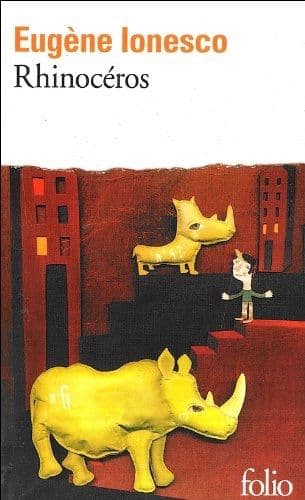
Rhinoceros (Rhinocéros)
Rhinoceros is Ionesco's first full-length political play, staging a provincial town in which citizens spontaneously transform into rhinoceroses until only the listless everyman Bérenger remains human. Its central mechanism is contagion by conformity: the metamorphosis spreads not through argument but through the irresistible pull of 'moving with the times,' as friends and colleagues rationalize their surrender to brute force. Ionesco insisted the play targeted totalitarianism of both Left and Right, but its dramatic force lies in Bérenger's unheroic final stand—a man who cannot transform, not a man who nobly refuses.
Key Insights
✦What is the central mechanism of Rhinoceros, and what does it reject?
The play's mechanism is contagion by conformity. A rhinoceros appears in a provincial town; soon there are two, then three, and the transformation spreads until nearly everyone has joined the herd. Crucially, the metamorphosis is not argued for—it is rationalized after the fact. Characters who transform insist they are simply 'moving with the times' or embracing 'nature' over outworn moral standards . What Rhinoceros rejects is the notion that totalitarianism operates primarily through ideology or coercion. Ionesco stages it as a social epidemic, a surrender driven by the desire to belong and the fear of standing alone. The play's horror lies in how ordinary the transformation feels to those undergoing it.
✦How did the play's premiere in Düsseldorf shape its political reception?
The world premiere took place at the Schauspielhaus Düsseldorf on 31 October 1959, and the audience's response was shaped by recent history . A New York Times report described a ten-minute ovation, with the German audience applauding every reference that could be applied to Nazism . Ionesco, however, insisted his target was totalitarianism from either the Right or the Left, and he predicted the play would be interpreted in Poland as anti-Stalinist . This tension between the author's universal framing and the audience's specific historical memory has followed the play ever since. The Düsseldorf reception demonstrates that a work can be claimed by its audience even as its author resists a single political reading.
✦Who is Bérenger, and why does Ionesco make him an unheroic hero?
Bérenger is a listless, hungover clerk with no strong convictions and a tendency to lean on his more confident friend Jean. He is not a noble individualist; as a contemporary review put it, he simply 'cannot move with the times' . This characterization is essential to the play's argument. If Bérenger were a heroic resistor, Rhinoceros would be a comforting parable about the triumph of the human spirit. Because he is weak, his final stand—'I'm the last man left, and I'm staying that way until the end'—is an act of sheer stubbornness rather than moral clarity . Ionesco suggests that resistance to conformity may not require virtue, only an incapacity or refusal to transform.
✦How does Rhinoceros relate to Albert Camus's The Plague?
The relationship is documented and substantial. Scholars have noted that the spread of 'rhinoceritis' through a provincial town mirrors the spread of plague in Camus's Oran, from a single dead rat to a citywide catastrophe . Ionesco drew on Camus's novel for structural and thematic material, including specific details: Daisy's mention of shops closed 'for transformation' echoes the plague-closed shops in The Plague . Camus had used the plague as an allegory for the spread of fascism—leftist militants in the 1930s called Nazism 'the brown plague'—and Ionesco adapted this device for his own reckoning with the rise of the Iron Guard in Romania . The two works are parallel studies in how societies accommodate catastrophe.
✦What are the translation and textual issues specific to Rhinoceros?
The play was first published by Gallimard in 1959 and first performed in German translation in Düsseldorf, before its French premiere in Paris in January 1960 . The first English translation, by Derek Prouse, was published by John Calder in 1960 and has become the standard version, later collected with The Chairs and The Lesson . Translation poses particular challenges because the play's comedy depends on the clash between bureaucratic clichés and the intrusion of animal sounds and movements. The transformation scenes require careful calibration: too much literalism (as in Orson Welles's London production, which showed actual horns sprouting) risks absurdity, while too little makes the horror abstract . The play's political resonance also shifts depending on the target culture's own history of conformity.
✦How has Ionesco's own biography been connected to the play's meaning?
Ionesco wrote Rhinoceros in 1957–1959, drawing on his memories of the rise of the fascist Iron Guard in his native Romania during the 1930s . He had witnessed how friends and intellectuals he respected succumbed to the appeal of collective ideology, and the play's depiction of transformation as a contagious surrender reflects that experience. Ionesco acknowledged this biographical source while insisting that the play was not narrowly autobiographical. He described the rhinoceros as a symbol of 'the poor lot'—ordinary people who fall in line behind totalitarian leaders because it is easier than standing apart . The play's power derives from this dual grounding: a specific historical trauma transformed into a general parable about the psychology of conformity.
Wealthy Psyche is an intellectual archive. We do not host, distribute, or sell book copies — physical or digital. We provide structured knowledge to help you think better, faster.