


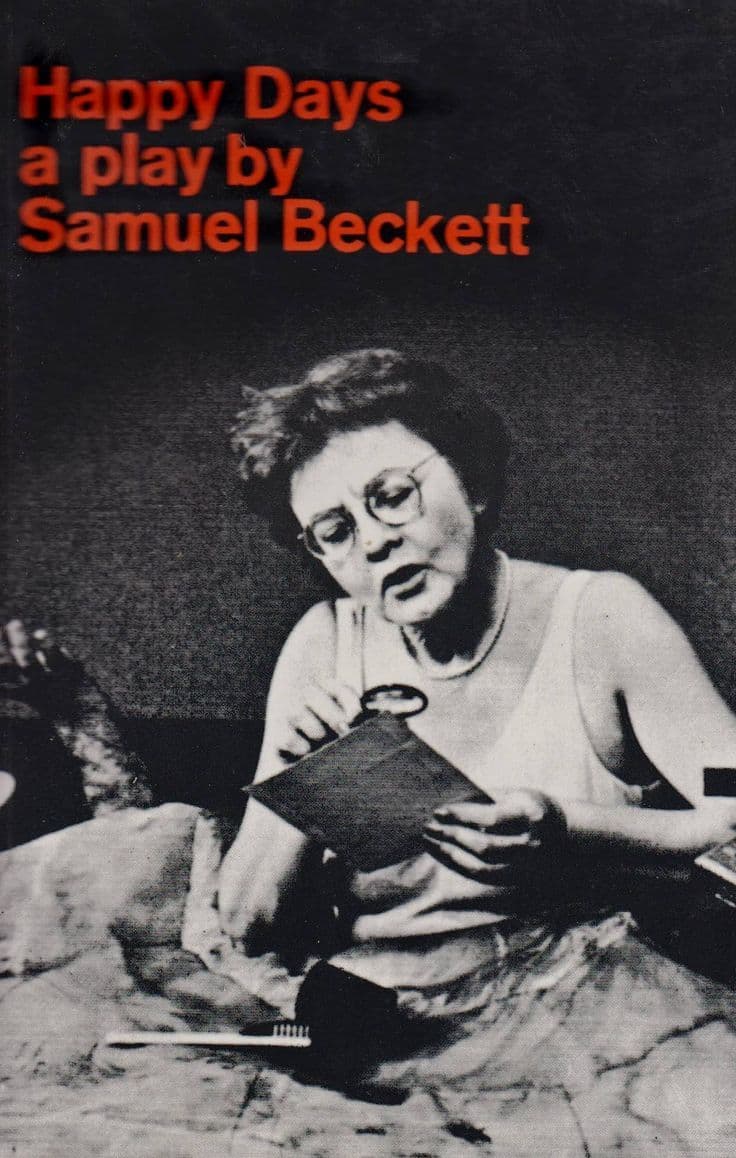
Happy Days

Happy Days follows Winnie, a woman buried to her waist in Act I and to her neck in Act II, who fills the time between a piercing bell and sleep with compulsive chatter, routine, and assurances that 'this will have been another happy day.' Its central mechanism is the management of nothingness through ritual: Winnie arranges her few possessions, tells stories, and demands that Willie's minimal presence confirm her existence. The play's distinctive claim is that happiness is not a state but a performance—a verbal and behavioral discipline maintained in the face of a catastrophe that has already happened and continues to happen, without explanation or end.
Key Insights
✦What is the central mechanism of Happy Days, and what does it reject?
The play's mechanism is the management of nothingness through ritual. Winnie is buried in a mound, exposed to relentless light, and awakened and put to sleep by a piercing bell. Her response is not despair but routine: she brushes her teeth, examines her possessions, tells stories, and demands that Willie listen. What Happy Days rejects is the assumption that happiness is an inner state that either exists or does not. Winnie's 'happy day' is a performance, a discipline maintained through repetition. The play does not ask whether she is truly happy; it shows her working to produce the conditions under which the phrase might still mean something. The arrival of Willie at the end, crawling toward her, is the minimal confirmation she needs to pronounce the day happy .
✦How did the play's premiere and early reception shape its reputation?
Happy Days premiered on September 17, 1961, at the Cherry Lane Theatre in New York, directed by Alan Schneider, with Ruth White as Winnie and John C. Becher as Willie . Beckett did not attend the premiere . The New York Times review by Howard Taubman described it as 'a song of rue that will haunt the inner ear,' praising Ruth White's 'heartrending pathos' and Alan Schneider's direction for its 'memorable combination of delicacy and strength' . The review also noted the play's allegorical dimension: Winnie as a 'puny, weary Earth Mother of a mean, despairing world.' The production established the play's reputation as one of Beckett's most emotionally direct works, and the image of the woman in the mound became iconic.
✦What is the significance of the two-act structure, and how does Act II differ from Act I?
The two-act structure allows Beckett to show deterioration without development. In Act I, Winnie is buried to her waist and has the use of her arms; she can handle her possessions, brush her teeth, and open her parasol. In Act II, she is buried to her neck and can move only her eyes. The stage directions specify that the second act is shorter than the first, and Winnie's monologue is more fragmented. A study guide notes that 'Act II of Happy Days is bleaker than Act I, and Winnie knows it' . She can no longer pray as she did at the start, and the phrase 'happy day' no longer triggers her smile. The structural change enacts the play's argument: the rituals that sustained her in Act I are losing their power, and the end is approaching without arriving.
✦What is the significance of Willie's final appearance, and how do critics interpret his crawl toward Winnie?
Willie's final appearance is the play's most debated moment. After remaining largely hidden behind the mound throughout, he emerges 'dressed to kill'—in formal attire, with a 'Battle of Britain moustache'—and crawls on all fours toward Winnie, whispering her name . Interpretations divide sharply. Some critics see this as a genuine connection, the moment when Winnie's persistence finally stirs her husband into action . Others read it as ironic: Willie's single utterance 'Win' may be an attempt to reach the revolver near her head rather than an expression of love, and Winnie's interpretation of it as affection may be self-delusion . Beckett's stage directions leave the intention ambiguous. What is clear is that Willie's movement is the only significant action in the play, and it occurs at the very end, when Winnie can no longer respond physically.
✦How have scholars interpreted Happy Days through the lens of aging and autonomy?
Recent scholarship has read the play through gerontology and aging studies. A 2024 study argues that Winnie 'upholds her dignity and autonomy despite her diminishing physical agency,' and that 'it is the strength of her words that projects a strong sense of self-value and self-esteem' . This reading challenges interpretations that see Winnie as merely pathetic or deluded. Instead, her compulsive chatter and routines are strategies for maintaining selfhood against the erasure of her body. The study connects this to social gerontologists' concerns about autonomy and dignity in old age, noting that older women face 'double discrimination due to both age and gender' and that Winnie's verbal discipline is a form of resistance to the invisibility that aging imposes .
✦What are the textual and publication issues specific to Happy Days?
Happy Days was first published in the United States by Grove Press in 1961 and in Great Britain by Faber and Faber in 1962 . Beckett wrote the play in English between 1960 and 1961, and he translated it into French himself as Oh les beaux jours, published by Editions de Minuit in 1963 . The French premiere, starring Madeleine Renaud and Jean-Louis Barrault, took place at the Venice Theatre Festival in September 1963 and was a major success . The play exists in multiple versions because Beckett revised it for different productions, and directors must negotiate his precise stage directions, which specify everything from the bell's piercing quality to the exact arrangement of Winnie's possessions. The 2010 Faber edition includes a preface by James Knowlson, Beckett's authorized biographer .
Wealthy Psyche is an intellectual archive. We do not host, distribute, or sell book copies — physical or digital. We provide structured knowledge to help you think better, faster.