


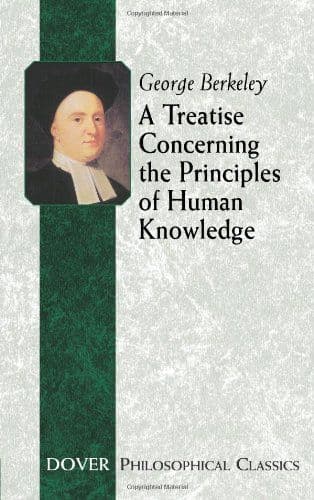
A Treatise Concerning the Principles of Human Knowledge
Berkeley's Treatise advances immaterialism: the thesis that matter does not exist and that physical objects are nothing but collections of ideas perceived by minds. The central mechanism is the principle 'esse est percipi'—to be is to be perceived—which Berkeley uses to argue that the only substances are spirits (minds) and their ideas. He rejects Locke's material substance as an incoherent posit, insisting that primary qualities are as mind-dependent as secondary ones. The work's stated aim is to defend common sense and religion against the skepticism and atheism that Berkeley believed followed from materialism.
Key Insights
✦What is the central claim of the Treatise, and what does it reject?
The Treatise's central claim is immaterialism: material substance does not exist, and physical objects are nothing but collections of ideas perceived by minds. Berkeley's principle 'esse est percipi'—to be is to be perceived—expresses the thesis that the existence of sensible things consists entirely in their being perceived . He rejects Locke's doctrine of material substance as an unintelligible posit, arguing that the very concept of a mind-independent substratum supporting qualities is incoherent. Berkeley also rejects the distinction between primary and secondary qualities, insisting that extension, figure, and motion are as mind-dependent as colour and taste. The work's stated purpose is to defend common sense and religion against the skepticism and atheism that Berkeley believed materialism inevitably produced .
✦How does Berkeley's immaterialism respond to John Locke's Essay Concerning Human Understanding?
Berkeley's Treatise is in large part a sustained critique of Locke's empiricism. Locke had distinguished primary qualities (extension, figure, motion) as genuinely existing in bodies from secondary qualities (colour, sound, taste) as powers to produce ideas in us. Berkeley argues that this distinction collapses: we cannot conceive of extension or figure without some sensible quality like colour, so primary qualities are just as mind-dependent as secondary ones . He also attacks Locke's notion of material substance as an unknown 'something I know not what' supporting observable qualities, arguing that if we have no idea of it, the word is meaningless on empiricist principles. Berkeley presents immaterialism not as a departure from empiricism but as its consistent completion.
✦What is the publication history of the Treatise, and how did the second edition differ?
The Treatise was first published in Dublin in 1710, printed by Aaron Rhames for Jeremy Pepyat . A second edition appeared in London in 1734, printed by Jacob Tonson, with the Three Dialogues between Hylas and Philonous conjoined in the same volume; this was the last edition in Berkeley's lifetime . The second edition contains additions and other changes, and scholarly editions carefully mark the variants between the two . Readers using modern editions should be aware that the 1734 text differs from the original 1710 printing, and that Berkeley's revisions reflect his ongoing engagement with critics. The work is in the public domain.
✦How was the Treatise received in Berkeley's lifetime, and what criticisms did it face?
Contemporary reception was mixed. Jonathan Swift reported that Berkeley 'became the founder of a sect then called the Immaterialists' with a 'very curious book,' and that 'many eminent persons were his proselytes' . But the work also provoked accusations of skepticism and atheism, despite Berkeley's explicit intention to refute both. The Three Dialogues between Hylas and Philonous (1713) was written as a more popular and accessible restatement of the Principles, designed to answer critics and clarify the argument . Some contemporaries suspected Berkeley of irony or of not truly believing his own conclusions . The work's initial reception by the London intelligentsia was not uniformly favourable, though Berkeley's reputation as a formidable thinker was established.
✦How does the Treatise relate to Berkeley's later Three Dialogues between Hylas and Philonous?
The Three Dialogues (1713) is a popular restatement and defence of the arguments first presented systematically in the Treatise. The Edinburgh Review described the Dialogues as 'a kind of festive parade after the main engagement,' repeating 'in a more graceful, popular, and animated form the leading arguments and illustrations of the Principles' . The Dialogues were written partly in response to accusations of skepticism and atheism that the Treatise had provoked, and they present the immaterialist case through a dialogue between Hylas (representing the materialist) and Philonous (representing Berkeley). Readers often find the Dialogues more accessible, but the Treatise remains the systematic exposition of the doctrine.
✦What is a common misconception about Berkeley's immaterialism?
A persistent misconception treats Berkeley's immaterialism as a form of subjective idealism in which each individual mind creates its own reality, or as a skeptical denial of the external world. In fact, Berkeley insists that the regular order of our perceptions—their coherence and predictability—is guaranteed by God, not by individual whim. The 'ideas' of which objects consist are not private fancies but are impressed on our minds by a benevolent spirit according to fixed laws of nature . Berkeley presents immaterialism as a defence of common sense against the paradoxical conclusions of philosophers: the table really does exist, he argues, because it is perceived; what is denied is only the philosopher's invented notion of matter behind the perception. Whether this defence succeeds is another matter, but the caricature of Berkeley as denying the reality of the world misrepresents his stated aim.
Wealthy Psyche is an intellectual archive. We do not host, distribute, or sell book copies — physical or digital. We provide structured knowledge to help you think better, faster.