


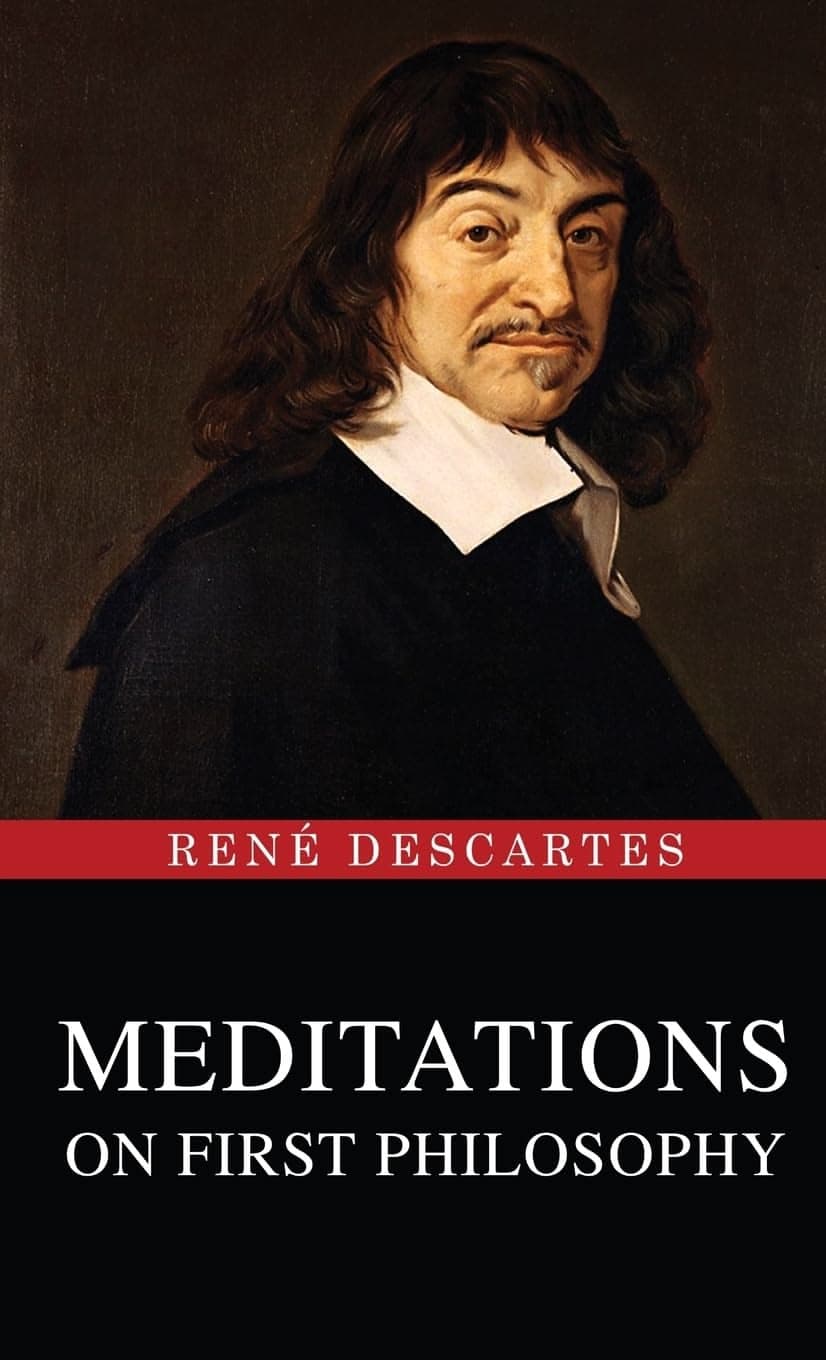
Meditations on First Philosophy: In Which the Existence of God and the Distinction of the Soul from the Body Are Demonstrated
Descartes's Meditations undertakes a systematic demolition of all received opinion through hyperbolic doubt, then rebuilds knowledge from the indubitable cogito. The central mechanism is the method of doubt itself: the senses deceive, dreams blur waking life, and an evil demon could make even mathematics uncertain—yet the act of doubting proves the doubter's existence. From this Archimedean point Descartes proves God's existence, argues that God's veracity guarantees the reliability of clear and distinct ideas, and establishes the real distinction between mind and body. The work's six meditations are exercises meant to be re-enacted by the reader.
Key Insights
✦What is the central claim of the Meditations, and what does it reject?
The central claim is that knowledge can be rebuilt from an indubitable foundation—the cogito—once all received opinion has been demolished by hyperbolic doubt. Descartes rejects the authority of the senses, the Scholastic reliance on Aristotelian physics and metaphysics, and the assumption that whatever seems evident is true. The method of doubt is not skepticism for its own sake but a therapeutic exercise: by pushing doubt to its extreme, Descartes isolates the one truth that cannot be doubted—that he exists as a thinking thing. From this Archimedean point he then proves God's existence and argues that God's veracity guarantees the reliability of clear and distinct perceptions, thereby restoring knowledge of the external world and establishing the real distinction between mind and body.
✦What role do the Objections and Replies play in the Meditations, and why are they important?
The Meditations was published in 1641 with a set of Objections and Replies, in which prominent philosophers and theologians—including Hobbes, Gassendi, Arnauld, and Mersenne—raised criticisms of the argument, and Descartes responded in detail. The Objections and Replies are not incidental to the work; they are integral to it, and Descartes supervised their publication alongside the Meditations . They reveal the positions Descartes was most concerned to defend: the nature of the cogito (whether it is a syllogism), the Cartesian circle (whether the proof of God's existence presupposes the reliability of clear and distinct ideas), and the real distinction of mind and body. Modern editions typically include the Objections and Replies, and scholars treat them as essential for understanding Descartes's argument .
✦What was the condemnation at Utrecht, and how did it shape the Meditations' reception?
In 1642, the University of Utrecht formally condemned Cartesian philosophy, largely at the instigation of Gisbertus Voetius, a prominent theologian and rector of the university . The condemnation was driven by several factors: Voetius's personal animosity toward Descartes's friend Henricus Regius, the perceived threat of Cartesianism to Aristotelian curriculum, and the suspicion that Descartes's mechanistic physics undermined theological orthodoxy. Descartes responded with a series of open letters defending himself. The Utrecht affair shaped the Meditations' reception by warning Descartes that his philosophy would be contested on theological grounds, and it may have influenced his decision to present the Meditations as a strictly philosophical exercise, avoiding explicit discussion of transubstantiation and other dangerous topics.
✦How does the Meditations differ from the Discourse on the Method?
The Discourse on the Method (1637) is a narrative and programmatic work: it tells the story of Descartes's intellectual development, presents the four rules of method, and sketches the results of applying them. The Meditations (1641) is a rigorous, meditative exercise: it leads the reader through a sequence of doubts and discoveries, designed to be re-enacted rather than merely read. The Discourse presents the cogito as a discovery within an autobiographical account; the Meditations presents it as the culmination of a methodical demolition of all belief. The Discourse is addressed to a general audience and was published in French; the Meditations is addressed to the learned and was published in Latin, with formal Objections and Replies. The two works overlap in content but differ in form, purpose, and audience.
✦What is the textual history of the Meditations, and which edition is standard?
The Meditations was first published in Latin in 1641 by Michel Soly in Paris, with an edition from Elsevier in Amsterdam in 1642 . The French translation by the Duc de Luynes appeared in 1647, with Descartes's approval; it contains some alterations and additions . The first English translation, by William Molyneux, appeared in 1680 under the title Six Metaphysical Meditations . The standard scholarly edition is in Volume VII of Adam and Tannery's Oeuvres de Descartes, and the most widely used English translation is by John Cottingham, published in the Cambridge edition of the Philosophical Writings (1984, revised 1996). The Cambridge edition includes the Objections and Replies, which are essential for understanding the work's argument.
✦What is the Cartesian circle, and how has it been interpreted?
The Cartesian circle is the apparent circularity in Descartes's argument: he proves God's existence by appeal to clear and distinct ideas, but he also argues that clear and distinct ideas are reliable only because God is not a deceiver. Critics, beginning with Arnauld in the Fourth Objections, charged that this reasoning presupposes what it aims to prove. Interpreters have responded in various ways. Some argue that Descartes distinguishes between clear and distinct ideas, which are self-verifying, and the general thesis that whatever is clearly and distinctly perceived is true, which requires God's guarantee. Others argue that the proof of God's existence is meant to remove doubt rather than establish the reliability of reason. The issue remains one of the most debated problems in Cartesian scholarship.
✦What is a common misconception about the Meditations' conclusion regarding the external world?
A frequent misreading treats the Meditations as concluding that the external world does not exist or that Descartes remains trapped in solipsism. In fact, Descartes argues that the external world does exist, and that its existence is guaranteed by God's veracity. Having proved that God exists and is not a deceiver, Descartes concludes that the clear and distinct idea of corporeal things must correspond to something real, since God would be a deceiver if it did not. The Meditations thus ends with the restoration of knowledge, not with its loss. The doubt is methodological, not a final destination: it is a means of clearing away prejudice so that knowledge can be rebuilt on secure foundations. The work's subtitle makes this clear: it demonstrates the existence of God and the distinction of the soul from the body.
Wealthy Psyche is an intellectual archive. We do not host, distribute, or sell book copies — physical or digital. We provide structured knowledge to help you think better, faster.