


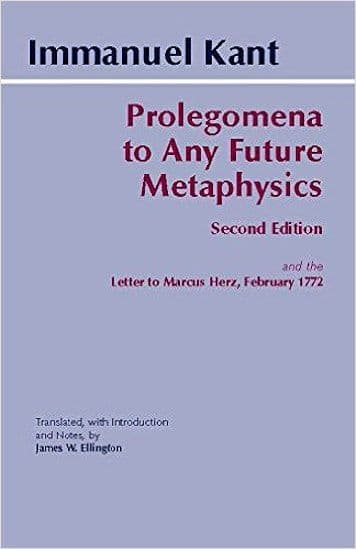
Prolegomena to Any Future Metaphysics That Will Be Able to Come Forward as Science
Kant's 1783 Prolegomena is a popular restatement of the Critique of Pure Reason, organized around a single question: how are synthetic a priori judgments possible? Its central mechanism is the analytic method—beginning from the fact that mathematics and pure natural science actually exist, then asking what conditions make them possible. Kant credits Hume's skepticism about causation with awakening him from dogmatic slumber, but argues Hume stopped at causality when the deeper problem encompasses all synthetic a priori cognition. The work defends transcendental idealism as the solution, restricting knowledge to appearances while preserving the possibility of metaphysics as science.
Key Insights
✦What is the central question of the Prolegomena, and why does Kant say metaphysics must stand or fall with it?
The central question is: how are synthetic a priori judgments possible? Kant argues that mathematics and pure natural science contain such judgments—propositions that extend our knowledge yet are known independently of experience—and that their actual existence proves their possibility . Metaphysics, by contrast, has not achieved the secure path of a science, and its possibility remains doubtful. If the general problem of synthetic a priori cognition can be solved, metaphysics may be established as science; if not, it must be abandoned. Kant presents the Prolegomena as an analytic method: it begins from the fact that synthetic a priori cognition exists in mathematics and physics, then seeks the conditions that make it possible, rather than proceeding synthetically from first principles as the Critique does.
✦How does Kant's debt to Hume shape the Prolegomena, and how does he go beyond Hume?
Kant credits Hume with interrupting his dogmatic slumber by challenging the rationalist assumption that causal connections can be known a priori . Hume had argued that causation rests on custom and habit, not reason. Kant accepts the force of this challenge but argues that Hume stopped too soon: he confined his attention to the principle of causality when the deeper problem encompasses all synthetic a priori cognition, including mathematics . If Hume's conclusion were correct, it would undermine not only metaphysics but also pure mathematics and natural science—a result at which Hume's good sense would have revolted. Kant's solution is transcendental idealism: the a priori conditions of experience are grounded in the structure of the knowing subject, not in things in themselves.
✦How does the Prolegomena differ from the Critique of Pure Reason in method and purpose?
The Critique proceeds synthetically: it begins from the elements of a priori cognition and builds toward the system of pure reason. The Prolegomena proceeds analytically: it begins from the actual existence of synthetic a priori judgments in mathematics and physics, then regresses to the conditions that make them possible . Kant intended the Prolegomena for a more general audience and for teachers of metaphysics, presenting the results of the Critique in a more accessible form. He also uses the work to respond to early critics and to clarify misunderstandings. The famous remark about Hume awakening him from dogmatic slumber appears prominently in the Prolegomena's preface, whereas Hume's name is largely absent from the first edition of the Critique; this difference reflects the intervening importance of the Prolegomena in shaping Kant's public presentation of his project .
✦What is the textual history of the Prolegomena, and which English translation should readers use?
The Prolegomena was first published in Riga by Johann Friedrich Hartknoch in 1783 . The first English translation, by John Richardson, appeared in 1818 and was described by later editors as 'a very bad one' . The standard modern English edition is Gary Hatfield's translation, published in Theoretical Philosophy after 1781 and widely used in Cambridge editions . Hatfield's translation is generally regarded as accurate and readable, though Kant's terminology poses inevitable difficulties for any translator. Readers should be aware that the Prolegomena was written as a popularization and defense of the Critique, not as a standalone systematic work, and that it presupposes familiarity with the Critique's basic distinctions.
✦What is a common misconception about the Prolegomena's relation to the Critique?
A frequent misreading treats the Prolegomena as a simplified substitute for the Critique, as if reading it could replace engaging with the longer work. In fact, Kant wrote it as a preparatory exercise and a defense, not a comprehensive statement of his system. The analytic method means that the Prolegomena presents conclusions whose grounds are fully developed only in the Critique. Some of the Critique's most important doctrines—the transcendental deduction, the schematism, the principles of pure understanding—are summarized or presupposed rather than argued in full. Readers who rely solely on the Prolegomena will grasp Kant's central question and his general solution, but they will miss the detailed architecture that supports it. The work is best read alongside the Critique, not instead of it.
Wealthy Psyche is an intellectual archive. We do not host, distribute, or sell book copies — physical or digital. We provide structured knowledge to help you think better, faster.