


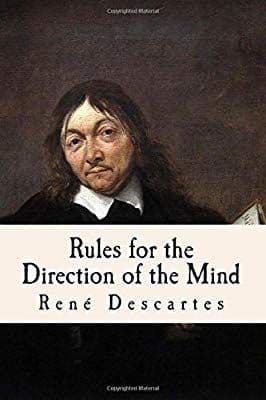
Rules for the Direction of the Mind

Descartes's unfinished early treatise sets out a universal method for attaining truth by reducing all problems to simple natures and intuiting their relations. The central mechanism is the doctrine of simple natures—irreducible, self-evident elements known by intuition—and the method of enumeration, which traces complex questions back to these elements and reconstructs them in ordered series. The work rejects the Scholastic reliance on syllogistic disputation and authority, arguing instead that a single, unified method based on mathematical reasoning can discipline the mind. Descartes planned thirty-six rules but completed only twenty-one.
Key Insights
✦What is the central claim of the Rules, and what does it reject?
The central claim is that all knowledge can be unified by a single method: every problem, however complex, must be reduced to its simplest elements—'simple natures'—which the mind grasps by direct intuition, and then reconstructed through ordered enumeration. Descartes rejects the Scholastic curriculum's reliance on syllogism and disputation, arguing that these obscure rather than discover truth. He also rejects the piecemeal accumulation of separate sciences, insisting that a universal mathematics (mathesis universalis) underlies all disciplines. The Rules are thus an early statement of Descartes's rationalist ambition: to replace the fragmented learning of the schools with a disciplined procedure that anyone can follow to certain knowledge.
✦Why was the work left unfinished, and what does its textual history reveal?
Descartes began the Regulae around 1628, probably in Latin, and worked on it over the following years, but he never completed it . He planned thirty-six rules but stopped at twenty-one, leaving some rules as titles only . The work remained unpublished during his lifetime; a Dutch translation appeared in 1684, and the first Latin edition in 1701 . The manuscript history is complex: the editio princeps and the Dutch translation were based on a lost manuscript, and there exists a shorter Cambridge manuscript, suggesting that Descartes circulated the text in manuscript form . Scholars have dated its composition variously, with internal evidence pointing to different periods, and the eventual publication of the Cambridge manuscript may revise the chronology.
✦What are 'simple natures,' and why are they foundational to the method?
Simple natures are the irreducible elements into which all complex problems can be resolved: things like extension, shape, motion, doubt, and existence, which are known so clearly and distinctly that they cannot be analysed further. The method requires the mind to intuit these simple natures directly and then to trace the necessary connections among them through enumeration. Because simple natures are self-evident, they serve as the indubitable starting points for the reconstruction of knowledge. This doctrine anticipates the foundationalism of the later Meditations, though the Rules presents it in a more technical and less metaphysical register. The method's efficacy depends on the correct identification of simples, a task that Descartes acknowledges requires practice and discipline.
✦How does the Rules relate to the later Discourse on the Method?
The Rules is the earliest systematic statement of Descartes's method, written roughly a decade before the Discourse, and it is far more technical and ambitious in scope. The Discourse's four rules are a simplified, popularized version of the elaborate procedure developed in the Regulae, shorn of the doctrine of simple natures and the detailed account of enumeration. Tarek Dika's recent study argues that Descartes's method remains unified from the Rules (1620s) through to the Principles of Philosophy (1644) . However, the Rules also contains material—particularly on imagination and the mathesis universalis—that Descartes did not carry forward in the same form. The work is thus both a precursor and a parallel text, valuable for understanding the method's development.
✦How was the Rules received and used before its publication?
Although unpublished during Descartes's lifetime, the Rules circulated in manuscript and exercised influence before its formal appearance. Husain Sarkar notes that even before its publication in a Dutch translation in 1684, the work had profoundly influenced the Port-Royal Logic, first published anonymously in 1662 . This influence suggests that the method and its doctrines were known to Descartes's circle and to the broader intellectual community through manuscript transmission. The work's posthumous publication in 1701 made it available to a wider audience, and it has since become a central text for scholars studying the origins of Cartesian method and the development of modern scientific reasoning.
Wealthy Psyche is an intellectual archive. We do not host, distribute, or sell book copies — physical or digital. We provide structured knowledge to help you think better, faster.