


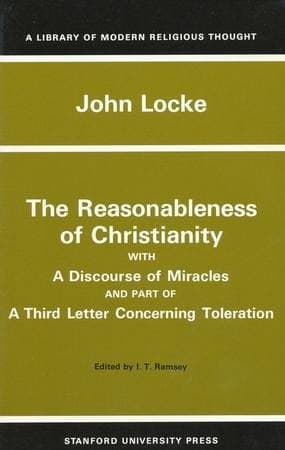
The Reasonableness of Christianity: As Delivered in the Scriptures

Locke's 1695 treatise argues that the essentials of Christian faith are few and simple, discoverable by anyone in Scripture, and fully compatible with reason. Its central mechanism is a reduction of dogma to a single fundamental article—that Jesus is the Messiah—which Locke presents as the sufficient basis for Christian identity and tolerant agreement. The work applies his empiricist epistemology to revelation: faith cannot contradict reason, and the gospel's purpose is to make salvation accessible to all, including the uneducated. The result is an irenic, scripture-centered Christianity that provoked accusations of Socinianism.
Key Insights
✦What is the central claim of The Reasonableness of Christianity, and what does it reject?
The central claim is that the essentials of Christian faith are few and simple, accessible to anyone who reads Scripture, and entirely compatible with reason. Locke reduces the fundamental article of faith to belief that Jesus is the Messiah, arguing that this alone is sufficient for salvation and for Christian identity. He rejects the imposition of elaborate doctrinal systems—particularly the scholastic subtleties and Calvinist orthodoxies of his day—as unnecessary burdens that obscure the gospel's simplicity. He also rejects the view that reason and revelation conflict: faith cannot convince us of anything that contradicts our knowledge, and revelation's function is to supplement reason where reason cannot reach, not to override it. The work is an exercise in Christian minimalism, designed to enable tolerant agreement among Protestants.
✦Why was Locke accused of Socinianism, and was the charge fair?
John Edwards, a Cambridge divine, attacked the work as 'all over Socinianized,' meaning it denied Christ's divinity and atonement in favor of a unitarian, rationalist Christianity . The charge gained traction because Locke deliberately avoided direct discussion of the Trinity and emphasized Jesus's role as Messiah rather than his metaphysical nature. Modern scholarship suggests the charge is at best partly fair. Diego Lucci's study of Locke's Christianity characterizes his position as a unique, heterodox but internally coherent Protestantism that is not straightforwardly Socinian . Locke's silence on the Trinity was likely strategic—an irenic choice to avoid sectarian dispute rather than a covert denial—though his Christology remains elusive. He defended himself in two Vindications, but the controversy shaped his reputation for centuries.
✦How does the work apply Locke's epistemology from the Essay Concerning Human Understanding?
The Reasonableness of Christianity applies the Essay's distinction between faith and reason to theological controversy. In the Essay, Locke had argued that faith is assent to propositions on the authority of God, while reason is the discovery of truth through natural faculties. Faith cannot contradict reason, because God would not reveal what reason demonstrates to be false. The Reasonableness puts this principle to work: Locke examines Scripture to determine what is actually required for salvation, stripping away later accretions and insisting that the gospel's essentials must be intelligible to ordinary believers. The work also reflects the Essay's empiricism in its appeal to plain scriptural text rather than metaphysical speculation. The result is a theology grounded in the same epistemic constraints as his philosophy of mind.
✦How was the book received in its own time, and what does the controversy reveal?
The work was published anonymously in 1695 and immediately became a subject of fierce controversy . Edwards led the attack, accusing Locke of subverting Christianity itself; Locke responded with A Vindication and later A Second Vindication. The controversy reveals the theological fault lines of the 1690s: the work was perceived as dangerous because it claimed to define Christianity's essentials without clerical authority, and because its minimalism seemed to undermine the doctrinal settlements of the Reformation. Yet it also found sympathetic readers. Molyneux reported that a learned prelate praised it as the best book Locke had written, while confessing he dared not say so publicly . The divide was between those who saw Locke's rationalism as a defense of Christianity against unbelief and those who saw it as a Trojan horse for heterodoxy.
✦What is the textual history of the work, and which edition should scholars use?
The first edition was published in London by Awnsham and John Churchill in 1695 . A second edition followed the same year, and Locke continued to revise the text in response to criticisms. The first major critical edition was published by Oxford University Press in 2018, edited by John C. Higgins-Biddle, with an authoritative text and extensive annotation . Earlier editions include George W. Ewing's 1965 edition, reprinted in 1997 . Higgins-Biddle's edition is now the standard scholarly text, superseding older reprints. Readers should note that the work's original anonymity and the rapidity of its reprinting mean that early editions differ in minor ways, and that Locke's Vindications are often printed alongside the main text in modern editions.
✦What is a common misconception about the work's relationship to Locke's political philosophy?
A frequent misreading treats The Reasonableness of Christianity as a purely theological work unrelated to Locke's political thought. In fact, the two are deeply connected. The work's insistence that the essentials of faith are simple and accessible to all supports the case for toleration: if salvation depends only on a few clear truths, then coercing conscience over speculative doctrines is both unjust and unnecessary. Locke's Letter Concerning Toleration had made a similar argument from the nature of belief; the Reasonableness supplies the theological premise that undergirds it. Thomas Jefferson's bill for establishing religious freedom in Virginia was influenced by Locke's arguments . The work is thus a bridge between his epistemology, his theology, and his politics, showing how the same commitment to reason's limits and individual judgment informs all three.
Wealthy Psyche is an intellectual archive. We do not host, distribute, or sell book copies — physical or digital. We provide structured knowledge to help you think better, faster.