


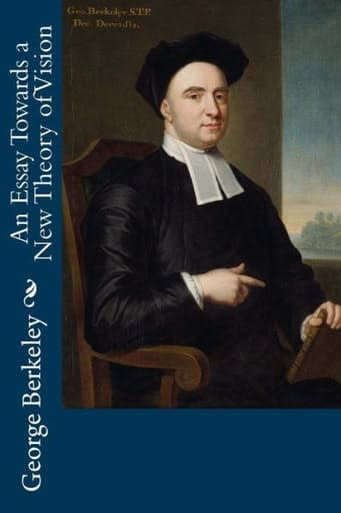
An Essay Towards a New Theory of Vision
Berkeley's first major work argues that distance is not immediately perceived by sight: visible ideas are signs that experience teaches us to correlate with tangible ideas. The central mechanism is the heterogeneity of sight and touch—the ideas of these two senses are specifically distinct, sharing no common kind. What we call visual distance is not a perception of space but an inference from visual cues to expected tactile sensations, learned like a language. The Essay deliberately brackets immaterialism, focusing on vision alone, while preparing the ground for Berkeley's later metaphysical conclusions.
Key Insights
✦What is the central claim of the Essay, and what does it reject?
The Essay's central claim is that distance or outness is not immediately perceived by sight. Visual cues—the perceived confusion or faintness of an object—do not resemble distance or have any necessary connection with it; they come to suggest distance only through experience, much as words suggest the ideas they stand for . Berkeley rejects the classical optic tradition of Descartes, Malebranche, and Molyneux, which held that we perceive distance by a natural geometry, judging it by lines and angles. He also rejects the assumption that sight and touch perceive the same spatial properties. The Essay shows that visible extension and tangible extension are specifically distinct, and that only through learned association do we interpret visual signs as indicating tangible objects at a distance.
✦What is the heterogeneity thesis, and why is it essential to Berkeley's argument?
The heterogeneity thesis holds that the ideas of sight and touch are two entirely distinct species, sharing no common kind. A visible colour and a tangible hardness are not two perceptions of the same property but two different sorts of idea altogether. This is essential because if sight and touch perceived the same spatial properties, the classical geometric account of distance perception might be defensible. By denying that visible and tangible extension are the same, Berkeley can argue that visual experience contains no intrinsic spatial depth. The heterogeneity thesis was a radical departure from contemporary optics, and Margaret Atherton's study of the Essay treats it as the work's central philosophical contribution, arguing that the New Theory deserves recognition as a landmark in scientific thought rather than merely a prelude to immaterialism .
✦How does the Essay relate to Berkeley's immaterialism, given that it does not explicitly defend it?
The Essay deliberately brackets the full immaterialist conclusion, focusing on vision while provisionally granting the existence of tangible objects. Berkeley later explained this strategy in the Principles: he wished to establish the symbolic, mind-dependent status of visual ideas without alienating readers who still believed in material substance. Portuguese scholarship on the Essay notes that Berkeley was already a committed immaterialist when he wrote it, and that the decision to suppress the broader metaphysical conclusions was strategic—a gradual approach designed to lead readers toward the radical claim that all sensible objects are mind-dependent . The Essay thus functions as an entry point: it demonstrates that at least visual objects do not exist outside the mind, preparing the way for the extension of this conclusion to all of nature.
✦How was the Essay received in its own time and by later philosophers?
Dugald Stewart reported that the Essay was regarded by many contemporaries as 'rather in the light of a philosophical romance than of a sober inquiry after truth,' but that its leading doctrines had become an essential part of every elementary treatise on optics . Kenneth Winkler notes that the work has had an 'excellent press' from early on, though he questions whether its reception was as uniformly positive as A. A. Luce suggested . The Essay influenced later thinkers including Thomas Reid, David Hume, and Adam Smith, and its account of perception was a central reference point in eighteenth-century British philosophy of mind . Maurice Merleau-Ponty engaged with Berkeley's thesis in the Phenomenology of Perception, arguing against the claim that spatial depth is invisible and refuting Berkeley's position .
✦What is the textual history of the Essay, and which edition is authoritative?
The Essay was first published in Dublin in 1709, printed by Aaron Rhames for Jeremy Pepyat . A second edition followed, and Berkeley revised the text again for inclusion with Alciphron in 1732 . The fourth and last edition corrected by Berkeley appeared in 1732, and it is this version that A. A. Luce reprinted in his authoritative edition of Berkeley's Works, indicating all alterations from earlier editions . Luce's edition, published by Thomas Nelson and Sons as part of the Bibliotheca Britannica Philosophica, remains the standard scholarly text. The work is in the public domain and widely available in modern reprints, though readers should verify which edition a given reprint follows.
✦What is a common misconception about Berkeley's account of distance perception?
A frequent misreading attributes to Berkeley the view that we first see an object's size and then calculate its distance geometrically. This is the position of the Optic Writers he opposed, not Berkeley's own. Berkeley argued that the same visual cues that suggest distance also suggest magnitude, and that we do not perceive size independently and then infer distance from it . The historian E. G. Boring perpetuated this error, and it has become commonplace despite Berkeley's explicit argument to the contrary. For Berkeley, the perception of both distance and size is the result of a learned, non-inferential process in which visual signs directly suggest tangible meanings, without any intervening calculation of angles or proportions.
Wealthy Psyche is an intellectual archive. We do not host, distribute, or sell book copies — physical or digital. We provide structured knowledge to help you think better, faster.