


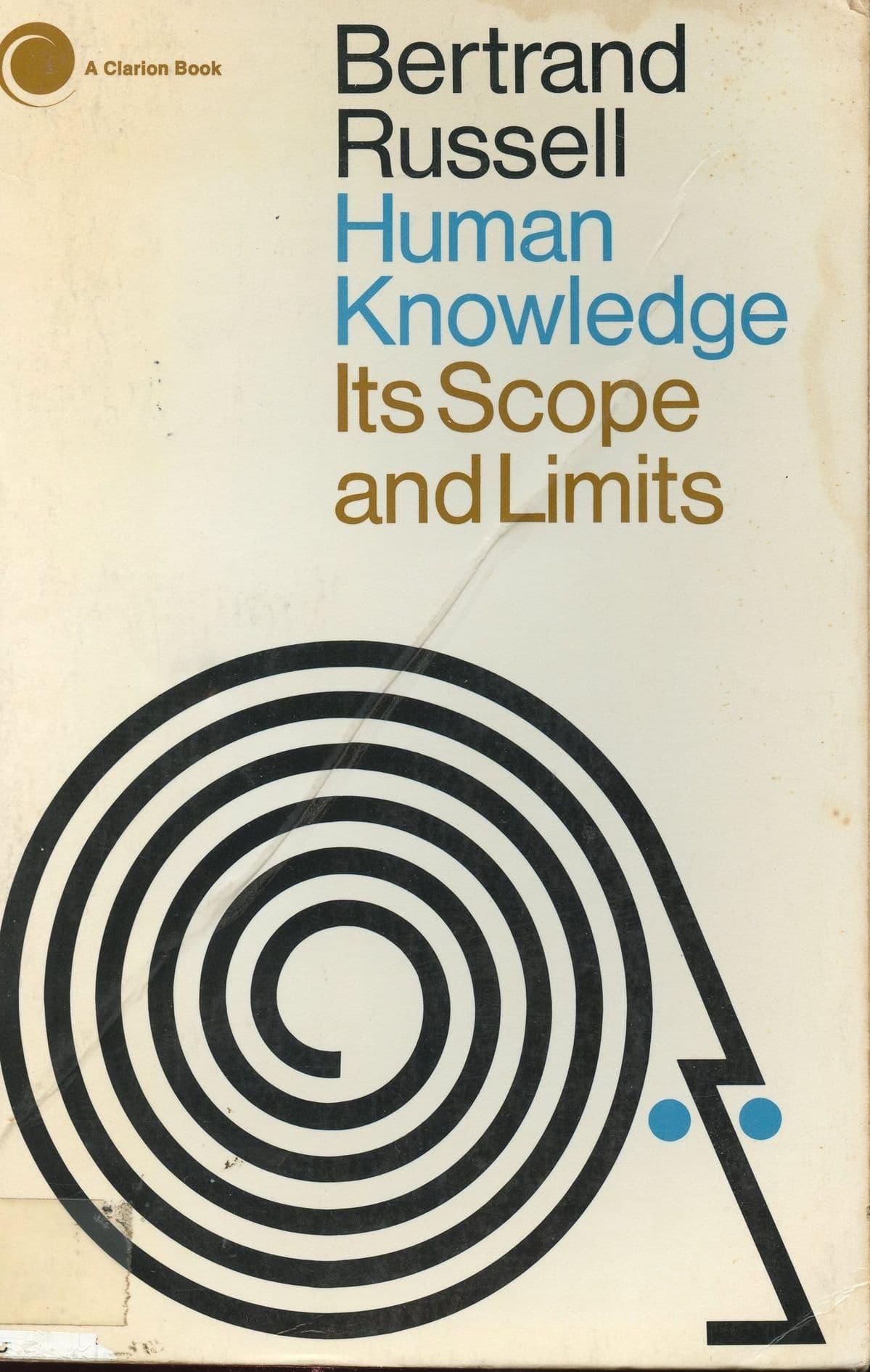
Human Knowledge: Its Scope and Limits

Russell's last major systematic work confronts the failure of pure empiricism: if all knowledge derives from individual perception, how can science's claims about unperceived entities be justified? His answer is a set of five probabilistic postulates—quasi-permanence, separable causal lines, spatio-temporal continuity, structural common origin, and analogy—that license non-demonstrative inference without pretending to certainty. The book's central mechanism is this candid acknowledgment that empiricism cannot justify its own presuppositions, offering instead a tentative Kantianism in which scientific method rests on postulates that are neither a priori nor empirically provable.
Key Insights
✦What is the central claim of Human Knowledge, and what does it reject?
The book's central claim is that scientific inference to unperceived events cannot be justified by empirical evidence alone. Russell argues that five postulates—quasi-permanence, separable causal lines, spatio-temporal continuity, structural common origin, and analogy—are required to validate non-demonstrative inference, and that these postulates themselves are neither provable from experience nor a priori certain. He rejects the view that empiricism can be self-sufficient: if all knowledge derives from perception, the leap from percepts to physics remains unjustified. He also rejects absolute certainty as a condition of knowledge, defending instead a probabilistic framework in which scientific claims are more or less probable rather than demonstrably true.
✦What are the five postulates of scientific inference, and what does each accomplish?
The first, quasi-permanence, holds that given an event, a closely similar event usually occurs nearby in space and time, grounding our everyday notions of persons and things without invoking metaphysical substance . The second, separable causal lines, asserts that series of events can be traced such that from some members we can infer others, making remote inference possible. The third, spatio-temporal continuity, denies action at a distance, requiring intermediate links in causal chains. The fourth, the structural postulate, licenses inference from similar experiences around a centre to a common causal origin with similar structure—as when multiple observers infer a public object . The fifth, analogy, extends causal knowledge from observed to unobserved cases, underpinning belief in other minds. None is certain; each confers antecedent probability .
✦Why is Human Knowledge described as marking the failure of Russell's empiricism?
Frederick Copleston and other commentators have noted that Russell explicitly acknowledges the inadequacy of pure empiricism as a theory of knowledge . The five postulates cannot be demonstrated or rendered probable by empirical arguments, because they are the very principles on which such arguments depend. To justify them by appeal to scientific inference would be circular. Russell therefore calls them 'postulates' rather than truths, conceding that empiricism cannot justify the presuppositions of empirical knowledge. This has led some to see a Kantian turn in his late philosophy, though Russell stops far short of developing a transcendental a priori. The resemblance lies only in the recognition that experience requires principles it cannot itself supply.
✦How does this book relate to Russell's earlier An Inquiry into Meaning and Truth?
Human Knowledge extends the project begun in the 1940 Inquiry, but with a sharper focus on the logic of scientific inference rather than the analysis of meaning. In the earlier book, Russell had examined basic propositions and the express/indicate distinction; here he moves from the foundations of empirical knowledge to the question of how science can legitimately infer beyond them. The five postulates are the mature fruit of this concern. Russell had been working on non-demonstrative inference throughout the 1940s, publishing preliminary papers before the book's appearance in 1948 . The continuity lies in the empiricist starting point; the difference lies in the explicit acknowledgment that empiricism alone cannot complete the task.
✦How was Human Knowledge received, and what did critics identify as its significance?
The book was widely reviewed as Russell's return to systematic philosophy after years of popular writing. The New York Times called it 'the nearest thing to a systematic philosophy written by one who does not believe in systems of philosophy,' praising its encyclopedic scope . A review in Language noted the book's ambition while questioning some of its technical claims . Copleston's history of philosophy treats the theory of non-demonstrative inference as addressing a problem posed by Keynes's Treatise on Probability, while observing that Russell's postulates are presented as neither eternal truths nor empirical generalizations . The reception confirmed the book's status as a major statement of late Russellian epistemology, even among those who disputed its conclusions.
✦What is a common misconception about the book's relation to Russell's earlier logical atomism?
A frequent misreading treats Human Knowledge as a late restatement of the logical atomism of 1918. In fact, the book abandons the atomist programme's central ambition: the construction of a logically perfect language mirroring atomic facts. Russell no longer seeks simples; he seeks postulates. The method is probabilistic and piecemeal, not foundationalist in the atomist sense. The book's concern is with the logical structure of scientific inference, not with the metaphysical inventory of the world's ultimate constituents. Readers who approach it expecting a mature logical atomism will find instead a candid reckoning with the limits of any such system, and a turn toward the pragmatic conditions under which science operates.
✦How does the book's account of perception differ from Russell's earlier views?
In Human Knowledge, Russell develops a causal theory of perception in which physical and mental events interact: a blow causes pain, a volition causes an arm to rise, and neither direction of causation is more problematic than the other . He acknowledges the empiricist's dilemma: if physics is true, percepts and their external causes may resemble each other so little that deriving knowledge of external objects from percepts becomes difficult to explain . His solution relies on the postulates, particularly the structural postulate, to license inference from the structure of percepts to the structure of external events. This is a more sophisticated and more chastened position than the confident constructionism of Our Knowledge of the External World.
Wealthy Psyche is an intellectual archive. We do not host, distribute, or sell book copies — physical or digital. We provide structured knowledge to help you think better, faster.