


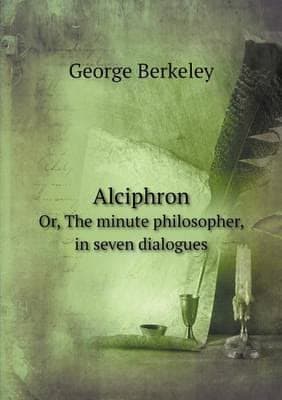
Alciphron, or the Minute Philosopher
Berkeley's seven-dialogue apology for Christianity targets the 'minute philosophers'—the free-thinkers of his day—through a dramatic confrontation between Alciphron and Lysicles, who defend fashionable deism and hedonism, and Euphranor and Crito, who defend revealed religion. The work's central mechanism is Berkeley's extension of immaterialism into apologetics: the fourth dialogue argues that the visible world is a divine visual language, so that perceiving nature is directly perceiving God's expression, granting the same kind of evidence for God's existence that hearing a speaker grants for a human mind.
Key Insights
✦What is the central aim of Alciphron, and how does it differ from Berkeley's earlier works?
Alciphron is an apology for the Christian religion against the free-thinkers, not a systematic exposition of immaterialism like the Principles or the Three Dialogues . Its scope is broader and its tone more polemical, examining ethical theories (Mandeville's egoism, Shaftesbury's sentimentalism) alongside specifically religious questions. Berkeley integrates his metaphysical views into the argument where they serve the apologetic purpose, but the work is not primarily a vehicle for his novel system. The title page explicitly announces its aim as a defence of Christianity against 'those who are called Free-thinkers' . The dialogue form allows Berkeley to stage the confrontation dramatically rather than present a treatise.
✦What is the 'divine visual language' argument, and why is it central to Alciphron?
In the fourth dialogue, Euphranor argues that the visible world is a language through which God speaks to human perceivers. Just as the sounds of a human voice are signs of a mind expressing itself, the orderly, significant relations among visual phenomena are signs of a Supreme Intelligence . The argument extends Berkeley's earlier New Theory of Vision into theology: we learn to interpret visual signs as we learn a language, and the coherence of that language warrants belief in a divine speaker. This gives Berkeley a distinctive apologetic advantage, grounding evidence for God in the very structure of perception rather than in abstract inference. It is the most philosophically original contribution of Alciphron.
✦What was the publication history of Alciphron, and how did later editions differ?
Alciphron was published in 1732 in Dublin and London, with a second London edition appearing the same year. All three early editions were in two volumes and appended Berkeley's Essay Towards a New Theory of Vision to the seventh dialogue . A third edition appeared in London in 1752, the year before Berkeley's death, in one volume. This edition made further revisions, most notably omitting sections 5 through 7 of the seventh dialogue, which had attacked abstract general ideas. Scholars have debated whether this omission reflects a modification of Berkeley's nominalism or was an inadvertent editorial decision . The first French translation appeared at The Hague in 1734, the earliest translation of any Berkeley work into a foreign language .
✦How does Alciphron relate to Mandeville's Fable of the Bees and Shaftesbury's Characteristics?
The second and third dialogues are direct engagements with Berkeley's contemporary moral targets. The second dialogue refutes Mandeville, whose Fable of the Bees had scandalized contemporaries with the paradox that private vices produce public benefits; Lysicles, the hedonistic free-thinker, speaks for this position . The third dialogue addresses Shaftesbury, whose Characteristics treated virtue as a kind of taste or enthusiasm and disparaged appeals to future rewards and punishments as selfish. Alciphron adopts Shaftesbury's more refined tone. Euphranor and Crito respond that both positions fail to account for the motives and sanctions necessary to sustain moral order, arguing that virtue requires the support of faith in divine providence and a future state .
✦What is a common misconception about Alciphron's place in Berkeley's corpus?
A frequent misreading treats Alciphron as a minor or merely popularizing work, a dilution of the rigorous philosophy of the Principles and Dialogues. In fact, it contains one of Berkeley's most distinctive and original arguments—the divine visual language—and represents his most sustained attempt to show the practical, religious stakes of immaterialism. The work is also a sophisticated literary performance: Berkeley's dialogue technique has been compared favourably to Henry More's, with one scholar describing Alciphron as a 'virtuoso chamber-music quartet' for its sharply dialectical quality . The characters of Alciphron and Lysicles were recognized by later readers as universal types, not merely period pieces . It deserves attention as philosophy and as rhetoric, not merely as an apologetic curiosity.
✦How was Alciphron received in its own time, and what criticisms did it face?
The work provoked immediate responses from the free-thinking camp; a pamphlet reply attacking Berkeley's treatment of Mandeville appeared in London in 1732 . Some critics, including the nineteenth-century editor Alexander Campbell Fraser, noted that Alciphron is 'inconclusive' and 'rhapsodic' compared to the tightly argued Three Dialogues . A more sympathetic assessment concedes that the work is not a systematic treatise but a 'semi-dramatic and deliberately polemical work' of considerable literary subtlety, and that its panoramic structure is appropriate to its apologetic aim . The work's influence was significant in its day but did not endure as a standard theological text in the way Butler's Analogy did, partly because the specific free-thinkers it targets came to seem dated .
✦What role does the character Dion play, and how does the dialogue structure shape the argument?
Dion, who has been identified as the character personating Berkeley himself, is largely a spectator who narrates the encounter to Theages rather than participating actively in the debate . This structural choice allows Berkeley to maintain a degree of authorial distance while presenting the arguments through Euphranor and Crito, who do the substantive philosophical work. The dialogue form is not merely decorative: it enables Berkeley to dramatize the free-thinkers' positions through characters with distinct personalities—Alciphron as the more intellectually serious deist, Lysicles as the shallow hedonist—and then dismantle them through Socratic questioning. The reader is invited to judge the arguments rather than receive a doctrinal pronouncement, though the sympathies of the text are unmistakable.
Wealthy Psyche is an intellectual archive. We do not host, distribute, or sell book copies — physical or digital. We provide structured knowledge to help you think better, faster.