


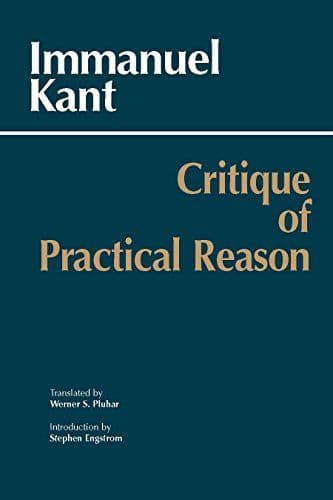
Critique of Practical Reason

Kant's second Critique establishes that pure reason can be practical: the moral law is a fact of reason that commands unconditionally, independent of any empirical desire. The central mechanism is the doctrine of the postulates—freedom, immortality, and God—which are not theoretical knowledge but practical necessities required for the moral law's coherence. Kant argues that the moral law reveals freedom through the feeling of respect, and that the highest good (virtue combined with proportionate happiness) demands a rational author of nature. The work's distinctive move is to reverse the priority of theory and practice: reason's practical use grounds its speculative interests.
Key Insights
✦What is the central claim of the second Critique, and what does it reject?
The central claim is that pure reason can be practical—that reason alone, without any empirical incentive, can determine the will through the moral law. Kant argues that the moral law is a 'fact of reason,' immediately given to consciousness as authoritative, and that this fact reveals freedom as its necessary condition. He rejects the view that morality must be grounded in happiness, sympathy, or any empirical feeling, since such foundations cannot yield unconditional obligation. He also rejects the pretension of speculative reason to prove freedom, immortality, or God theoretically; these can only be postulated practically. The Critique's famous conclusion—the starry heavens above and the moral law within—marks the priority of practical over theoretical reason.
✦What are the postulates of practical reason, and why are they necessary?
The postulates are freedom, immortality, and the existence of God. Freedom is presupposed by the moral law, since 'ought implies can.' Immortality is required because the moral law commands complete conformity of the will to the law, which no finite being can achieve in a single lifetime; endless progress is needed. God is postulated because the highest good—happiness proportioned to virtue—must be possible, and only a wise, benevolent, omnipotent author of nature can guarantee this coincidence. These postulates are not theoretical knowledge; they are subjectively necessary for the moral agent's rational hope. As Kant explains, the moral law commands unconditionally, and the postulates secure the conditions under which its ultimate end is achievable .
✦How does the Critique of Practical Reason relate to the Groundwork?
The Groundwork (1785) sought out and established the supreme principle of morality; the second Critique (1788) provides its critical examination and completes the argument. The Groundwork had left several problems unresolved, including the deduction of the moral law and the relation between freedom and the categorical imperative. The Critique supplies the 'fact of reason' as the ground of obligation and elaborates the postulates that the Groundwork had not developed. Kant also corrects a potential misunderstanding from the Groundwork: the moral law is not derived from freedom; rather, freedom is inferred from the moral law's unconditional authority. The later work thus reverses the order of exposition while preserving the substance of the earlier position.
✦What is the textual history of the work, and which English translation is authoritative?
The Critique of Practical Reason was first published in Riga by Johann Friedrich Hartknoch in 1788 . The first English translation was by Thomas Kingsmill Abbott, published in 1873 by Longmans, Green, Reader, & Dyer . Lewis White Beck's translation, published by Bobbs-Merrill in 1956, became the standard for decades and remains widely used . The Cambridge edition, translated by Mary Gregor and revised with an introduction by Andrews Reath (2015), is now described by the publisher as 'the authoritative translation' . Readers should be aware that Gregor's translation is the most current scholarly standard, though Beck's remains serviceable.
✦What is a common misconception about the moral feeling of respect?
A frequent misreading treats respect (Achtung) as a mere feeling that motivates moral action, as if Kant were smuggling sentiment back into his rationalist ethics. In fact, respect is not a pathological feeling produced by sensible inclination; it is a feeling produced by the moral law itself, through the thwarting of self-love. It is the phenomenal manifestation of the law's authority on sensibility. As the Stanford Encyclopedia of Philosophy notes, the feelings Kant considers crucial to moral motivation—respect for the law, respect for rational nature, moral feeling—are themselves rationally grounded, reflecting the immediate effect of the law on our sensibility . Respect is therefore not a rival to reason but its sensible effect, the way the moral law is felt by a finite being.
Wealthy Psyche is an intellectual archive. We do not host, distribute, or sell book copies — physical or digital. We provide structured knowledge to help you think better, faster.