


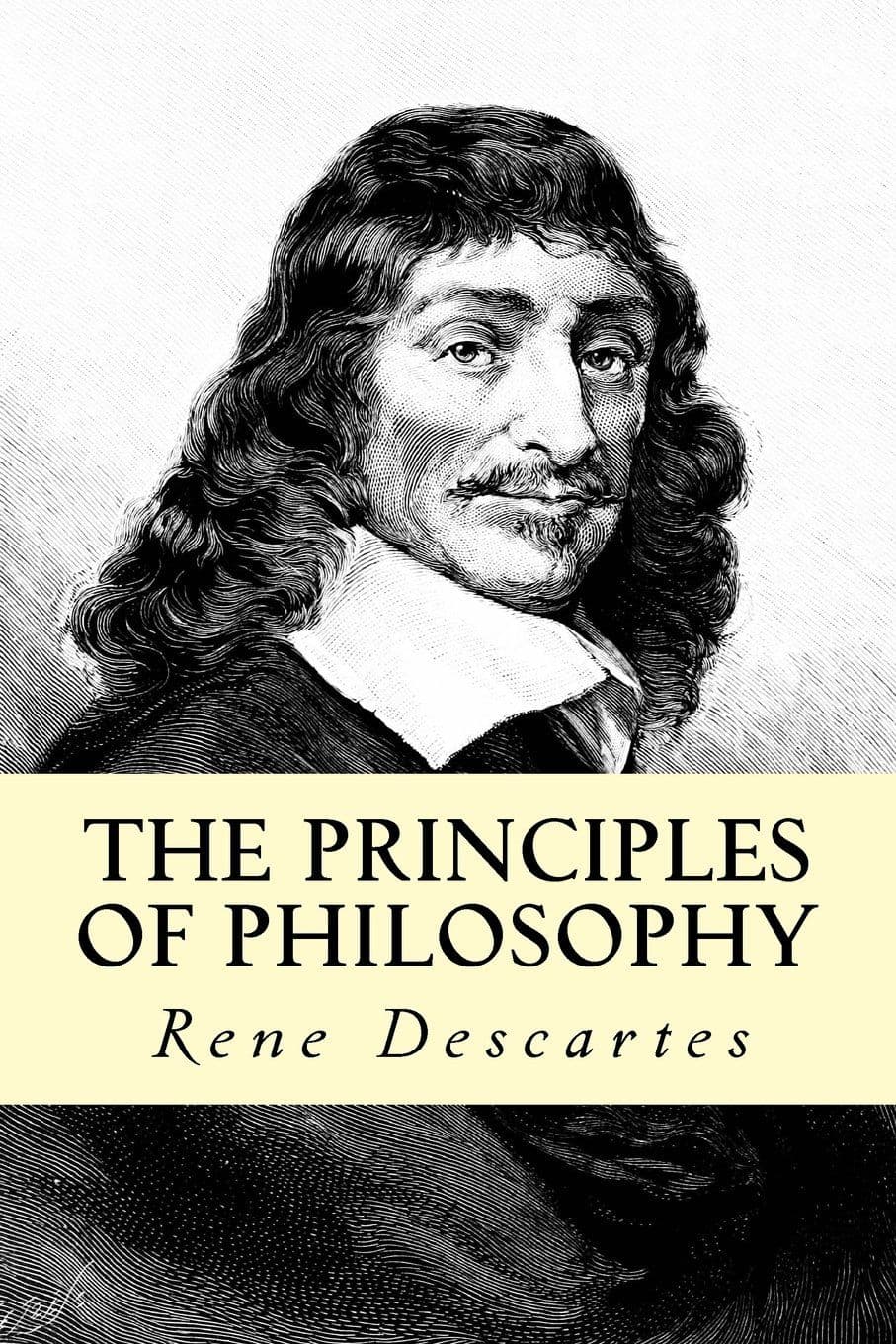
Principles of Philosophy
Descartes's longest and most ambitious work attempts to deduce the whole of scientific knowledge from Cartesian metaphysics in textbook form. Its central mechanism is the tree of philosophy: metaphysics is the root, physics the trunk, and the particular sciences the branches, all deriving from the cogito and the proof of God's existence. The Principles presents the vortex theory of planetary motion, the mechanistic account of light and matter, and the laws of nature in a systematic order intended to replace Scholastic textbooks. It synthesizes the Discourse and the Meditations while adding extensive cosmological and physical detail.
Key Insights
✦What is the central aim of the Principles, and how does it differ from Descartes's earlier works?
The Principles is Descartes's longest and most ambitious work, and the only one in which he attempted to actually deduce scientific knowledge from Cartesian metaphysics . It is a synthesis of the Discourse on Method and the Meditations, but it goes far beyond both in scope, presenting the full system of physics, cosmology, and physiology in textbook form . Where the Meditations proceeds analytically, leading the reader through doubt to certainty, the Principles proceeds synthetically, laying out definitions and axioms from which conclusions follow. Roger Ariew argues that Descartes conceived the project as a rival to Scholastic textbooks, aiming to replace Aristotle as the authority in the schools .
✦What is the 'tree of philosophy' metaphor, and why is it important?
In the French Preface, Descartes describes philosophy as a tree: metaphysics is the root, physics the trunk, and the particular sciences—medicine, mechanics, morality—are the branches. The metaphor expresses the systematic ambition of the Principles: all knowledge derives from a single foundation, and the sciences are not separate disciplines but applications of the same method and metaphysics. This is why the work begins with the principles of human knowledge (Part I), proceeds to the principles of material things (Part II), then the visible universe (Part III), and finally the earth (Part IV). The tree image also implies that practical benefits—the improvement of medicine and the mastery of nature—depend on getting the roots and trunk right.
✦How does the French translation of 1647 differ from the Latin original?
The French translation by Claude Picot, published in 1647, is not a mere translation. It contains a great deal of additional material and a number of alterations to the original text, and it was published with Descartes's enthusiastic approval . There is good evidence that Descartes himself was responsible for some of the additions, including the Preface to the French translation . This means that the French version is not simply a derivative text but a parallel edition with independent authority. Modern scholarly translations, such as the Miller and Miller edition, use the Latin as their primary source but incorporate significant material from Picot's French version, recognizing that Descartes authorized both .
✦How was the Principles received as a scientific work, and what was its influence?
The Principles was enormously influential in the seventeenth and early eighteenth centuries. Cartesian celestial mechanics, based on the vortex theory, held sway for well over a century, and some of the best minds of the period—including Leibniz, Malebranche, Euler, and the Bernoullis—attempted to modify and quantify the theory of vortices into an acceptable alternative to Newton's theory of universal gravitation . The work was thus not merely a philosophical treatise but a seminal document in the history of science. Its influence declined after Newtonian physics became dominant, but the Principles remains essential for understanding the mechanistic worldview that Newton's system replaced.
✦Why does Descartes present the Principles in a synthetic rather than analytic order?
Descartes distinguishes between the analytic method of the Meditations, which leads the reader through doubt to discovery, and the synthetic method of the Principles, which lays out definitions and axioms and derives conclusions from them. The synthetic order is more suitable for a textbook, because it presents the completed system in a clear, ordered fashion. Daniel Garber and Lesley Cohen argue, however, that the common claim that the Principles is written 'in accordance with the synthetic method' is too simple . While the work is more geometric in presentation than the Meditations, it also contains material and arguments that do not fit neatly into the analytic-synthetic dichotomy. The relation between the two works is better understood as a difference in rhetorical purpose rather than a strict methodological opposition.
✦What is a common misconception about the Principles' relationship to the Meditations?
A frequent misreading treats the Principles as merely a restatement of the Meditations in textbook form, a popularization with no independent philosophical significance. In fact, the Principles contains substantial new material and develops positions that are absent from or only sketched in the Meditations. Its physics, cosmology, and physiology are not derivable from the Meditations alone; they represent Descartes's attempt to show what the metaphysical foundations make possible. The work also differs in its treatment of key doctrines, including the nature of the union of mind and body and the explanation of sensory perception. Readers who rely solely on the Meditations miss the systematic ambition that the Principles embodies, and they encounter a different Descartes—less the solitary meditator than the architect of a comprehensive philosophy.
Wealthy Psyche is an intellectual archive. We do not host, distribute, or sell book copies — physical or digital. We provide structured knowledge to help you think better, faster.