


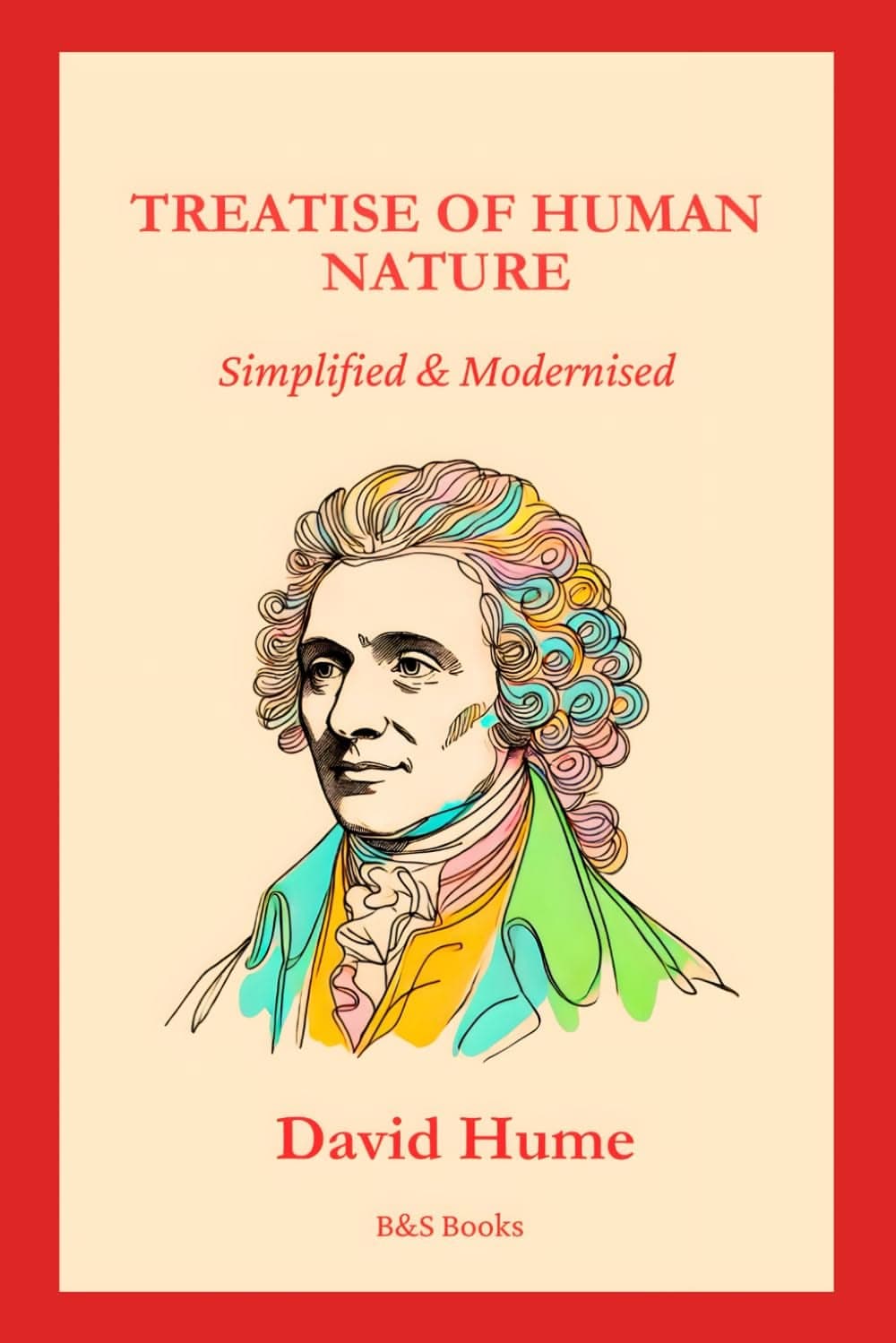
A Treatise of Human Nature: Being an Attempt to Introduce the Experimental Method of Reasoning into Moral Subjects
Hume's Treatise attempts to do for moral philosophy what Newton did for physics: explain all mental phenomena through a small set of empirical principles. Its central mechanism is the distinction between impressions (lively perceptions) and ideas (faint copies), from which Hume derives his accounts of causation, the self, and morality. Causation is reduced to custom-based expectation rather than rational insight; the self dissolves into a bundle of perceptions; morality is grounded in sentiment, not reason. The work's ambition is total: a science of human nature that explains understanding, passions, and morals through one experimental method.
Key Insights
✦What is the central claim of the Treatise, and what does it reject?
The Treatise's central claim is that the science of human nature can be pursued experimentally: all mental phenomena, from causal inference to moral judgment, can be explained by tracing ideas back to impressions and showing how the imagination associates them. Hume rejects the rationalist view that reason alone can discover necessary connections in nature or objective moral truths. He also rejects the Cartesian ego and the Lockean substantial self, arguing that introspection reveals only a bundle of perceptions with no underlying subject. The work's ambition is systematic: Book I treats understanding, Book II the passions, Book III morals, all on the same empirical foundation. Hume's own summary judgment was that the Treatise 'fell dead-born from the press,' but its arguments became foundational for later empiricism and naturalism .
✦What is the impressions/ideas distinction, and why is it foundational to the Treatise?
Hume divides all perceptions into impressions and ideas. Impressions are the lively, forceful perceptions we have when we see, feel, love, or hate; ideas are the faint copies of these impressions in memory and imagination. The distinction is foundational because it supplies Hume's criterion of meaningfulness: every simple idea must be traceable to a corresponding impression, and any purported idea that cannot be so traced is suspect. This principle drives his critique of metaphysical notions like substance and necessary connection. The distinction also structures the Treatise's method: Hume begins with the origins of ideas in impressions, then shows how the imagination combines them into the complex beliefs and passions of ordinary life. The criterion is not without difficulties—Hume himself acknowledges the problem of the 'missing shade of blue'—but it remains the engine of his naturalistic project.
✦How does Hume's account of causation in the Treatise differ from his later Enquiry?
The Treatise's account is embedded in a detailed psychological machinery that the Enquiry largely abandons. In the Treatise, Hume explains causal belief through the association of ideas: repeated conjunctions produce a habit of the imagination, and the resulting feeling of determination is projected onto the world as necessary connection. The Enquiry retains the core argument—that reason cannot justify causal inference and that custom is 'the great guide of life'—but strips away much of the psychological detail about the imagination and its fictions. The later work is more polished and accessible, but the Treatise's analysis is richer and more philosophically ambitious. Hume later disavowed the Treatise and asked that his philosophical sentiments be judged by the Enquiries, but scholars continue to debate whether the Enquiry's streamlined account is genuinely equivalent to the Treatise's more complex one.
✦What is the 'bundle theory' of the self, and what problem does it create?
Hume argues that when he introspects, he never encounters a persistent self or ego; he finds only particular perceptions—heat, light, love, hate—succeeding one another. The self is therefore nothing but a bundle of perceptions, and personal identity is a fiction generated by the imagination's tendency to attribute continuity to resembling perceptions. The problem this creates is the one Hume himself acknowledges in the Treatise's Appendix: if the self is a bundle, what holds the bundle together? The imagination's principles are not sufficient to explain the felt unity of consciousness, and Hume confesses that he cannot resolve the difficulty. This candid admission has been read as a crucial moment of philosophical honesty, and the 'Appendix problem' remains a central topic in Hume scholarship, with interpreters divided over whether it is a fatal flaw or a productive tension.
✦How was the Treatise actually received in Hume's lifetime, and was it truly 'dead-born'?
Hume's famous description of the Treatise as 'dead-born from the press' has shaped its reception history, but recent scholarship complicates this picture. Mark G. Spencer and Mikko Tolonen argue that the Treatise 'made a livelier entry into the world than a disappointed Hume lamented' . Their research, building on work since the late 1940s, shows that reviews appeared in Britain, Ireland, and Europe, and that some of Britain's leading intellectuals were debating the Treatise's theories in public venues. While the book was far from a commercial success in Hume's lifetime, the narrative of total neglect is misleading. Hume's disappointment was real, and it motivated the recasting of the Treatise into the Enquiries, but the work did attract serious critical attention from its first appearance.
✦What is the publication history of the Treatise, and how did it reach its modern form?
The Treatise was published anonymously in three volumes: Books I and II (Of the Understanding and Of the Passions) appeared in 1739 from John Noon, and Book III (Of Morals) followed in 1740 from Thomas Longman . Hume composed the work in France before he was thirty. The standard scholarly edition for much of the twentieth century was L. A. Selby-Bigge's 1888 edition, revised by P. H. Nidditch in 1978, which incorporated Hume's manuscript amendments and included the Abstract of the Treatise . More recent critical editions, including those from Cambridge and Broadview, provide fuller annotation and contextual material. Readers should note that Hume later disavowed the Treatise in an advertisement, asking that the Enquiries be regarded as containing his considered philosophical sentiments .
✦What is a common misconception about the Treatise's relationship to the Enquiries?
A frequent misconception treats the Enquiries as mere popularizations of the Treatise, simplified for a general audience but philosophically equivalent. In fact, Hume described the Enquiries as a 'casting anew' of the Treatise's material, and he added new arguments, restructured themes, and corrected what he called 'negligences in his former reasoning' . The Enquiry Concerning the Principles of Morals, in particular, differs significantly from Book III of the Treatise in its treatment of justice, benevolence, and the role of language in moral discourse. Hume himself regarded the second Enquiry as 'incomparably the best' of his writings. The relationship is therefore one of revision and development, not mere abridgment. Scholars who rely solely on the Enquiries miss arguments and nuances that are unique to the Treatise.
Wealthy Psyche is an intellectual archive. We do not host, distribute, or sell book copies — physical or digital. We provide structured knowledge to help you think better, faster.