


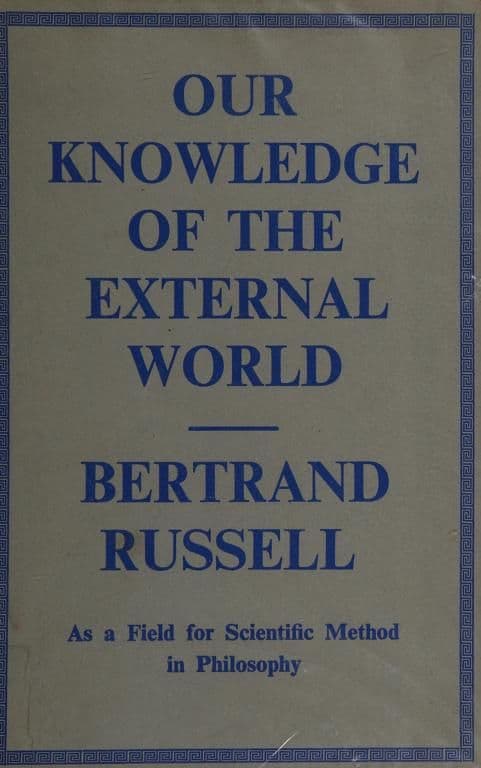
Our Knowledge of the External World: As a Field for Scientific Method in Philosophy

Delivered as the 1914 Lowell Lectures, this book applies the apparatus of modern mathematical logic to the traditional problem of the external world. Russell's central move is constructive: physical objects are not inferred entities behind sense-data but logical constructions out of 'sensibilia'—actual and possible sense-data—assembled by the methods of symbolic logic. The book rejects both idealist monism and the inference to unknowable things-in-themselves, arguing that scientific method in philosophy replaces metaphysical speculation with piecemeal logical analysis. Its treatment of continuity, infinity, and Zeno's paradoxes exemplifies this programme.
Key Insights
✦What is the central claim of Our Knowledge of the External World, and what does it reject?
The book argues that physical objects—tables, chairs, stars—are not entities we infer as the hidden causes of our sensations, but logical constructions out of sensibilia, the class of actual and possible sense-data. Russell rejects the view, which he had held in The Problems of Philosophy, that behind sense-data there exist unknowable 'things-in-themselves' that cause them. He also rejects the idealist monism of Bradley and Hegel, which treats reality as a single internally related whole. The method is neither empirical psychology nor metaphysical speculation but logical analysis: the philosopher's task is to show how the statements of science can be translated into statements about sense-data without remainder, using the techniques of symbolic logic.
✦What are 'sensibilia,' and why does Russell introduce them?
Sensibilia are the entities out of which Russell constructs physical objects. They include actual sense-data—the patches of colour, sounds, and textures I am presently experiencing—and possible sense-data, the perspectives that would be had by observers at other places and times. A physical object is the class of all such sensibilia that would ordinarily be said to belong to it. This move solves a problem: if physical objects were mere collections of actual sense-data, they would exist only when perceived. By including possible sense-data, Russell can give an account of the unperceived existence of objects without positing a mysterious realm of things-in-themselves. The construction is explicitly offered as a logical technique, not a psychological hypothesis about how we come to believe in objects.
✦How does this book relate to The Problems of Philosophy?
Our Knowledge of the External World revises the epistemological framework of The Problems of Philosophy (1912). In the earlier book, Russell had distinguished sense-data from physical objects and argued that the latter must be inferred as the external causes of the former, while conceding that their intrinsic nature remains unknown. By 1914, he had abandoned this inferential view. The new approach treats physical objects as logical constructions from sensibilia, eliminating the need for unknowable causes. A contemporary reviewer noted that Russell had altered his views since the earlier book and that the suggestion for the new method came from Whitehead . The shift marks Russell's turn from a causal theory of perception to a constructionist programme.
✦Why does the book devote so much space to Zeno's paradoxes and the mathematics of infinity?
Russell treats Zeno's paradoxes and the theory of infinite numbers as case studies in the scientific method he advocates. Traditional philosophy, he argues, has been misled by inadequate logical analysis into accepting paradoxes as deep mysteries. The mathematical logic developed by Frege, Peano, and Russell himself dissolves these puzzles by showing that an infinite series can have a limit and that an infinity of instants does not require an infinitely long time. Zeno's error, on Russell's reading, lies in assuming that the runner must cover the points 'one by one' . The discussion exemplifies the book's broader claim: philosophical problems should be resolved by logical clarification, not by metaphysical construction.
✦How was the book received, and what did reviewers identify as its most original contribution?
A review in The International Journal of Ethics (1915) called the book 'in some respects ... the most important contribution that has been made to philosophy for a long time past' . The reviewer identified the most strikingly original part as Russell's application of modern logical apparatus to the problem of the reality of the external world, noting that the suggestion for this method came from Whitehead. The review also observed that the book opens with a critique of two tendencies: the moribund idealistic tradition of Kant and Hegel, and the pragmatist and Bergsonian reaction against reason. While respectful, the review questioned whether Russell's explanation of monism applied as well to Hegel and Spinoza as to Bradley.
✦What is a common misconception about the book's relationship to logical atomism?
A frequent misreading treats Our Knowledge of the External World as a straightforward statement of logical atomism. In fact, the book predates Russell's 1918 lectures on logical atomism and does not yet employ that label or its full apparatus. The 1914 book is primarily a work of epistemological construction—showing how physical objects can be built from sensibilia—rather than a metaphysical inventory of the world's ultimate simples. The atomic particulars and atomic facts of the later doctrine are not yet the organising framework. The book is better understood as a transitional work in which Russell applies the logic of Principia Mathematica to traditional epistemological problems, preparing the ground for the more systematic atomism he would develop during and after the First World War.
✦What is the publication history of the book, and does it remain in print?
The book was first published in 1914 by the Open Court Publishing Company in Chicago and London, based on the Lowell Lectures Russell delivered in Boston in March and April of that year . A revised edition was issued in 1926 by George Allen & Unwin in London, and this revised text became the standard version . The 1926 edition was reprinted multiple times, including a 1952 printing and later impressions . The original 1914 text is in the public domain and is available through the Internet Archive . Readers should note that citations to the book often refer to the 1926 revised edition, which differs from the first printing.
Wealthy Psyche is an intellectual archive. We do not host, distribute, or sell book copies — physical or digital. We provide structured knowledge to help you think better, faster.