


Amerika (The Man Who Disappeared)
Kafka's first novel follows Karl Rossmann, a young European sent to America after a family scandal, through a series of encounters with institutions that promise belonging and deliver exclusion. The novel's central mechanism is the repeated offer of shelter that turns into ejection: his uncle's mansion, the Occidental Hotel, Brunelda's apartment. Its distinctive claim is that America is not a place of freedom but a projection screen for European fantasies of escape—Kafka never visited the country, and the novel's geography is deliberately inaccurate, with a sword-wielding Statue of Liberty and a bridge between New York and Boston. The unfinished narrative ends at the Nature Theatre of Oklahoma, where Karl is finally accepted without credentials.
Key Insights
✦What is the central mechanism of Amerika, and how does it differ from Kafka's other novels?
The novel's mechanism is the cycle of provisional inclusion and sudden exclusion. Karl Rossmann arrives in America and is taken in by his wealthy uncle, only to be cast out over a minor transgression. He finds work at the Occidental Hotel, only to be dismissed after an incident with a drunk guest. He falls in with two vagabonds and becomes a servant to Brunelda, only to escape again. What distinguishes Amerika from The Trial and The Castle is that Karl is not accused or seeking recognition from an inaccessible authority. He is simply trying to survive, and the institutions that briefly shelter him operate on rules he cannot anticipate. The novel's unfinished ending at the Nature Theatre of Oklahoma offers a rare moment of acceptance—Karl is hired without qualifications—but the text breaks off before we learn whether this inclusion holds.
✦Why is the novel's title contested, and what does the dispute reveal about Kafka's intentions?
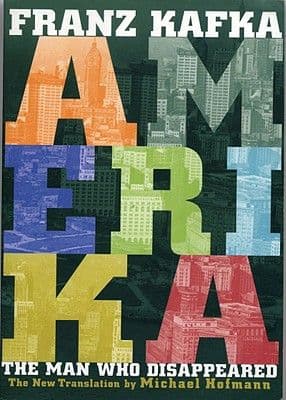
Kafka never called the novel Amerika. He referred to it as his 'American novel' in conversation and used the working title Der Verschollene (The Missing Person or The Man Who Disappeared) in a letter to Felice Bauer in 1912 . The title Amerika was imposed by Max Brod when he edited and published the unfinished manuscript in 1927, three years after Kafka's death . Recent translators have divided over whether to restore Kafka's title. Mark Harman chose Amerika: The Missing Person, while Michael Hofmann used Amerika: The Man Who Disappeared . The dispute matters because 'Amerika' frames the novel as a book about a country, while 'Der Verschollene' frames it as a book about a person who has vanished—a bureaucratic category for someone whose legal status is unknown, neither confirmed alive nor dead .
✦How has Max Brod's editing shaped the novel we read, and what have later editors changed?
Brod assembled the unfinished manuscript from Kafka's papers, arranged the chapters, and gave the novel its title. His editorial interventions were significant: he regularized Kafka's punctuation, smoothed inconsistencies, and presented the text as more coherent than Kafka left it . For decades, readers encountered Amerika through Brod's version, translated by the Muirs in 1938. Since the 1980s, an international team of scholars has been producing German critical editions based on Kafka's original manuscripts, removing Brod's stylistic interventions and correcting transcription errors . Mark Harman's 2008 English translation, based on the restored text, aims to recover Kafka's humor and the particularity of his language, which Brod's smoothing had obscured . The novel is therefore not a single stable text but a contested reconstruction.
✦What is the significance of the novel's unfinished ending at the Nature Theatre of Oklahoma?
The Oklahoma chapter is the novel's final, incomplete section. Karl sees an advertisement for the Nature Theatre, which promises employment for everyone, applies, and is hired despite having no skills . Max Brod claimed that Kafka hinted the theatre would allow Karl to find 'a profession, a stand-by, his freedom, even his old home and his parents, as if by some celestial witchery' . But this happy ending was never written, and some scholars view it as a fantasy of reconciliation that Kafka abandoned rather than completed. The chapter's tone shifts markedly from the preceding sections: the prose becomes more lyrical, the obstacles dissolve, and Karl is accepted without credentials. The unfinished state leaves the reader suspended between the possibility of redemption and the recognition that Kafka never delivered it.
✦How does Kafka's depiction of America relate to the reality of the country he never visited?
Kafka had no first-hand experience of America. His knowledge came from reading travel accounts, newspaper reports, and the experiences of relatives who had emigrated . The novel is filled with deliberate or careless inaccuracies: the Statue of Liberty holds a sword rather than a torch, there are no harbor piers in New York, a bridge connects New York City and Boston, and the geography between New York and Oklahoma includes mountains resembling the Rockies . These errors have been read as evidence that Kafka was not attempting realism but creating a projection screen for European fantasies about America as a land of boundless opportunity and sudden ruin. The America of the novel is hyper-real, composed of cultural myths—the rags-to-riches uncle, the vast technological hotel—rather than observed fact .
✦What are the major English translations of Amerika, and how do they differ?
The first English translation was by Willa and Edwin Muir, published in 1938 by Routledge as Amerika . The Muirs worked from Brod's edited German text and their version shaped Kafka's Anglophone reception for decades. Michael Hofmann's 1996 translation, titled Amerika: The Man Who Disappeared, was the first to engage critically with the text's editorial history. Mark Harman's 2008 translation, Amerika: The Missing Person, is based on the restored German critical edition and is widely praised for recovering Kafka's humor and for its precision in rendering his prose . Ritchie Robertson's 2012 Oxford translation, The Man Who Disappeared (America), includes extensive notes on the text's composition and historical context. Each translation makes different choices about how to handle Brod's interventions and Kafka's unfinished syntax.
Wealthy Psyche is an intellectual archive. We do not host, distribute, or sell book copies — physical or digital. We provide structured knowledge to help you think better, faster.