


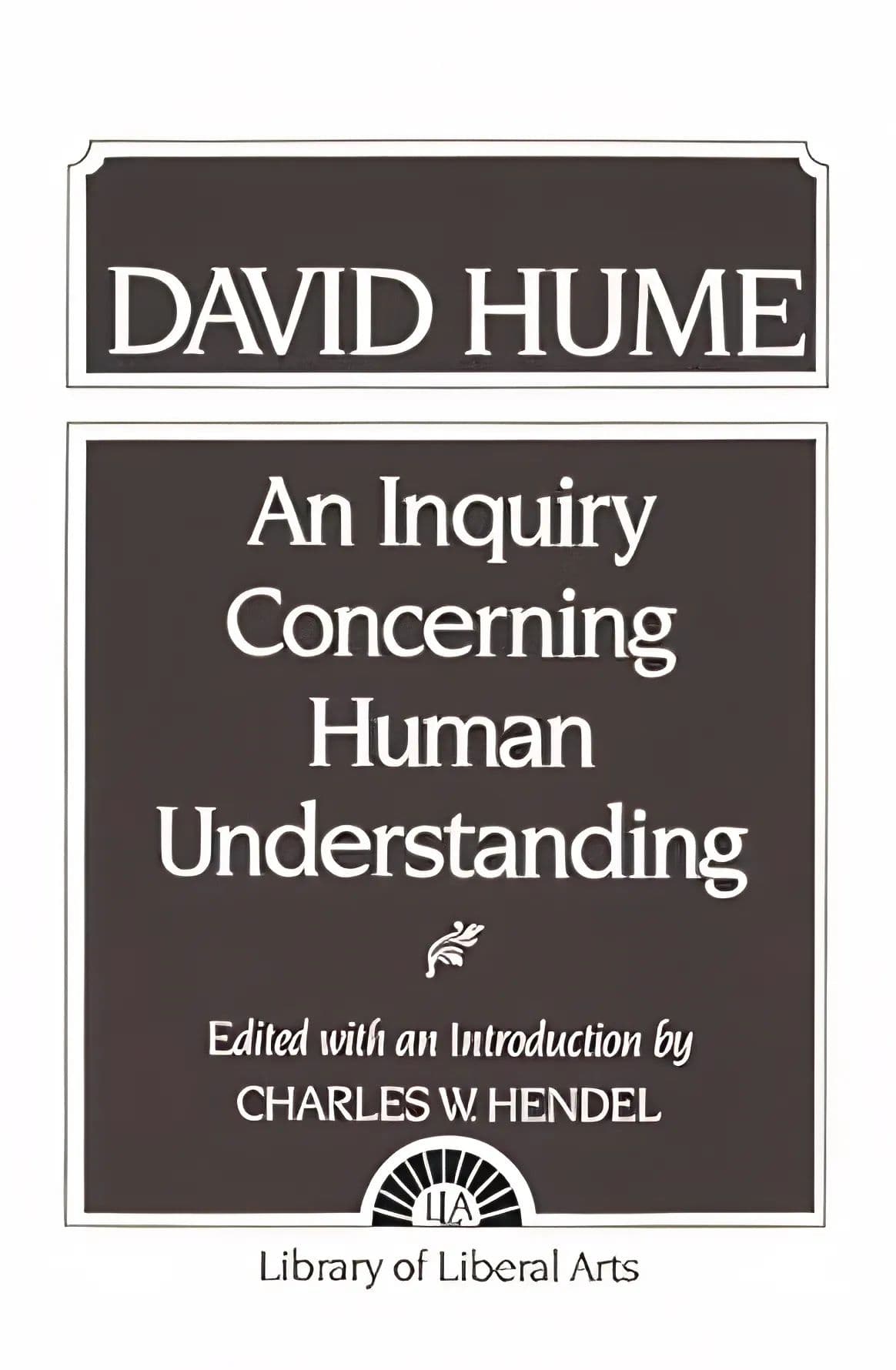
An Enquiry Concerning Human Understanding
Hume's 1748 Enquiry is a compressed restatement of Book I of his Treatise, organized around the fork between relations of ideas and matters of fact. The central mechanism is the argument that causal reasoning, the basis of all factual inference, cannot be justified by reason or experience: we infer effects from causes not through insight into necessary connection but through custom and habit. This skeptical conclusion is then applied to miracles and providence, and the book closes with a defense of mitigated skepticism as the proper philosophical temperament.
Key Insights
✦What is the central claim of the Enquiry, and what does it reject?
The Enquiry's central claim is that all objects of human reason divide into relations of ideas and matters of fact. Relations of ideas—mathematics and logic—are known with certainty independent of experience. Matters of fact rest on experience, and all our reasoning about matters of fact depends on the relation of cause and effect. Hume then argues that causal inference cannot be justified by reason or by experience: we never perceive necessary connection, and no amount of observed conjunction proves that the future will resemble the past. He rejects the rationalist view that causal necessity is intelligible a priori, and he rejects the attempt to ground induction in argument, since all such argument would itself rely on induction.
✦What is 'Hume's Fork,' and why is it foundational to empiricism?
Hume's Fork is the division of meaningful propositions into two exhaustive classes: relations of ideas, which are either intuitively or demonstratively certain (such as geometry and arithmetic), and matters of fact, which are known only through experience . The fork is foundational because it draws a sharp limit around what can be known: any claim that purports to be about reality but is neither a logical truth nor an empirically testable matter of fact is, on this scheme, without content. The twentieth-century logical positivists, particularly A. J. Ayer, revived the fork as a criterion of meaning, treating it as a linguistic rule rather than a psychological description of belief . Hume's own use of it was less programmatic, but its influence on empiricism has been immense.
✦Why does Hume include the essay on miracles, and how does it connect to his epistemology?
The essay 'Of Miracles' applies the Enquiry's epistemology to religious knowledge. Hume argues that no testimony is sufficient to establish a miracle unless the falsehood of the testimony would be more miraculous than the event it reports. Since uniform experience is the foundation of all probable reasoning, and miracles by definition violate uniform experience, the evidence for any miracle is necessarily outweighed by the evidence against it. The essay is not an isolated polemic but a consequence of the Enquiry's account of belief: belief is a lively idea derived from custom, and testimony is a species of causal inference. Some critics, including Laird, have accused Hume of begging the question by assuming what he sets out to prove .
✦How does the Enquiry differ from the Treatise of Human Nature?
The Enquiry is a revision of Book I of the Treatise, but it is not merely an abridgment. Hume removed much of the Treatise's detailed psychological speculation, abandoned the 'of the understanding' framework, and added material on miracles and providence that was not in the original . The style is more polished and less technical, reflecting Hume's frustration at the Treatise's poor reception. He later disavowed the Treatise, asking that his philosophical sentiments be judged solely by the Enquiries. However, the Enquiry omits some of the Treatise's most original and difficult arguments, particularly those concerning personal identity and the idea of substance. Readers seeking Hume's full system must consult both works.
✦How has the Enquiry's account of causation held up in later philosophy?
The Enquiry's critique of necessary connection set the agenda for much of subsequent epistemology. Kant credited Hume with awakening him from dogmatic slumber and attempted to answer the challenge by grounding causation in the a priori categories of the understanding. In the twentieth century, the logical positivists adopted Hume's fork while attempting to give a linguistic analysis of causal statements, and the problem of induction remains unresolved in contemporary philosophy. Critics have challenged Hume's assumption that we have no impression of necessary connection, arguing that agency or power is experienced directly. Others have defended a regularity theory of causation, though Hume's own position is more nuanced than the simple regularity reading often attributed to him.
✦What is the textual history of the Enquiry, and which edition should readers use?
The Enquiry was first published in 1748 as Philosophical Essays Concerning Human Understanding, and the title was changed to An Enquiry Concerning Human Understanding in the 1758 edition . Hume continued to revise the text throughout his life, and the posthumous 1777 edition is generally regarded as the definitive version of his intentions, though scholars note that the 1777 text may include changes made by printers or editors after Hume's death in 1776 . The standard scholarly edition is Tom L. Beauchamp's critical edition for the Clarendon Hume series, which collates the lifetime editions and provides extensive annotation . For student use, the Selby-Bigge/Nidditch edition reprinted from the 1777 text remains widely assigned .
✦What is a common misconception about the Enquiry's relationship to skepticism?
A frequent misreading treats Hume as a total skeptic who denies the rationality of science and everyday belief. In fact, the Enquiry closes with a defense of 'mitigated skepticism,' which Hume distinguishes from the excessive Pyrrhonian variety. Mitigated skepticism acknowledges the limits of human reason while permitting us to follow nature, custom, and common life. Hume does not recommend suspending all belief; he recommends modesty about what philosophy can prove. The famous concluding injunction to commit to the flames any book containing neither abstract reasoning nor experimental reasoning is rhetorical, not a serious proposal for censorship. Hume's skepticism is therapeutic rather than destructive: it cures dogmatism without paralyzing action.
Wealthy Psyche is an intellectual archive. We do not host, distribute, or sell book copies — physical or digital. We provide structured knowledge to help you think better, faster.