


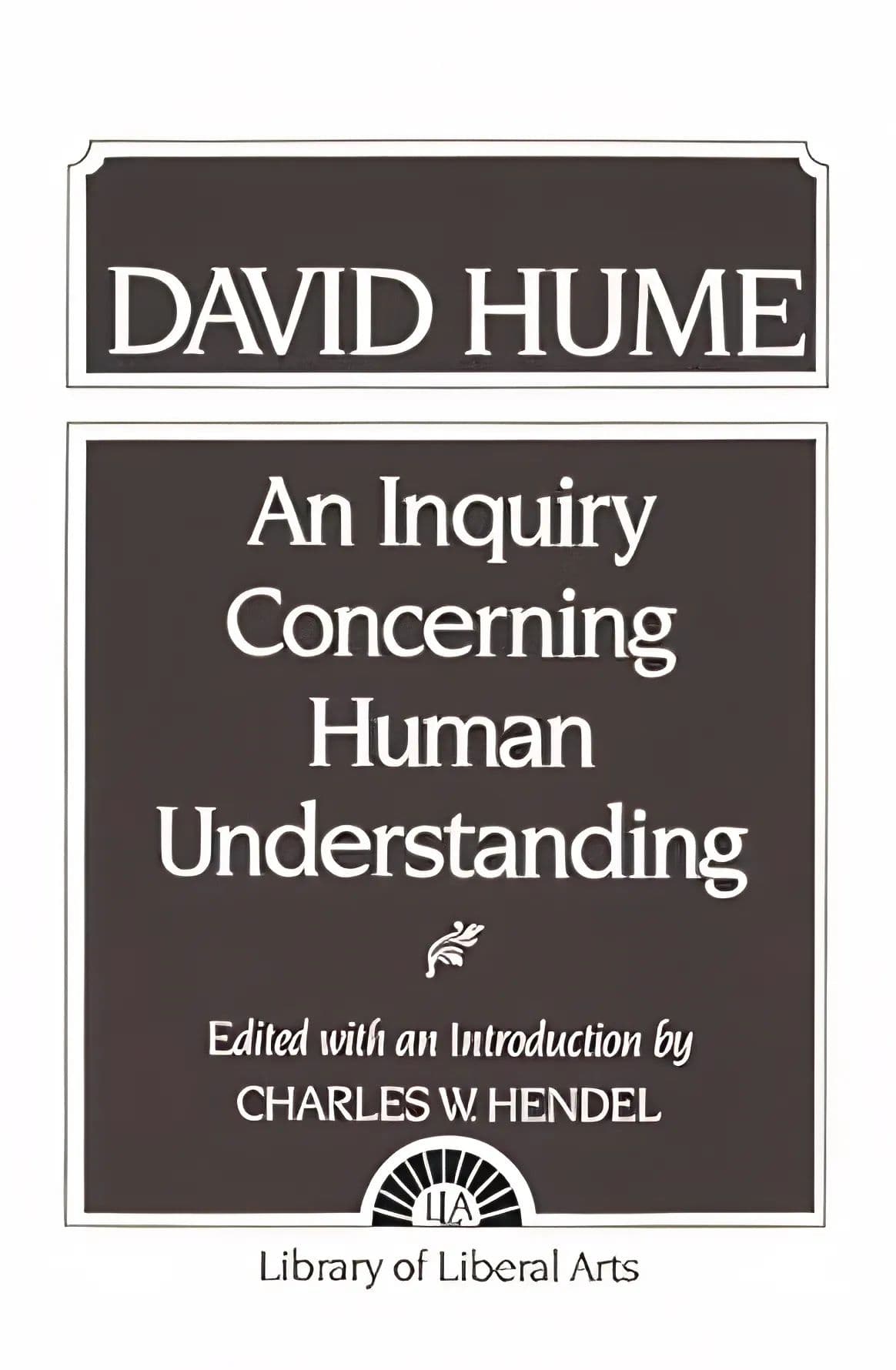
An Enquiry Concerning the Principles of Morals
Hume's 'second Enquiry' recasts Book III of the Treatise into a polished, empirical investigation of moral judgment. Its central mechanism is the claim that moral distinctions arise not from reason but from sentiment: we approve of qualities because they are useful or agreeable to the person possessing them or to others. Hume grounds this sentimentalism in sympathy, a principle of communicated feeling that explains how we can be moved by the interests of strangers. The work rejects psychological egoism and rationalist ethics alike, defending a naturalistic virtue ethics centered on personal merit.
Key Insights
✦What is the central claim of the second Enquiry, and what does it reject?
The Enquiry's central claim is that morality is determined by sentiment, not reason. Hume argues that moral judgments express feelings of approbation and disapprobation rather than conclusions of rational insight. Reason can inform us of facts and means-end relations, but it cannot by itself motivate action or pronounce an action virtuous; only sentiment can do that. Hume rejects moral rationalism, the view that moral truths are discovered by reason alone, and he also rejects psychological egoism, the Hobbesian view that all intentional action is ultimately self-interested. His alternative is a sympathy-based sentimentalism in which we approve of qualities that are useful or agreeable, whether to the possessor or to others .
✦How does the Enquiry's argument differ from Book III of the Treatise?
The Enquiry is not a mere abridgment but a recasting with significant shifts in emphasis. Hume abandoned the Treatise's detailed psychological machinery—the associationist account of sympathy and the complex taxonomy of the passions—in favor of a more accessible and empirically grounded argument. The central difference, as one comparative study argues, is a shift from investigating the origins of virtues to exhibiting their utility: the Enquiry foregrounds the usefulness and agreeableness of qualities rather than tracing their roots in human nature . Hume's basic naturalistic and descriptive stance remains unchanged, but the later work presents the case with greater elegance and rhetorical force. Hume himself judged it 'incomparably the best' of all his writings .
✦What role does sympathy play in Hume's moral theory, and how does it differ from self-interest?
Sympathy, for Hume, is a principle of communicated feeling: we come to share in the sentiments of others, including those remote from us, by means of association and resemblance. It is not merely pity for suffering but a general capacity for emotional contagion that allows us to approve of qualities beneficial to strangers. This distinguishes Hume's position from psychological egoism. When we approve of benevolence in a person whose interests do not affect us, we are not covertly calculating our own advantage; we are moved by sympathy with the beneficiaries. Hume's account surpasses Hutcheson's moral sense theory by providing a naturalistic mechanism—sympathy—for how the moral sense operates, rather than positing it as a divinely implanted faculty .
✦What was the publication history of the Enquiry, and which edition is authoritative?
The Enquiry was first published in 1751 by A. Millar in London . It went into ten editions during Hume's lifetime, and he revised it continually; the last edition seen through the press by Hume himself appeared in 1772 . This 1772 edition serves as the copy-text for the authoritative Clarendon Edition edited by Tom L. Beauchamp, published by Oxford University Press in 1998 . Beauchamp's edition includes a historical introduction, extensive annotation, a biographical appendix identifying persons mentioned by Hume, and a critical apparatus charting all substantive variants between editions . Readers using older or unauthorized editions should be aware that they may not reflect Hume's final corrections and revisions.
✦How was the Enquiry received in Hume's lifetime, and what criticisms did it face?
Contemporary critics such as James Balfour and Thomas Reid perceived the Enquiry as the work of an Epicurean and a sceptic, reading Hume's naturalistic account of morality as undermining religious foundations of ethics . The work's reception was bound up with the controversies surrounding Hume's earlier writings: the Treatise had been criticized for its difficult prose and recondite arguments, and the Enquiry was partly an attempt to correct those stylistic failures while retaining the doctrines . Hume's disavowal of the Treatise in a 1775 advertisement directed readers to the Enquiries as the authoritative statement of his views. Despite the hostile reactions from some quarters, the Enquiry attracted serious philosophical attention and contributed to the development of sentimentalist ethics in the Scottish Enlightenment.
✦What is a common misconception about the Enquiry's status as a work of moral philosophy?
A frequent misreading treats the Enquiry as a merely descriptive account of moral psychology with no normative implications—as if Hume were only reporting how people happen to make moral judgments without defending any standard of virtue. In fact, the work advances a substantive virtue ethics: Hume identifies the qualities he considers genuinely virtuous (benevolence, justice, courage, and other useful or agreeable traits) and defends them against rival accounts. Whether this amounts to a normative theory in the modern sense is debated, but the Enquiry is not neutral between competing conceptions of merit. Hume's rejection of egoism and his defense of humanity as a genuine motive are normative claims, not merely observations about human behavior .
Wealthy Psyche is an intellectual archive. We do not host, distribute, or sell book copies — physical or digital. We provide structured knowledge to help you think better, faster.