


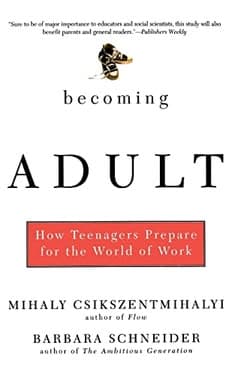
Becoming Adult: How Teenagers Prepare for the World of Work

Co-authored with sociologist Barbara Schneider, this book applies Csikszentmihalyi's flow framework to a five-year longitudinal study of over 1,000 American adolescents transitioning from school to work. Its central finding is a paradox of expectation: teenagers across race, class, and gender hold remarkably optimistic career aspirations—often higher among low-income and minority youth than affluent whites—yet they lack realistic knowledge about how to attain them, and schools rarely provide the conditions that foster sustained engagement with challenge. The book argues that the experience of 'intense concentration' in skill-demanding activities, not just goal-setting, is what prepares youth for adult work [citation:10][citation:18].
Key Insights
✦What is the central claim of Becoming Adult, and what does it reject?
The book's central claim is that American adolescents hold remarkably positive educational and occupational expectations—about 80% expect to complete four years of college, and these aspirations hold across race, class, and gender lines, with low-income and minority youth often more optimistic than affluent whites [citation:10][citation:18]. What they lack is realistic knowledge about careers and opportunities to develop the skills and attitudes needed for a rapidly changing workplace. Csikszentmihalyi and Schneider reject the assumption that clear vocational goals and work experience alone guarantee a smooth transition to adulthood. Their data show that neither is sufficient. Instead, they argue that adolescents need experiences of intense concentration in skill-demanding activities—flow experiences—that teach them to enjoy challenge, and that these opportunities are unevenly distributed, often unavailable to lower-income families [citation:10].
✦How does this book apply Csikszentmihalyi's flow theory to adolescence and work?
Becoming Adult extends the flow framework from Csikszentmihalyi's earlier work on optimal experience into the domain of adolescent development and career preparation. The book's argument is that the quality of experience matters more than the content of aspirations: teenagers who have opportunities to become deeply absorbed in challenging, skill-demanding activities—whether in classrooms, extracurricular projects, or internships—develop the capacity to enjoy challenge and persist through difficulty. Publishers Weekly summarized the authors' recommendation: adolescents need 'intense concentration in any activity that requires skill and discipline' [citation:10][citation:18]. This is a direct application of the flow model, which holds that enjoyment arises when challenges and skills are balanced, and that such experiences build the psychological resources needed for future engagement.
✦What was the study's methodology, and what made it distinctive?
The research was a five-year longitudinal study launched in 1992, following over 1,000 adolescents from 20 middle schools and 13 high schools across the United States, with data collected in four waves until 1997 [citation:4]. The sample was deliberately constructed to approximate the racial and ethnic composition of the country, including low-income and minority students often excluded from career development research. The team used the Experience Sampling Method (ESM), in which students reported on their feelings and activities at randomly selected moments, alongside interviews, questionnaires, and a Career Orientation Survey [citation:4]. This mixed-methods design allowed the researchers to capture not just what teenagers said about their futures but how they actually experienced their daily activities—a methodological signature of Csikszentmihalyi's research program.
✦What did reviewers identify as the book's contribution and limitations?
Howard Gardner called it 'an important book' tackling an area about which little is known, praising its 'valuable quantitative and qualitative findings, many of them surprising' [citation:3][citation:17]. Publishers Weekly noted that the authors 'interpret their data clearly' and offer 'sensible recommendations for educational policy,' predicting the study would be of 'major importance to educators and social scientists' [citation:10][citation:18]. The main limitation is one of scope rather than execution: the book is a research monograph with policy implications, not a practical guide for parents or teachers. Its recommendations—more internships, project-based learning, and attention to the quality of classroom experience—are grounded in data but remain general. Readers seeking specific interventions or curricula will not find them here; the book diagnoses the problem and points toward principles rather than prescribing detailed solutions.
✦How does this book relate to Csikszentmihalyi's earlier Being Adolescent?
Becoming Adult extends the research program of Being Adolescent (1984, co-authored with Reed Larson), which also used the Experience Sampling Method to study how teenagers spend their time and what makes their daily experiences enjoyable or tedious. Where Being Adolescent focused on the general texture of adolescent experience—school, family, leisure, and the emotional states associated with each—Becoming Adult narrows the lens to the transition from school to work and asks how adolescents develop the attitudes, skills, and expectations relevant to adult careers. The methodological continuity is direct: both books rely on ESM data to capture the quality of moment-to-moment experience rather than retrospective self-report. The later book adds a longitudinal design and a sociological co-author, Barbara Schneider, whose expertise in educational stratification sharpens the analysis of how opportunity is distributed.
✦What does the book say about the role of families and schools in shaping career outcomes?
Families and schools emerge as central but unevenly effective. The book discusses the importance of parental guidance and role modeling from other adults, and it examines how different high schools structure the transition to post-secondary paths [citation:10]. A chapter on 'Guiding Students into the Future: Three Schools of Thought' analyzes how institutional approaches shape student trajectories. The finding that lower-income and minority students are often more positive about school than affluent peers complicates narratives about aspiration gaps: the problem is not a deficit of hope but a deficit of realistic knowledge and opportunity. The authors argue that schools could do more to provide the kinds of challenging, absorbing experiences that build the capacity to enjoy effort, but they acknowledge that such programs are 'seldom available to lower-income families,' making the book as much a critique of educational inequality as a study of adolescent psychology [citation:10].
Wealthy Psyche is an intellectual archive. We do not host, distribute, or sell book copies — physical or digital. We provide structured knowledge to help you think better, faster.