


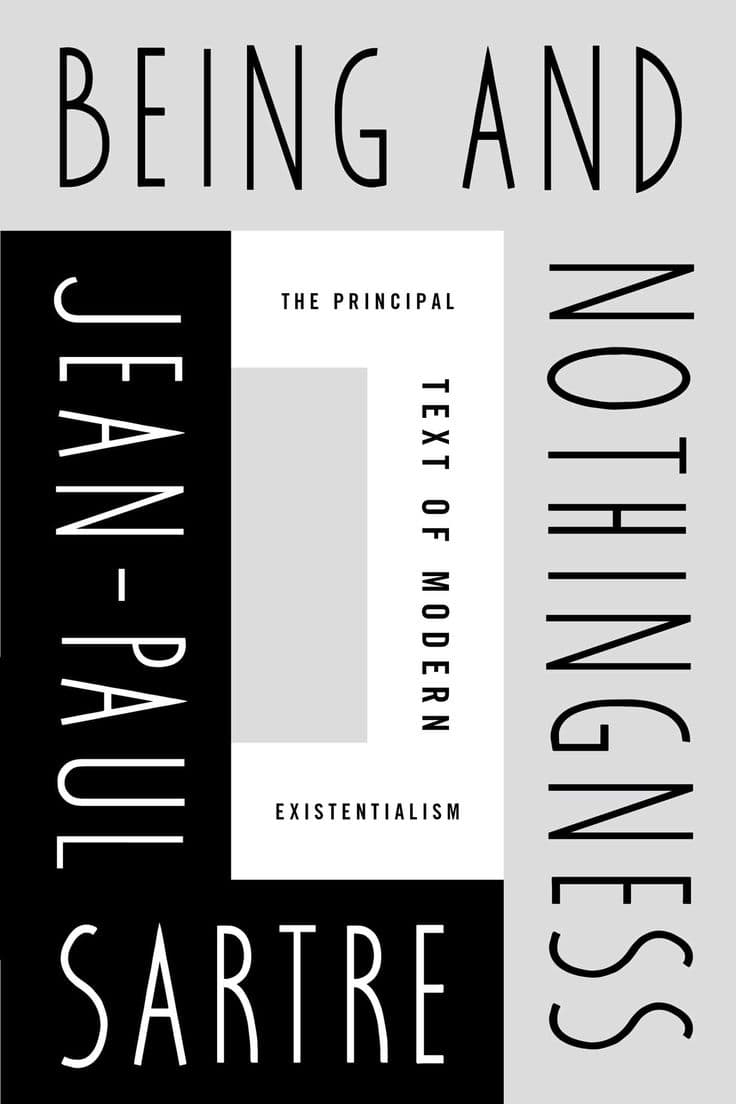
Being and Nothingness (L'Être et le néant)

Sartre's 1943 masterwork is a phenomenological ontology that begins from a single distinction: being-in-itself, the brute, full, and non-conscious being of things, and being-for-itself, the nothingness that consciousness introduces into the world through its capacity to negate. Its central mechanism is the claim that consciousness is defined by the nothingness at its heart—it is not what it is and is what it is not—so that human reality is condemned to be free, to project itself toward possibilities it can never fully become. The book's analysis of bad faith, the Look, and the futile desire to be God unfolds from this ontological structure.
Key Insights
✦What is the central argument of Being and Nothingness, and what does it reject?
The book's central argument is that consciousness is structurally a nothingness: it is not a thing among things but a negating activity that separates itself from what it is and projects toward what it is not. Sartre distinguishes being-in-itself, the full and inert being of objects, from being-for-itself, the conscious being that is defined by lack and possibility . What the book rejects is any account of consciousness as a substance, a soul, or a collection of mental states. It also rejects the determinist view that human action can be explained by causes, arguing instead that freedom is total and inescapable. The famous analyses of bad faith, the Look, and the desire to be God all derive from this ontology: they are descriptions of how the for-itself attempts, and fails, to become a stable self.
✦What is 'bad faith,' and why is it the book's most widely discussed concept?
Bad faith is the lie to oneself by which consciousness denies its own freedom and pretends to be a fixed thing. Sartre's examples are famous: the waiter who plays at being a waiter, the woman who allows her hand to be held while detaching her attention from what she is doing, the man who declares that he is a coward as though this were a fact about his nature rather than a pattern of choices . Bad faith is possible because consciousness is not what it is: the waiter is not identical with his role, and that gap is the site of freedom. The concept is widely discussed because it offers a non-moralistic account of self-deception that does not rely on an unconscious, and because it reveals the social and psychological mechanisms by which people evade responsibility for their lives.
✦How does the 'Look' structure Sartre's account of relations with others?
The Look is Sartre's account of how the other person's gaze objectifies me. When I am seen, I experience myself as an object for the other's consciousness: my possibilities are frozen into a fixed identity, and my freedom is alienated. The famous example is the man peering through a keyhole who, on hearing footsteps, suddenly experiences himself as a voyeur rather than as a free subject . This structure generates the 'conflict' that Sartre says is the essence of relations with others: each consciousness seeks to objectify the other while resisting objectification, and love, sadism, and masochism are all strategies within this struggle. The Look is the basis of Sartre's claim that hell is other people, developed dramatically in No Exit.
✦Why did Sartre's later work criticize Being and Nothingness, and does the Critique of Dialectical Reason supersede it?
Sartre's later work criticized the 1943 book for treating freedom abstractly, without adequate attention to the material and historical conditions in which it operates. The Critique of Dialectical Reason attempts to situate the for-itself within the practico-inert—the domain of worked matter and social structures—and to account for how freedom is constrained by scarcity and class relations. Thomas Flynn notes that Sartre did not simply abandon his earlier philosophy; he recognized that the case he had made for it had 'transformed itself into a case for something else' . The Critique does not so much supersede Being and Nothingness as extend it: the earlier book supplies the ontology, and the later work supplies the historical and political analysis that the ontology lacked.
✦How has Being and Nothingness's account of radical freedom been criticized by later philosophers?
The most persistent criticism is that Sartre's account of freedom is too absolute: if every choice is free and every situation is freely constituted, then the concept of freedom loses its critical edge, because no situation can be described as unfree. Maurice Merleau-Ponty argued that Sartre's dualism between the for-itself and the in-itself leaves no room for the lived body, which is neither pure consciousness nor mere matter . Later feminists, including Simone de Beauvoir in The Second Sex, appropriated and revised Sartre's framework to analyze how social structures constrain freedom without eliminating it. The debate about whether radical freedom is a coherent position or an unhelpful exaggeration remains central to Sartre scholarship.
✦How does Hazel Barnes's English translation shape the book's reception?
Hazel Barnes's 1956 translation, published by the Philosophical Library and later reissued by Washington Square Press and Routledge, has been the standard English version for nearly seven decades . Barnes was a philosopher sympathetic to Sartre's project, and her translation includes an introduction and extensive notes that have shaped how Anglophone readers understand the text. The translation has been praised for its scholarship and criticized for occasional opacity, particularly in passages where Sartre's French exploits the resources of grammar and etymology in ways that English cannot easily replicate. Readers should be aware that key terms—for-itself, in-itself, facticity, bad faith—are technical and were defined by Sartre in a glossary he supplied for the French edition, and that translation choices about these terms significantly affect how the argument is understood.
✦What is the most common misreading of the book's title and its distinction between being and nothingness?
The most persistent misreading takes 'nothingness' to mean emptiness, absence, or a kind of nihilistic void, as if Sartre were celebrating the absence of being. But nothingness in Sartre is an active, structuring concept: it is what consciousness introduces into the world through negation—the capacity to say 'not,' to imagine what is absent, to separate oneself from what one is. The distinction between being-in-itself and being-for-itself is not between something and nothing but between two modes of being, one of which is defined by the nothingness that it carries within itself. A related error treats the book as a work of pessimism or despair, when its aim is descriptive: it analyzes the structures of human reality, including the futile desire to be God, without recommending any particular attitude toward them.
Wealthy Psyche is an intellectual archive. We do not host, distribute, or sell book copies — physical or digital. We provide structured knowledge to help you think better, faster.