


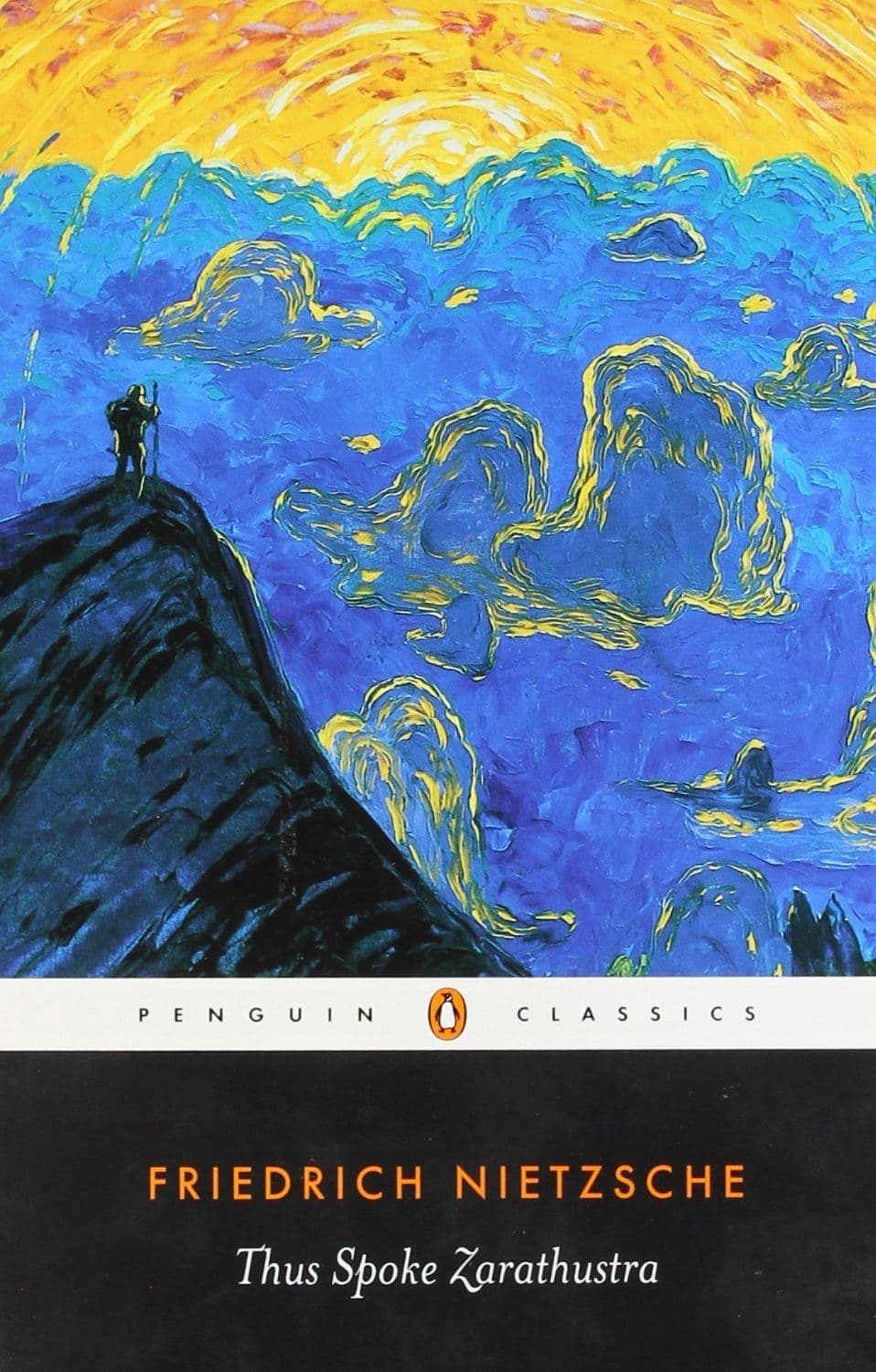
Thus Spoke Zarathustra
Nietzsche's self-described 'book for everyone and no one' is less a treatise than a dramatic narrative in which the prophet Zarathustra descends from his mountain to announce that God is dead and to teach the Übermensch as the meaning of the earth. Its distinctive mechanism is the fusion of poetry, parody, and philosophical provocation: rather than arguing for doctrines, Zarathustra enacts them through speeches, parables, and encounters with figures who embody the last man, the higher man, and the tempter. The book's central demand is fidelity to the earth—a rejection of otherworldly hopes in favor of a life-affirming embrace of existence, crystallized in the doctrines of the will to power and eternal recurrence.
Key Insights
✦What is the central teaching of Thus Spoke Zarathustra, and what does it reject?
The book's central teaching is that humanity is something to be overcome: the Übermensch, not God or the last man, is the meaning of the earth. Zarathustra announces that God is dead—not as a triumphant atheism but as a diagnosis of the collapse of the metaphysical framework that had sustained European values—and demands that his listeners remain faithful to the earth rather than inventing otherworldly hopes . What the book rejects is every form of life-denial: the ascetic ideal, the contempt for the body, the comfortable nihilism of the 'last man' who seeks only security and avoids risk . The will to power and eternal recurrence are the affirmative doctrines through which this rejection is completed.
✦How did the book's unusual publication history affect its reception and interpretation?
Zarathustra appeared in four parts between 1883 and 1885, with the final part privately printed at Nietzsche's own expense and distributed only to a handful of friends . It received almost no attention during Nietzsche's lucid lifetime. The first public edition of all four parts appeared in 1892, after his mental collapse, and the book's subsequent promotion—particularly by his sister Elisabeth—transformed it into something Nietzsche had not intended: edifying literature carried in the packs of German soldiers during the First World War . This reception history is crucial because it separated the book from its philosophical context and made it available for nationalist and militarist appropriation.
✦How has the philosophical status of Zarathustra been assessed by later scholars?
Recent philosophical scholarship has tended to marginalize the book, treating it as a literary experiment rather than a serious contribution to Nietzsche's philosophical argument . This neglect is understandable: Nietzsche himself acknowledged its heterodoxy, remarking that if he had published it under another name, no one would have guessed its author was the same man who wrote Human, All Too Human . Yet the book was celebrated by creative artists and by seminal continental thinkers including Heidegger, Deleuze, and Löwith. The tension between its literary reception and its philosophical marginalization remains unresolved. Some critics argue that the book's form is inseparable from its content, and that reading it as philosophy requires attending to its rhetoric rather than extracting doctrines from it.
✦What does the doctrine of eternal recurrence mean in the context of this book?
Eternal recurrence, described by Britannica as the basic conception of Zarathustra, asks how one would have to be disposed toward oneself and one's life to desire nothing more fervently than the infinite repetition of every moment without alteration . It functions less as a cosmological claim than as an existential test: the thought of eternal return forces the individual to confront whether their existence is affirmed absolutely or merely tolerated. In the book, Zarathustra presents this doctrine as the culmination of his teaching, the point at which the will to power turns against its own resentment of time and learns to will the past as well as the future. Whether Nietzsche intended the doctrine literally or hypothetically remains a matter of scholarly dispute.
✦How has the Übermensch been misused and misunderstood since the book's publication?
The Übermensch was famously perverted by Nazi propagandists into a racial and nationalist ideal, a reading the text does not support. The association owes much to Elisabeth Förster-Nietzsche, who controlled Nietzsche's literary estate and refashioned his work in the image of her antisemitic husband, linking his name to Hitler in the public mind . The book's Übermensch is not a biological type but a project of self-overcoming, defined by fidelity to the earth and the creation of values rather than by blood or nation. A related misreading treats the Übermensch as a heroic individualist who dominates others, when Zarathustra's teaching is directed at humanity as a whole and emphasizes generosity, creativity, and the overcoming of resentment rather than the exercise of power over the weak.
✦How do the English translations of Zarathustra differ, and which should readers choose?
The first English translation, by Alexander Tille in 1896, was followed by Thomas Common's widely circulated 1909 version, which remained standard for decades despite significant errors—Kaufmann reportedly wondered whether Common 'had little German and less English' . Kaufmann's 1954 translation and Hollingdale's 1961 version became the standard scholarly editions, though both have been criticized for dampening Nietzsche's more controversial metaphors and altering punctuation in ways that affect meaning . Graham Parkes's 2005 translation aims to convey the text's musicality, and the Cambridge edition by Adrian Del Caro and Robert Pippin (2006) seeks to restore its poetic brilliance. Readers should be aware that Zarathustra is the most stylistically self-conscious of Nietzsche's works, and translation choices significantly shape how its doctrines are perceived.
✦Why did Nietzsche consider Zarathustra his most important work, and does that judgment hold?
Nietzsche regarded Zarathustra as his masterpiece and the fullest expression of his mature philosophy, a judgment Britannica endorses in calling it the first thorough statement of his thought . The book's importance for Nietzsche lay partly in its form: it allowed him to present his ideas not as arguments but as a vision, with the prophet Zarathustra as a dramatic persona through whom he could speak with a authority that aphorism and essay could not provide. Whether the book succeeds as philosophy is another matter. Its doctrines are announced rather than defended, and the narrative structure leaves their interrelations ambiguous. But as a literary enactment of a philosophical sensibility—a way of seeing and valuing the world—it remains unmatched in Nietzsche's corpus.
Wealthy Psyche is an intellectual archive. We do not host, distribute, or sell book copies — physical or digital. We provide structured knowledge to help you think better, faster.