


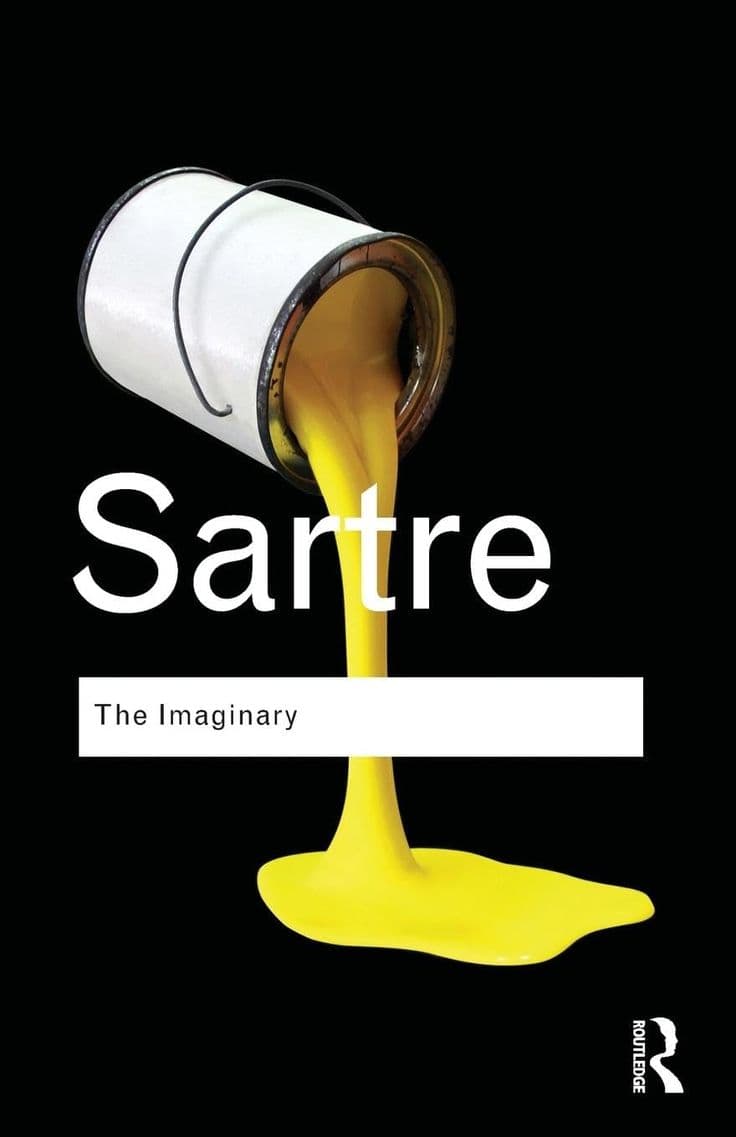
The Imaginary (L'Imaginaire)
Sartre's 1940 phenomenological study argues that imagination is not a faculty of producing faint copies of perceptions but a distinct mode of consciousness defined by its negative relation to the real. Its central mechanism is the claim that the image is an 'irreal' object: when we imagine a centaur or a absent friend, consciousness posits its object as nothingness, as not existing in the perceptual world. The book's distinctive contribution is the identification of the 'analogon'—the material or mental substitute (a photograph, a painting, a feeling) through which consciousness aims at this irreal object, a structure that makes imagination an act of freedom rather than a passive reproduction of experience.
Key Insights
✦What is the central argument of The Imaginary, and what does it reject?
Sartre's central argument is that imagination is not a reproductive faculty that stores and revives perceptions, but a distinct mode of consciousness that posits its object as nothingness. When I imagine a centaur or an absent friend, I do not perceive a faint copy; I intend an object that is explicitly posited as not existing in the perceptual world, as absent or unreal . What the book rejects is the classical psychological account of the image as a diminished sensation, a 'picture in the mind' that resembles what it represents. Against this, Sartre insists that the image is defined by its negative relation to reality: to imagine is to transcend the real toward an irreal object, and this transcendence is the ground of human freedom.
✦What is the 'analogon,' and why is it central to Sartre's theory?
The analogon is the material or mental substitute through which consciousness aims at an irreal object. When I look at a photograph of a friend, the paper and ink are the analogon; my consciousness does not take them as the object of perception but uses them as a support for intending the absent friend as an image . The analogon can be external (a painting, a photograph) or internal (a feeling, a bodily sensation). Its role is crucial because it explains how imagination can be both spontaneous and constrained: consciousness is free to posit irreal objects, but it requires an analogon to do so. This structure distinguishes Sartre's account from theories that treat the image as a self-sufficient mental entity.
✦How does the book relate to Husserl's phenomenology, and what does Sartre contribute to it?
Sartre encountered Husserl's work in Berlin and was fascinated by the idea of intentionality, which he adapted for his own purposes. The Imaginary is often described as the first attempt to introduce Husserl's phenomenology into the English-speaking world, and Sartre's book is explicitly designed as a phenomenological essay . His contribution is to apply Husserl's method to a specific problem—the nature of the image—and to draw conclusions that Husserl himself did not. Where Husserl treated imagination as one mode of intentionality among others, Sartre argues that the imaginative consciousness is defined by its positing of nothingness, a claim that anticipates the ontology of Being and Nothingness.
✦How has Merleau-Ponty's critique of The Imaginary shaped its reception?
Merleau-Ponty reviewed The Imaginary critically, and his objections became a reference point for later discussions. His central complaint was that Sartre's dualistic ontology—the sharp separation between the real and the imaginary, perception and imagination—underestimates the continuity between them. Merleau-Ponty's later work develops an alternative account in which the imaginary is not a negation of the real but a dimension of it, rooted in the body's expressive capacities . This critique has been influential in shaping the view that Sartre's theory of imagination, while powerful, is limited by its commitment to a rigid opposition between presence and absence, reality and irreality.
✦What is the most common misreading of Sartre's claim that the image is 'nothingness'?
The most persistent misreading takes 'nothingness' to mean that the image is unreal in the sense of being a mere illusion or a figment with no significance. But Sartre's point is structural rather than evaluative: the image's object is posited as not existing in the perceptual world, and this negation is what makes imagination a mode of freedom. The image is not a defective perception but a different kind of intentional act, one that transcends the given toward what is absent or unreal. A related error treats the theory as a denial of the image's concrete richness—the vividness of a remembered face, for instance. Sartre does not deny that images can be vivid; he denies that vividness is what defines them as images.
✦How do the English translations of The Imaginary differ, and which should readers use?
The first English translation, published by Methuen in 1948 under the title The Psychology of Imagination, was the standard version for over half a century. Routledge published a new translation by Jonathan Webber in 2004, prepared with Arlette Elkaïm-Sartre's revised edition after Sartre's death, which rectifies flaws in the 1948 version and seeks to recapture the essence of Sartre's phenomenology . Webber's translation is now the standard scholarly edition and is widely preferred for its accuracy and philosophical precision. Readers should be aware that the 1948 title, The Psychology of Imagination, emphasizes the psychological dimension, while the 2004 title, The Imaginary, reflects the book's broader phenomenological and ontological ambitions.
Wealthy Psyche is an intellectual archive. We do not host, distribute, or sell book copies — physical or digital. We provide structured knowledge to help you think better, faster.