


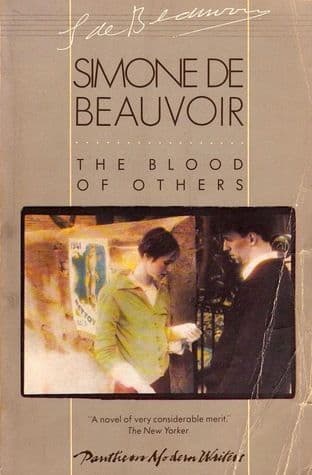
The Blood of Others (Le Sang des autres)

Beauvoir's 1945 novel, written during the Occupation, follows Jean Blomart through a single night at the bedside of his dying lover, Hélène, as he reconstructs the choices that led her to volunteer for the mission that killed her. Its central mechanism is the progressive dismantling of Jean's belief that he can keep his hands clean: he breaks with his bourgeois family, joins and leaves the Communist Party, and becomes a Resistance leader, only to discover that every commitment to collective action requires sending others—including those he loves—to risk their lives. The novel's title names the irreducible cost of freedom exercised in history.
Key Insights
✦What is the central argument of The Blood of Others, and what does it reject?
The novel's central argument is that responsibility for others cannot be evaded, and that every commitment to collective action exacts a cost paid in the lives of others. Jean Blomart begins as a bourgeois heir who rejects his privilege and seeks to become a 'working-class man,' then moves through communism, syndicalism, and finally the Resistance, each stage representing an attempt to locate a form of action that does not implicate him in the suffering of others . What the novel rejects is the fantasy of political purity—the belief that one can fight for freedom without sending others to die. Hélène's death is the price of Jean's commitment, and the novel refuses to console him for it. Responsibility, here, is not a matter of intentions but of consequences.
✦How does the novel reinterpret Sartre's concept of bad faith, and why is this significant?
A 2014 study in the Korean journal *Bulletin d'études françaises* argues that while Beauvoir shares Sartre's definition of bad faith as the desire to escape existential anguish by pretending to be a fixed thing, she departs from him in treating it as surmountable through moral effort . For Sartre, bad faith is an inevitable structure of consciousness; for Beauvoir, it is a condition that can be overcome. The novel's two protagonists, Jean and Hélène, move from what the study calls the 'illusion of solipsism' to a recognition of themselves as 'generous man'—capable of assuming responsibility for their freedom and the freedom of others . The novel is thus Beauvoir's first literary attempt to articulate an ethics of ambiguity, a project she would develop philosophically in *The Ethics of Ambiguity* two years later.
✦Why has the novel's reception been shaped by its status as a 'Resistance novel,' and what has this obscured?
The novel is still promoted as a Resistance narrative centered on Jean Blomart, and the Penguin edition's back cover describes it as portraying 'the agony of the French Resistance and the inner distress and awakening of a man' . This framing has obscured the novel's dual structure: it alternates between Jean's and Hélène's perspectives, with seven chapters from Jean and six from Hélène . A 2023 article in *Educational Theory* asks why Hélène's search for moral selfhood has not been received as an equally exemplary existentialist narrative, suggesting that the androcentrism of reception has made her invisible . Hélène's trajectory—from a selfish, light young woman to a lucid volunteer who accepts death for a cause she understands—is as central to the novel's ethical argument as Jean's, and its neglect distorts the book's achievement.
✦What was the novel's critical reception in the Anglophone world, and how does it compare with later assessments?
The *Partisan Review*'s 1948 assessment was harsh, dismissing the novel's temporal structure as 'only a trick' and accusing Beauvoir of proving she 'knows her twentieth century novel' without achieving the concentration the device promised . The reviewer conceded that the book 'juggles' with existentialist categories but found the performance unconvincing. Later assessments have been more generous. Readers on platforms like ThriftBooks describe it as the best entry-point to existentialism, praising its integration of philosophy and story, and one reviewer calls it 'far better than any of her other novels' . The divergence reflects a broader shift: the novel's formal experiments, once seen as pretentious, are now read as integral to its argument about the interdependence of separate lives.
✦How does the novel's structure—a single night interspersed with flashbacks—serve its philosophical purpose?
The frame is Jean's vigil at Hélène's deathbed, and the narrative unfolds as his memory reconstructs the years that led to her fatal mission. The structure enacts the novel's central claim about responsibility: Jean cannot separate his present from his past, and every choice he made is re-lived in the light of its consequence. The *Partisan Review* critic complained that the device was wasted, that the flashbacks could have been refracted through the dying night with 'intense concentration' but were not . A more sympathetic reading sees the deliberate dispersal as the point: Jean's life is not a coherent narrative he can master, but a series of entangled decisions whose meaning only becomes clear when it is too late to change them. The form mirrors the ethical condition the novel describes.
✦What are the translation and publication issues surrounding The Blood of Others in English?
The English translation is by Yvonne Moyse and Roger Senhouse, first published in the United States by Alfred A. Knopf in 1948 and in the United Kingdom by Secker & Warburg . Penguin issued it in 1964 in its Twentieth-Century Classics series, and it has been reissued multiple times, including a 1983 Pantheon paperback and a 2024 Penguin edition with an introduction by Ali Smith . The translation has been the standard English version for over seventy-five years and has not been superseded by a major rival version. Readers should be aware that the novel's French title, *Le Sang des autres*, carries a biblical resonance—the blood of others is both a sacrifice and a stain—that the English title preserves but does not fully explain. The novel's engagement with the political debates of the 1930s also presupposes a historical context that many English-language readers will need to reconstruct.
Wealthy Psyche is an intellectual archive. We do not host, distribute, or sell book copies — physical or digital. We provide structured knowledge to help you think better, faster.