


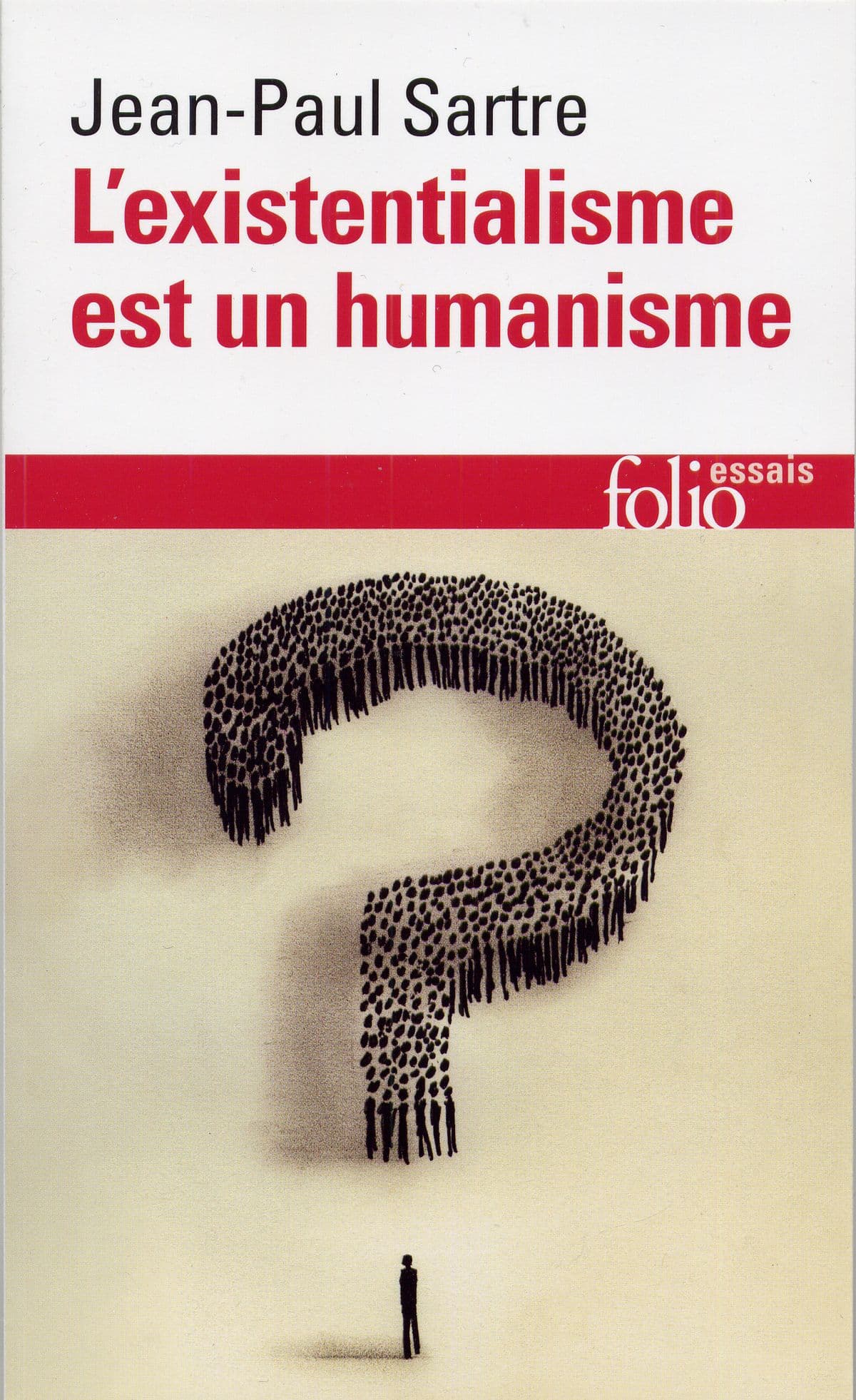
Existentialism Is a Humanism

This 1946 lecture, delivered to a packed Paris hall and published almost immediately, is Sartre's popular defense of existentialism against its Catholic and Communist critics, who accused it of nihilism, quietism, and bourgeois individualism. Its central mechanism is the reformulation of existentialist freedom as moral responsibility: because 'existence precedes essence,' humans have no fixed nature to fall back on, and are therefore condemned to invent values through their choices. The lecture's distinctive claim is that this very groundlessness makes existentialism a humanism, since it places the entire burden of meaning on human action rather than on God, nature, or history.
Key Insights
✦What is the central claim of the lecture, and what does it reject?
The lecture's central claim is that 'existence precedes essence': humans are not designed according to a fixed nature or divine plan, but first exist and then define themselves through their choices. Sartre rejects the accusation that existentialism is a pessimism or a license for quietism, arguing instead that its emphasis on freedom and responsibility makes it a humanism. The humanist dimension consists in the claim that humans are the only beings for whom existence is at issue, and that the values they create are the only values there are. The lecture insists that this creates anguish, abandonment, and despair—not as reasons for inaction but as the conditions under which action becomes meaningful .
✦Why did Sartre later repudiate the lecture, and what does that repudiation reveal about the text?
Sartre came to regret the lecture's popularity and its simplification of his philosophy. Annie Cohen-Solal's introduction to the Yale edition notes that Sartre later explicitly rejected the text, so much so that he refused to allow its re-publication in France, where it remained unavailable in French for decades . The lecture was delivered as a popular defense of existentialism against its critics, and its clarity was purchased at the cost of philosophical precision. Sartre's repudiation suggests that the text should be read as a historical intervention rather than as a definitive statement of his philosophy. It represents what he was willing to say to a general audience at a particular moment, not what he ultimately believed.
✦What is the 'principle of activity' or 'engagement' that Sartre emphasizes in the lecture, and why is it central?
Sartre's principle of activity is that humans are not defined by what they say or feel but by what they do. A person who claims to be generous but never acts generously is not generous; a person who calls himself a coward is not a coward unless he acts that way. This principle is central because it provides the lecture's answer to the charge of quietism: existentialism is not a philosophy of contemplation but a philosophy of engagement. It places the entire weight of meaning on action, and it denies any gap between intention and responsibility that could serve as an excuse. The principle also grounds the lecture's humanism: if humans are what they do, then the human world is entirely a human product .
✦How has the lecture's account of freedom been criticized as inconsistent with Being and Nothingness?
Critics have argued that the lecture's account of freedom is more voluntaristic than the one developed in Being and Nothingness. In the lecture, Sartre speaks of humans as 'condemned' to be free and treats freedom as the capacity to choose one's values and projects. In Being and Nothingness, freedom is described in terms of consciousness's relation to its facticity—the given conditions of one's life—and is understood as the power to confer meaning on that facticity rather than to escape it. Thomas Flynn argues that Sartre's thought in the 1946 lecture is more unified and accessible than the complex argument of Being and Nothingness, but the unity is achieved by simplifying the later work's nuanced account of freedom and constraint . The lecture's emphasis on choice can make freedom seem more omnipotent than the earlier book's description.
✦What was the popular reception of the lecture, and what does it reveal about the intellectual climate of 1946 Paris?
The lecture was delivered to a huge, enthusiastic audience in Paris in 1946, and it was published almost immediately. Its reception was marked by the extraordinary popularity of existentialism as a cultural phenomenon in the postwar period: Sartre's name was associated with jazz clubs, Left Bank cafés, and a new fashion for youthful rebellion. Annie Cohen-Solal's biography and her introduction to the Yale edition describe a city where the room was filled to overflowing and the lecture became a kind of manifesto for the movement . The popular reception is instructive: it shows that existentialism in 1946 was not only a philosophy but a cultural event, and that the lecture's simplifications were part of its appeal. The text was written for that audience, not for the academic readers who would later scrutinize it.
✦How do the English translations of the lecture differ, and which should readers choose?
The lecture first appeared in English in 1948 in a translation by Philip Mairet, published by Methuen and reissued by Methuen & Co., and this version remains in print in various editions . A new translation by Carol Macomber was published by Yale University Press in 2007 under the title Existentialism Is a Humanism, with an introduction by Annie Cohen-Solal and notes by Arlette Elkaïm-Sartre . The Yale edition is generally preferred by scholars for its accuracy, and it includes the notes that Sartre added when the text was published. The Mairet translation is older and more elegant in places, but its idiom is dated. Readers should be aware that the lecture's tone is deliberately accessible, and that both translations have succeeded in preserving the directness that made it popular, though the Yale edition is the more reliable guide to what Sartre actually said.
Wealthy Psyche is an intellectual archive. We do not host, distribute, or sell book copies — physical or digital. We provide structured knowledge to help you think better, faster.