


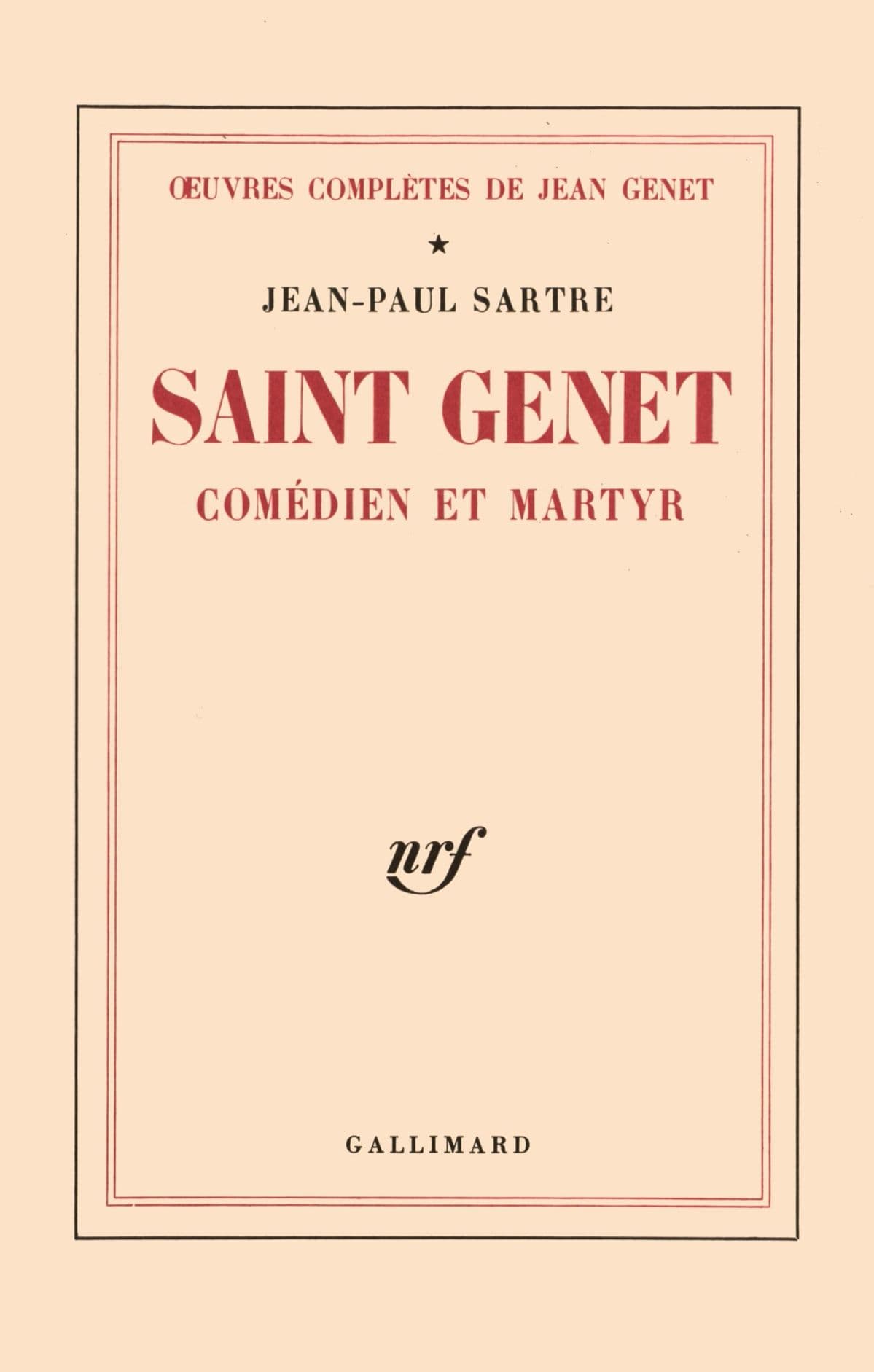
Saint Genet

Sartre's 1952 study of Jean Genet is not a conventional biography or literary criticism but an existentialist psychoanalysis of a life and a body of work. Its central mechanism is the claim that Genet's identity as thief, homosexual, and writer was constituted by the hostile gaze of others—the moment when a child was caught stealing and told he was a thief—and that Genet's entire subsequent life was a free, defiant reappropriation of that imposed identity. The book's distinctive argument is that Genet's writing is an act of existential self-creation: he takes the condemnation and transforms it into a vocation, demonstrating in his life the very freedom Sartre's philosophy describes.
Key Insights
✦What is the central argument of Saint Genet, and what does it reject?
The central argument is that Genet's identity was constituted by the hostile gaze of others and then freely reappropriated by Genet himself. At the age of ten, Genet was caught stealing and was told by a foster parent that he was a thief; Sartre treats this moment as a founding trauma in which an external judgment became an internal identity . What the book rejects is any reading of Genet as a passive product of his circumstances. Sartre insists that Genet's response to the judgment was a free choice: he decided to become what others said he was, to take the word 'thief' and make it his own, and this reversal is the origin of his writing. The book's larger claim is that Genet's life demonstrates, in extremis, the freedom that Sartre's philosophy describes.
✦How does Saint Genet apply the philosophy of Being and Nothingness to a specific life?
Saint Genet is the most sustained application of Being and Nothingness to a concrete historical existence. The foundational concept of the Look, developed abstractly in the 1943 treatise, is here given a biographical anchor: Genet is objectified by the judgment 'you are a thief,' and his subsequent life is an attempt to recover his subjectivity by reappropriating and inverting that objectification. The analysis of bad faith is also central: Sartre traces Genet's strategies for fleeing the freedom that his reappropriation had left him with, and shows how his writing becomes a way of taking responsibility for a life that was given to him as a condemnation. The book is therefore a test case for the philosophy, showing what its concepts look like when they are applied to a life rather than to abstract examples.
✦What was Genet's own reaction to the book, and how did it affect his relationship with Sartre?
Genet's reaction was ambivalent and ultimately resentful. Sartre's book had made him famous, but it had also taken him over—it presented his life as a philosophical case study, and Genet felt that Sartre had done to him what others had done before: defined him, fixed him, explained him. Edmund White's biography of Genet records that Genet resented Sartre's monumentalization, and that the publication of Saint Genet marked a turning point in his relationship with Sartre, who had been a friend and advocate. The irony is precise: Sartre's book about the gaze and its power to objectify had itself become a gaze that objectified Genet. The incident illustrates the risks of the existentialist biographical method, and it has become a standard reference point in discussions of Sartre's relationship with his subjects.
✦What is the most common misreading of Saint Genet?
The most persistent misreading treats the book as a biography, a factual account of Genet's life that can be evaluated for accuracy. But Sartre's aim is not biographical reconstruction; it is existentialist psychoanalysis, and the facts of Genet's life are treated as materials for the analysis of a project rather than as ends in themselves. A related error treats the book as an endorsement of Genet's life and work. Sartre admires Genet's freedom, but the book is also a critique: it shows the cruelty and self-destructiveness of Genet's reappropriation, and it does not present his solution as exemplary for others. The book's value lies in its method—the demonstration of how freedom operates under conditions of constraint—not in its subject's particular choices.
✦How does Saint Genet differ from Sartre's later biography of Flaubert, The Family Idiot?
Saint Genet was a forerunner of the much larger and more ambitious study of Flaubert that Sartre worked on for decades, but the differences are instructive. Saint Genet focuses on the psychology and ethics of a single individual, treating Genet's life as a case study in freedom and bad faith. The Family Idiot, by contrast, attempts a total biography that incorporates the social, historical, and material conditions of Flaubert's existence, and it represents Sartre's turn toward a more Marxist framework, with concepts drawn from the Critique of Dialectical Reason. The later study is therefore more social and historical, while Saint Genet remains more existential and individualist. The comparison shows the trajectory of Sartre's thinking about biography, from the analysis of freedom to the analysis of the conditions within which freedom operates.
✦How does Bernard Frechtman's English translation shape the book's reception?
The standard English translation is by Bernard Frechtman, published by George Braziller in 1963, over a decade after the French original. Frechtman was Sartre's principal English translator, and his version of Saint Genet is the one most English-language readers have encountered. The translation has been praised for its fidelity to Sartre's philosophical vocabulary but has also been criticized for its opacity, particularly in passages where Sartre's prose is most dense and technical. The book is long and difficult in French, and the translation does not make it easier; some reviewers have suggested that Frechtman's literalism preserves the difficulty of the original rather than smoothing it out. Readers should be aware that the book's argument depends on careful attention to Sartre's distinction between being and having, facticity and transcendence, and that translation choices about these terms significantly affect how the analysis is understood.
Wealthy Psyche is an intellectual archive. We do not host, distribute, or sell book copies — physical or digital. We provide structured knowledge to help you think better, faster.