


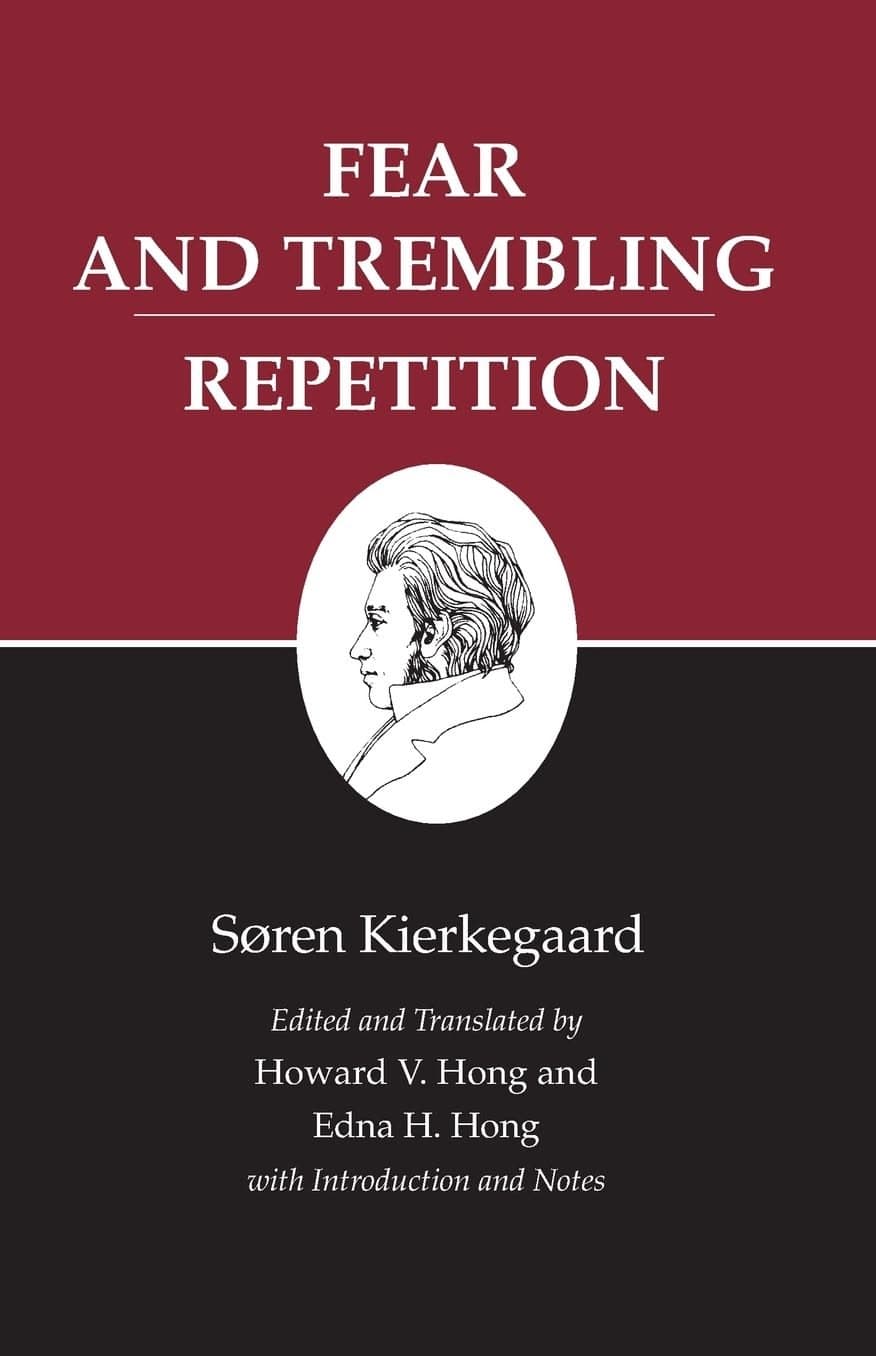
Repetition

Published in 1843 under the pseudonym Constantin Constantius, this book is a philosophical experiment in which a young man's erotic and religious crisis is observed by a psychologist who attempts to reproduce the conditions of a past experience. Its central mechanism is the claim that repetition is not the mere recurrence of the same but the recreation of the self through a movement of faith: whereas recollection moves backward, repetition moves forward, and it is the condition of freedom and meaning in existence. The book's distinctive argument is that only the religious individual, through a movement of repentance, can achieve the repetition that the aesthete seeks in vain.
Key Insights
✦What is the central argument of Repetition, and what does it reject?
The central argument is that repetition is not the recurrence of the same but a forward movement that recreates the self through faith, and that this movement is the condition of freedom and meaning. Constantin Constantius rejects the Greek conception of knowledge as recollection, which moves backward toward what has already been known . Repetition, by contrast, moves forward: it is the 'new' that is not a negation of the old but its rebirth. The book's experiment tests whether repetition is possible in the aesthetic, ethical, and religious spheres, and it concludes that only in the religious sphere—through the movement of repentance and faith—can repetition be achieved. The young man's return to the beloved is a figure for the soul's return to itself in God.
✦What is the significance of the book's pseudonym, Constantin Constantius, and why is it ironic?
Constantin Constantius—'Constant the Constant One'—is a psychologist who seeks constancy through repetition, yet his experiment fails. He tries to reproduce a trip to Berlin and finds that the experience cannot be recreated; the same hotel room, the same theater, the same routine do not produce the same joy. The pseudonym is ironic because Constantin's attempt to achieve constancy through the mechanical repetition of the aesthetic is precisely what the book diagnoses as impossible. He is a detached observer who believes he can master repetition through experimental control, but the book's argument is that repetition requires a leap of faith, not a method. The pseudonym thus names the failed version of repetition, not its truth.
✦How does Repetition relate to Fear and Trembling, published in the same year?
Repetition and Fear and Trembling were published in 1843, and they are often read as complementary works, though their relation is complex and has been much debated . Both are concerned with the movement of faith and the limits of philosophical comprehension, but they approach the theme from opposite directions. Fear and Trembling examines the teleological suspension of the ethical in the Abraham story; Repetition examines the possibility of recovering what has been lost through a movement of faith. A central point of dispute between the two works is the relation of the religious to the ethical: does faith suspend the ethical, as Fear and Trembling suggests, or does it fulfill it, as Repetition may suggest? The comparison reveals that Kierkegaard's authorship is not a unified system but a series of experiments.
✦How has the book's treatment of the young man's love story been interpreted?
The young man's love for a woman is a figure for something deeper: his inability to achieve repetition through erotic attachment reveals that the aesthetic and ethical spheres cannot provide the constancy he seeks. He breaks his engagement, is consumed by guilt and melancholy, and discovers that he cannot forget the beloved through recollection. His eventual 'return' is not a reunion with her but a movement of repentance that restores him to himself before God. The love story is not merely a psychological case study; it is an allegory of the soul's relation to what it has lost. The young man's suffering is the necessary condition of his transformation, and his 'repetition' is not the recovery of the beloved but the recovery of himself.
✦What are the main English translations of Repetition, and how do they differ?
The first English translation was by Walter Lowrie, published by Princeton University Press in 1941 and reprinted in 1954 . The standard modern translation is by Howard V. Hong and Edna H. Hong, published by Princeton University Press in 1983 as part of Kierkegaard's Writings . The Hong edition includes extensive historical introduction, notes, and related materials, making it the preferred scholarly version. M. G. Piety's translation for Oxford University Press, published in 2009, is also widely used and is praised for its readability and its attention to Kierkegaard's rhetorical strategies. Readers should be aware that the book's effect depends on the alternation between Constantin's detached narration and the young man's passionate letters, and that translation choices about register significantly shape how the conflict between these voices is perceived.
✦Why did Kierkegaard describe Repetition as a 'peculiar cross' between a novel and a philosophical treatise?
Kierkegaard's description captures the book's hybrid form: it contains a narrative frame (Constantin's experiment), letters from the young man, and a philosophical meditation on repetition. The book is not a novel because it lacks the continuous plot and characterization of fiction; it is not a treatise because it does not argue systematically. Instead, it stages a philosophical problem through the voices of its characters, allowing the reader to observe the failure of aesthetic repetition and to infer the necessity of the religious alternative. The hybrid form is itself an experiment in indirect communication, and it reflects Kierkegaard's conviction that philosophical truth cannot be communicated through direct exposition alone. The reader must engage with the text as a problem to be worked through, not as a doctrine to be received.
Wealthy Psyche is an intellectual archive. We do not host, distribute, or sell book copies — physical or digital. We provide structured knowledge to help you think better, faster.