


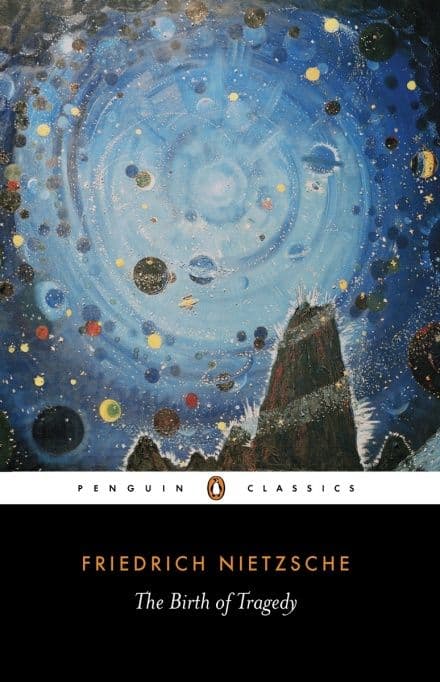
The Birth of Tragedy

Nietzsche's first book, published in 1872, argues that Greek tragedy achieved a fragile balance between two artistic drives: the Apollonian, which imposes form, clarity, and individuation, and the Dionysian, which dissolves boundaries and confronts the terror and ecstasy beneath existence. Its distinctive mechanism is the claim that this balance was destroyed by Socratic rationalism, and that modern culture might recover it through the rebirth of tragic art in Wagner's music-dramas. The book is less a work of classical scholarship than a cultural polemic, using the origins of tragedy as a diagnosis of modernity's rationalistic impoverishment.
Key Insights
✦What is the central argument of The Birth of Tragedy, and what does it reject?
The book argues that Greek tragedy was born from the tension between two artistic drives: the Apollonian, associated with dream, form, and the principle of individuation, and the Dionysian, associated with intoxication, dissolution, and the terrifying truth of suffering . Tragedy's achievement was to hold these together, offering a metaphysical consolation that made existence bearable. What the book rejects is the Socratic faith that reason and dialectic can master existence, a faith Nietzsche blames for the death of tragedy and for modern culture's shallow optimism . The book's wager is that Wagner's music-dramas might effect tragedy's rebirth and with it a cultural renewal.
✦How did the book's academic reception unfold, and why was it considered scandalous?
The Birth of Tragedy effectively ruined Nietzsche's professional reputation in classical philology . The most vehement attack came from Ulrich von Wilamowitz-Moellendorff, who denounced the work as slipshod and misleading . Nietzsche's friend Erwin Rohde responded in defense, exposing inaccuracies in Wilamowitz's citations, and Richard Wagner also issued a reply—though his intervention only served to characterize Nietzsche as the composer's lackey . The scandal was not merely scholarly: Nietzsche had used a work of classical scholarship to mount a polemic on behalf of Wagner's Bayreuth project and against the rationalism of modern German culture, a fusion of academic and propagandistic aims that his peers found unacceptable .
✦How did Nietzsche's own view of the book change, and what does the 1886 'Attempt at Self-Criticism' reveal?
Fourteen years after its publication, Nietzsche appended a prefatory essay to the 1886 edition titled 'An Attempt at Self-Criticism,' in which he called the book 'badly written, ponderous, embarrassing, image-mad and image-confused, sentimental' and 'without the will to logical cleanliness' . The 1886 edition also changed the subtitle from 'Out of the Spirit of Music' to 'Hellenism and Pessimism' and deleted the original preface to Wagner, effectively removing the book's dedication to the composer . These changes signal Nietzsche's later rejection of both Wagner and Schopenhauer, whose metaphysics had underpinned the original argument . The self-criticism is not a retraction but a revaluation: Nietzsche asks what the book might have been had it dared to say what it gestured toward.
✦What is the relationship between the book's argument and Schopenhauer's philosophy?
Schopenhauer was the principal philosophical bond between Nietzsche and Wagner in the late 1860s, and The Birth of Tragedy is steeped in his metaphysics . The book's account of the Dionysian as a confrontation with the suffering and absurdity underlying existence, and its claim that art offers a temporary redemption from that suffering, are direct borrowings from Schopenhauer's aesthetics. What Nietzsche does not yet do is break with Schopenhauer's pessimism; the book's 'metaphysical consolation' is Schopenhauerian in structure. Nietzsche later came to see Schopenhauer's metaphysics as rooted in the Christian tradition he sought to disengage from, and his rejection of that metaphysics was one reason he went beyond the position of his first book .
✦What is the most common misreading of the Apollonian-Dionysian duality?
The most persistent misreading treats the Apollonian and Dionysian as a simple opposition between reason and emotion, order and chaos, or the Western and the irrational. But Nietzsche presents them as two artistic drives that are both necessary and that achieve their highest expression in combination. The Apollonian is not 'the bad side' and the Dionysian 'the good side'; tragedy requires both, and the book's argument is that Greek culture at its height held them in a delicate balance . A related error treats the duality as a fixed metaphysical schema, when Nietzsche's later work revises and abandons it. The duality is a diagnostic instrument for understanding cultural health, not a permanent ontology of human nature.
✦How do English translations of The Birth of Tragedy differ, and which editions are standard?
The first English translation was by William A. Haussmann in 1909. Walter Kaufmann's translation, published by Vintage and often bound with The Case of Wagner, became the standard English edition for decades and is praised for reflecting Nietzsche's idiom and vitality . A later Cambridge edition, translated by Ronald Speirs with an introduction by Raymond Geuss, appeared in 1999 and is widely used in academic contexts . Kaufmann's edition includes extensive commentary and correspondence, while the Cambridge edition emphasizes contextual and philosophical framing. Readers should be aware that the book's prose is deliberately rhetorical and image-driven, and that translation choices significantly affect how its argument—especially its treatment of Socrates and Wagner—is perceived.
✦Why did Nietzsche later turn against Wagner, and how does that reversal bear on the book's argument?
Nietzsche's later rejection of Wagner was bound up with his rejection of Schopenhauer and of the Schopenhauerian aesthetics that had shaped The Birth of Tragedy. In writings from the late 1870s and in The Case of Wagner (1888), Nietzsche came to see Wagner's music as artificial and decadent, an expression of Christian values and of resentment against life rather than an affirmation of it . This reversal is philosophically significant because the book's central wager was that Wagner's music-dramas could effect the rebirth of tragic culture. If Wagner is decadent rather than regenerative, the book's constructive proposal collapses. The Birth of Tragedy is thus not only a diagnosis of Greek culture but a failed prophecy about modern art, a failure Nietzsche spent his later career acknowledging and reframing.
Wealthy Psyche is an intellectual archive. We do not host, distribute, or sell book copies — physical or digital. We provide structured knowledge to help you think better, faster.