


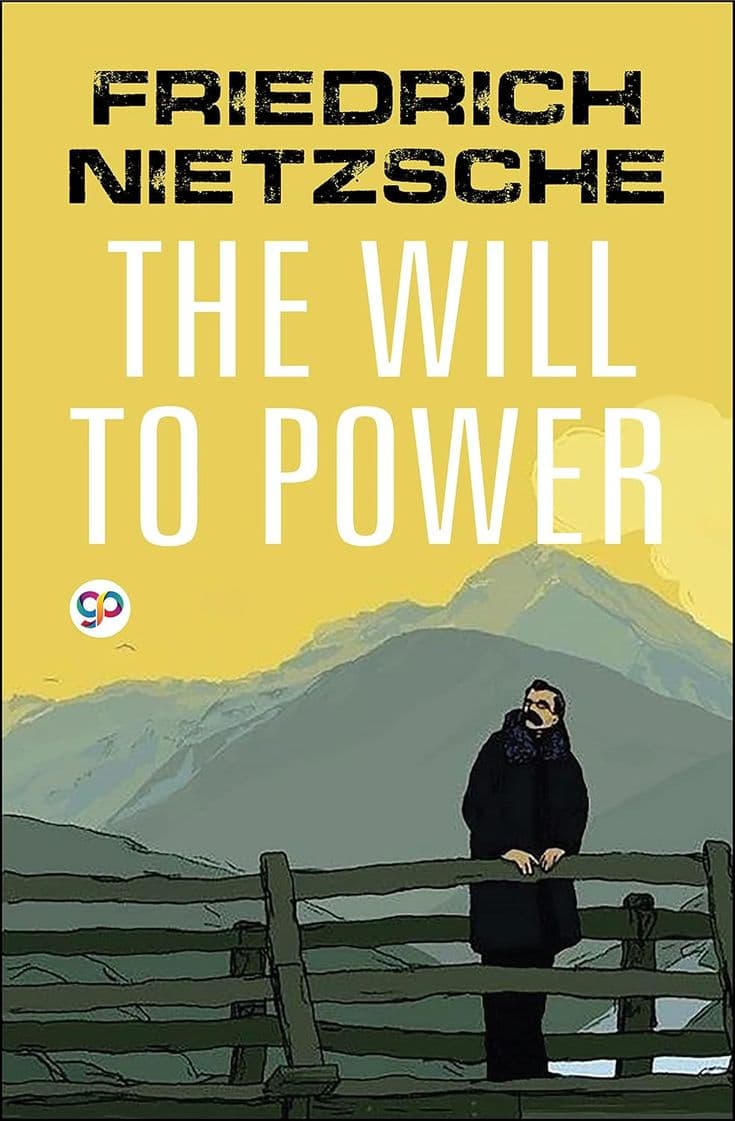
The Will to Power (posthumous)
This is not a book Nietzsche wrote. It is a posthumous compilation of his notebooks, assembled by his sister Elisabeth Förster-Nietzsche and Heinrich Köselitz after his collapse, and arranged to suggest a systematic magnum opus he never completed. Its distinctive problem is therefore editorial rather than philosophical: the 'will to power' is a genuine Nietzschean concept, but the book bearing that title is a fabricated unity imposed on fragments written at different times for different purposes. Reading it as Nietzsche's masterwork mistakes an editorial construction for an authorial intention, and the history of that mistake is inseparable from the book's use by Nazi ideologues.
Key Insights
✦Was The Will to Power actually written by Nietzsche as a book?
No. Nietzsche never completed a book titled The Will to Power. He had planned a work under a related title—'The Revaluation of All Values'—and made extensive notes toward it, but he abandoned the project before his collapse in 1889. After his death, his sister Elisabeth Förster-Nietzsche and Heinrich Köselitz assembled these notebooks into a volume published in 1901, arranging the fragments to suggest a coherent systematic work . The title, structure, and apparent unity are editorial impositions. The 'will to power' is a genuine concept in Nietzsche's published writings, but the book bearing that name is a posthumous construction, not an authorial completion.
✦How did Elisabeth Förster-Nietzsche's editorial interventions distort the material, and what motivated them?
Elisabeth controlled Nietzsche's literary estate after his collapse and used that control to shape his reception. The Will to Power was compiled from notebooks, discarded drafts, and private material, and Elisabeth edited and arranged these fragments to align with her own nationalist and antisemitic convictions . Carol Diethe's biography argues that Elisabeth's motivations were partly personal: the compilation allowed her to present herself as a philosopher in her own right and to position herself at the center of her brother's legacy . She also restricted access to the archives, ensuring that her version of Nietzsche dominated for decades. Scholars only began to grasp the extent of the tampering after World War II.
✦How was The Will to Power used by National Socialism, and what does that appropriation reveal?
The compiled volume provided Nazi ideologues with quotable fragments that could be presented as Nietzsche's philosophical justification for power politics, hierarchy, and conquest. A dissertation on the misappropriation notes that The Will to Power was edited and controlled by Elisabeth to comply with her belief in National Socialism and Aryan supremacy, and was later used by the regime as philosophical cover for its policies . The appropriation was possible precisely because the book's fragmentary, decontextualized form made it amenable to selective quotation. This history does not prove Nietzsche was a Nazi—his published works contain passages hostile to antisemitism and German nationalism—but it demonstrates how posthumous editing can make an author available for uses he would have rejected.
✦How do the Kaufmann/Hollingdale and Ludovici translations differ, and does translation affect the book's authority?
Anthony Ludovici's translation, published in the 1909–1913 Complete Works, was the standard English version for decades but was based on Elisabeth's compromised compilation and carried its editorial assumptions into English . Walter Kaufmann and R. J. Hollingdale's 1967 translation, published by Random House, was a deliberate corrective: Kaufmann was among the scholars who had exposed the compilation's unreliability, and his edition included commentary contextualizing the fragments and challenging their arrangement . Translation matters here because the very form of the 'book'—its chapter divisions, sequence, and apparent argument—was an editorial invention. A translation that reproduces that structure without flagging its arbitrariness perpetuates the illusion of a unified work.
✦Does The Will to Power have any philosophical value despite its compromised origins?
The notebooks from which it was compiled contain material of genuine philosophical interest, including Nietzsche's drafts on nihilism, eternal recurrence, and the revaluation of values. The problem is not that the fragments are worthless but that their arrangement misrepresents them. Heidegger, who delivered lecture courses on Nietzsche under the title 'The Will to Power,' treated the concept as central to Nietzsche's thought while recognizing that the published volume was an editorial construction . Heidegger's approach—engaging the concept while acknowledging the textual problem—suggests a way forward. Readers can consult the fragments in the critical edition (the Colli-Montinari KSA) where they are arranged chronologically rather than thematically, revealing the development of Nietzsche's thinking rather than a fabricated system.
✦What is the most common misconception about this book, and why does it persist?
The most persistent misconception is that The Will to Power represents Nietzsche's definitive philosophical system, the magnum opus he intended but did not live to finish. This view persists partly because the book's title is so memorable and its apparent comprehensiveness so convenient: it offers a single volume that seems to contain Nietzsche's 'real' philosophy, arranged systematically. Elisabeth's editorial efforts and the book's early circulation cemented this impression. But the critical consensus since the late twentieth century has been that the volume is not a reliable guide to Nietzsche's intentions. The notes were written over years, for different purposes, and often contradict each other. Reading them as a unified work flattens the experimental, exploratory character of Nietzsche's thinking.
✦How did Heidegger's engagement with 'The Will to Power' influence the book's philosophical reception?
Heidegger delivered his first lecture course on Nietzsche in the winter semester of 1936/37 under the title 'Nietzsche. The Will to Power,' followed by a companion course on eternal recurrence . His engagement was structured as a confrontation (Auseinandersetzung) with Nietzsche as the culmination of Western metaphysics. Heidegger treated the will to power as a genuine philosophical concept, not merely an editorial artifact, while his readings of the fragments were attentive to their textual problems . The lectures were enormously influential in the twentieth century, shaping the reception of Nietzsche in continental philosophy. But they also contributed to the impression that The Will to Power was a coherent work, an impression Heidegger's own textual sophistication did not entirely dispel.
Wealthy Psyche is an intellectual archive. We do not host, distribute, or sell book copies — physical or digital. We provide structured knowledge to help you think better, faster.