


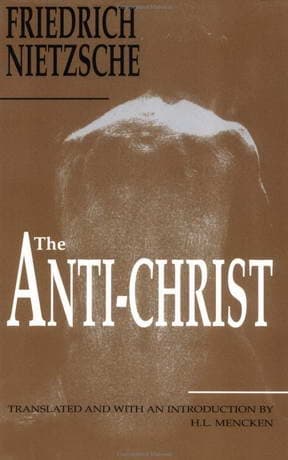
The Antichrist

Written in 1888 but withheld from publication until 1895, Nietzsche's most sustained polemic argues that Christianity is not a religion of love but a symptom of physiological and cultural décadence—a 'vampire' that drained the vitality of the ancient world and continues to poison modern values. The book's distinctive mechanism is its revaluation of all values through a single diagnostic lens: the Christian moral order, rooted in ressentiment and hostility to life, is judged not by its intentions but by its effects on human flourishing. Nietzsche's alternative is not atheism as such but a pagan affirmation of strength, hierarchy, and the will to power.
Key Insights
✦What is the central argument of The Antichrist, and what does it reject?
The book argues that Christianity is not a moral teaching to be debated but a physiological and cultural symptom of décadence—a condition in which an organism loses its instincts and prefers what injures it . Nietzsche's indictment is that Christian values, rooted in ressentiment and hostility to life, have inverted the natural hierarchy of strength and weakness, health and sickness, and have drained the vitality of every culture they have touched. What the book rejects is not merely theism but the entire evaluative framework that treats compassion, humility, and otherworldly hope as virtues. The alternative is a revaluation that affirms life, power, and the noble type of human being, though the book does not fully specify what that affirmation would look like in practice.
✦Why was the book withheld from publication, and how did its delayed appearance shape its reception?
Nietzsche completed The Antichrist in September 1888, but its publication was delayed by Franz Overbeck and Heinrich Köselitz, who feared its controversial content and Nietzsche's deteriorating mental state . It finally appeared in 1895, after Nietzsche's collapse, in a selectively edited form. Daniel W. Conway notes that once in print, the book was 'summarily denounced as a product of its author's incipient madness,' and it has never attracted the serious scholarly readership that Nietzsche's other works have . Even sympathetic readers have tended to treat the critique of Christianity as an 'inessential (and perhaps malignant) outgrowth' of his more promising philosophical insights, leaving the book in a 'shadowy, liminal position' on the periphery of his oeuvre . The suppression and the madness narrative have together insulated the book from the scrutiny it merits.
✦How does The Antichrist relate to Nietzsche's projected 'Revaluation of All Values'?
Nietzsche conceived The Antichrist as the first book of a projected four-part work titled 'The Revaluation of All Values' . The book's subtitle, 'Curse on Christianity,' signals its function as the negative, destructive half of that project: before values can be revalued, the existing ones must be dismantled. The remaining three books were never completed, and the material Nietzsche had prepared was posthumously assembled by his sister as The Will to Power, a compilation whose editorial integrity is widely disputed. Reading The Antichrist as the one completed portion of the revaluation gives it a structural importance that its reception has generally denied it. It is not a peripheral outburst but the intended foundation of Nietzsche's late philosophical program.
✦How does the book's critique of Christianity differ from that of Beyond Good and Evil and On the Genealogy of Morality?
The Antichrist extends the critique of Christian morality developed in Beyond Good and Evil and the Genealogy, but it does so with a ferocity and single-mindedness that those works deliberately avoid. Where Beyond Good and Evil analyzes the dogmatic faith in opposite values and the Genealogy traces the historical emergence of slave morality, The Antichrist treats Christianity as a unified pathological phenomenon and demands its abolition. Nietzsche's earlier works maintain a philosophical distance, employing aphorism and historical reconstruction; The Antichrist adopts the register of prosecution, complete with verdict and sentence. This shift in tone is part of why the book has been marginalized, but it also makes it the clearest statement of what Nietzsche took the practical stakes of his critique to be.
✦What is the most common misreading of The Antichrist's argument?
The most persistent misreading takes the book as a straightforward endorsement of atheism or as a proto-secular manifesto. But Nietzsche's target is not belief in God as such; it is the evaluative system that Christianity instituted and that persists even in secular modernity. He explicitly distinguishes between the 'redeemer' type of Jesus—whom he treats with a measure of ambivalence, as a figure whose 'practice' rather than doctrine was closer to a kind of instinctive life—and the institutional Christianity founded by Paul, which he regards as the true corruption . A related error treats the book's praise of strength and hierarchy as a political program, when Nietzsche's concern is cultural and physiological rather than partisan. The Antichrist is a diagnosis of a condition, not a blueprint for a movement.
✦How do the English translations of The Antichrist differ, and what should readers know about them?
The first English translation was by H. L. Mencken, published by Knopf in 1918 . Mencken's version has been praised for capturing something of Nietzsche's nervous, varied, and rapid prose style, which Mencken himself described as departing from conventional German in its tempo and rhythm . Earlier translations by Thomas Common and Anthony M. Ludovici existed before Mencken's, and Mencken acknowledged their merits while aiming for a more stylistically faithful rendering . Later scholarly translations, including those by R. J. Hollingdale and Walter Kaufmann, are generally preferred for accuracy, though Mencken's remains historically significant as the version that introduced the book to many English-language readers. Readers should be aware that the book's tone is inseparable from its argument: a translation that smooths Nietzsche's invective can make the critique seem more measured, and therefore more respectable, than it is.
Wealthy Psyche is an intellectual archive. We do not host, distribute, or sell book copies — physical or digital. We provide structured knowledge to help you think better, faster.