


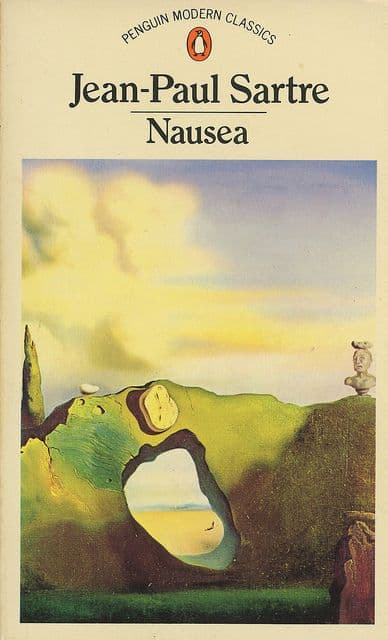
Nausea (La Nausée)

Sartre's 1938 novel, written as the diary of Antoine Roquentin, is a phenomenological experiment in fiction rather than a philosophical treatise in disguise. Its central mechanism is the progressive erosion of meaning: objects, words, and social routines lose their familiar coherence, culminating in the chestnut tree root that reveals existence as brute, contingent 'de trop'—too much, without justification. Roquentin's nausea is not a symptom to be cured but a lucid confrontation with contingency, and the novel's final pages tentatively propose that a work of art, 'hard as steel,' might offer the only form of salvation available to a consciousness that has seen through the illusions of everyday life.
Key Insights
✦What is the central argument of Nausea, and how does it differ from Being and Nothingness?
The novel's central argument is that existence is contingent and unjustified—things simply are, without reason or necessity—and that the nausea Roquentin experiences is the bodily registration of this insight. What distinguishes the novel from Being and Nothingness is that the later treatise was used for decades as an interpretive key to the novel, a practice that scholars have increasingly challenged. Alistair Rolls and Elizabeth Rechniewski argue that certain interpretations have 'congealed' around Nausea, confining it within the framework of Being and Nothingness and obscuring its specifically literary strategies . The novel's treatment of temporal experience, in particular, differs from the later philosophical account, undermining the assumption that the treatise can serve as an 'explication manual' for the fiction .
✦What is the significance of the chestnut tree scene, and why has it become iconic?
The chestnut tree root is the novel's climactic revelation: Roquentin, sitting on a park bench, sees the root as it is, stripped of the human meanings habitually projected onto it. Its existence is brute, obscene, and without justification—'de trop,' too much. Hayden Carruth observed that it is 'scarcely possible to read seriously in contemporary literature, philosophy, or psychology without encountering references to Roquentin's confrontation with the chestnut tree,' describing it as 'one of the sharpest pictures ever drawn of self-doubt and metaphysical anguish' . The scene's power lies in its concreteness: Sartre does not argue for contingency abstractly but renders it as a perceptual event, a visceral encounter with the sheer givenness of things that language and habit normally conceal.
✦How does Nausea relate to Sartre's later autobiographical work, The Words?
The relationship is one of retrospective irony. Nausea ends with Roquentin's tentative hope that writing a novel—something 'beautiful and hard as steel'—might justify his existence and redeem the contingency he has confronted. In The Words, Sartre's autobiography published twenty-six years later, he dismantles precisely this hope, presenting his childhood literary vocation as a bourgeois illusion imposed by his family. The later book reads almost as a correction of the earlier novel's ending: what Roquentin hoped art might accomplish, the older Sartre regards as a form of bad faith. This trajectory suggests that Nausea's 'solution' was provisional, and that Sartre himself came to see the aesthetic salvation it proposed as inadequate to the problem it addressed.
✦How do the English translations of Nausea differ, and which should readers use?
The translation history is unusually tangled. The first English version was Robert Baldick's The Diary of Antoine Roquentin, published by John Lehmann in 1949 and later by Penguin in 1965 . Lloyd Alexander's translation, published by New Directions in the United States in 1959 under the title Nausea, became the standard American edition and remains in print, reissued in 2013 with an introduction by James Wood . The two translations differ in title, tone, and availability: Baldick's is the British version, Alexander's the American. Readers should be aware that the novel's effect depends heavily on the register of Roquentin's diary—its alternation between clinical observation and visceral disgust—and that translation choices about diction and rhythm significantly shape how the philosophical content is experienced.
✦What is the most common misreading of Roquentin's nausea?
The most persistent misreading treats nausea as a psychological ailment, a depression or neurosis that Roquentin suffers and might recover from. But Sartre's point is precisely the opposite: nausea is not a symptom of illness but a lucid response to a truth that ordinary consciousness represses. Roquentin's problem is not that he is sick but that he has seen something others have not—the contingency of existence—and cannot unsee it. A related error reads the novel as a straightforward illustration of Sartrean philosophy, as if the fiction were merely a vehicle for doctrines developed elsewhere. The novel's form—a diary with no omniscient narrator, no plot resolution, and no authoritative interpretation—resists this reduction. The reader is placed in the same position as Roquentin: confronted with existence, without a system to contain it.
✦How does Nausea relate to Camus's The Stranger, published four years later?
The two novels are often paired as the founding fictions of French existentialism, but their differences are instructive. Camus's Meursault narrates in a flat, affectless register that registers events without interpreting them; Sartre's Roquentin is hyper-reflective, compulsively analyzing his experience and searching for meaning even as he discovers its absence. Meursault's confrontation with absurdity comes through social judgment at his trial; Roquentin's comes through perceptual overload in a park. Camus's novel ends with Meursault opening himself to the 'tender indifference' of the world; Sartre's ends with a tentative hope that art might impose a 'steel' hardness on existence. The comparison reveals that 'absurdity' in the period was not a single doctrine but a contested terrain, with Sartre and Camus developing divergent responses to a shared diagnosis.
Wealthy Psyche is an intellectual archive. We do not host, distribute, or sell book copies — physical or digital. We provide structured knowledge to help you think better, faster.