


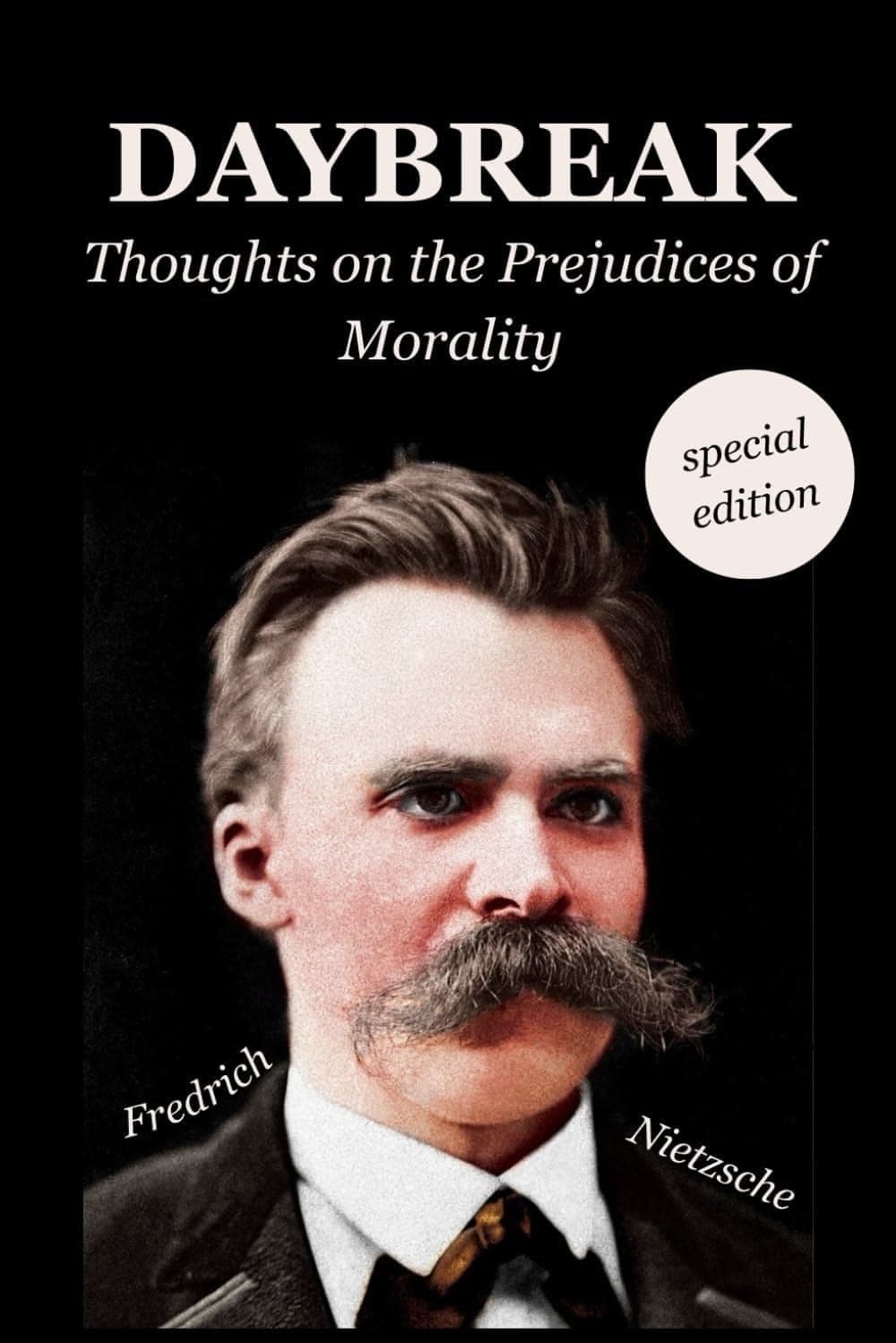
Daybreak (Morgenröte)

Nietzsche's 1881 aphoristic work is the opening salvo in what he later called his 'campaign against morality.' Rather than announcing a new doctrine, Daybreak undertakes a patient, naturalistic excavation of moral prejudices—showing that values presumed to be divinely ordained or rationally self-evident are in fact human, all too human productions rooted in drives, customs, and the 'feeling of power.' Its distinctive mechanism is the aphorism as a tool of psychological dissection: each fragment isolates a belief, traces its shameful or mundane origin, and leaves the reader to draw the unsettling conclusion. The book's target is not morality as such but the unexamined authority of moral custom.
Key Insights
✦What is the central argument of Daybreak, and how does it differ from Nietzsche's later critiques of morality?
Daybreak does not yet announce a full-scale revaluation of values. Its method is excavation: Nietzsche examines specific moral prejudices—the belief in punishment, the authority of custom, the supposed altruism of pity—and shows that their origins lie in human drives, social utility, and the 'feeling of power,' not in divine command or rational insight . George J. Stack notes that Nietzsche called it the opening of his 'campaign against morality,' but that the campaign here proceeds through subtle, experimental reflections rather than the bitterness and hysteria of his later prose . The book's critique is diagnostic and preparatory; the constructive doctrines of will to power and eternal recurrence belong to later works.
✦Why is Daybreak the least studied of Nietzsche's major works, and what has this neglect obscured?
Keith Ansell-Pearson identifies Daybreak as the least studied of Nietzsche's works, a neglect attributable to the greater attention paid to his subsequent writings . Paul Franco's study of Nietzsche's middle period argues that this neglect extends to the entire 'free-spirit trilogy'—Human, All Too Human, Daybreak, and The Gay Science—which has been perceived as inconsistent with the rest of Nietzsche's thought or dismissed because of its aphoristic style . The cost is significant: these works reveal a Nietzsche committed to reason, science, and the Enlightenment, a thinker of moderation rather than Dionysian excess, whose intellectual honesty continues to inform his final writings .
✦How does Daybreak fit into the 'free-spirit trilogy' of Nietzsche's middle period?
Nietzsche himself suggested that Human, All Too Human, Daybreak, and The Gay Science share a common goal: 'to erect a new image and ideal of the free spirit' . Franco's study treats the three works as a coherent phase in which Nietzsche departs sharply from his earlier romantic writings and differs in important ways from the prophetic mode beginning with Zarathustra . Daybreak occupies a pivotal position within this sequence. It intensifies the naturalistic critique of morality begun in Human, All Too Human while preparing the ground for the more affirmative, experimental philosophy of The Gay Science. Reading it in isolation from its companion volumes can obscure this trajectory.
✦What is the significance of Nietzsche's description of Daybreak as a 'self-suppression of morality'?
In the 1886 preface, Nietzsche characterizes the book as die Selbstaufhebung der Moral—a phrase that Stack argues both earlier translators and Hollingdale's standard English version miss in its Hegelian significance . The term means a 'self-suppression' or 'self-overcoming' of morality: a negation of morality in one sense and its preservation in another. Nietzsche does not deny that many actions called immoral ought to be avoided, or that many called moral ought to be encouraged . His critique operates from within a new moral point of view, one that refuses to accept custom as self-justifying. This dialectical structure is easily lost in readings that treat Daybreak as a straightforward assault on morality as such.
✦How does the aphoristic form of Daybreak serve its philosophical purpose?
The aphorism is not merely a stylistic preference in Daybreak; it is the instrument of the book's method. Where a systematic treatise would need to establish premises and defend inferences, the aphorism isolates a single prejudice, exposes its hidden genealogy, and withdraws, leaving the reader to absorb the implications. Rebecca Bamford has argued that Nietzsche uses mood (Stimmung) within the aphorisms to identify and counter the authority of the 'morality of custom' . Stack observes that the book's 'light touch' is integral to its effect, and that Nietzsche's subtle, experimental reflections are not marred by the later excesses of his prophetic prose . The form enacts the freedom it describes.
✦What are the main English translations of Daybreak, and how do they differ?
The first English translation was Johanna Volz's The Dawn of Day, published by Macmillan in 1903 . J. M. Kennedy's version appeared in 1911, and R. J. Hollingdale's Daybreak: Thoughts on the Prejudices of Morality, published by Cambridge University Press in 1982, became the standard scholarly English edition . Stack's review praised Hollingdale for superseding his predecessors' 'weak, un-Nietzschean language' and for conveying the freshness and paradoxical turns of the German . A later Cambridge edition edited by Maudemarie Clark and Brian Leiter appeared in 1997 , and a Stanford translation titled Dawn was published in 2011 .
Wealthy Psyche is an intellectual archive. We do not host, distribute, or sell book copies — physical or digital. We provide structured knowledge to help you think better, faster.