


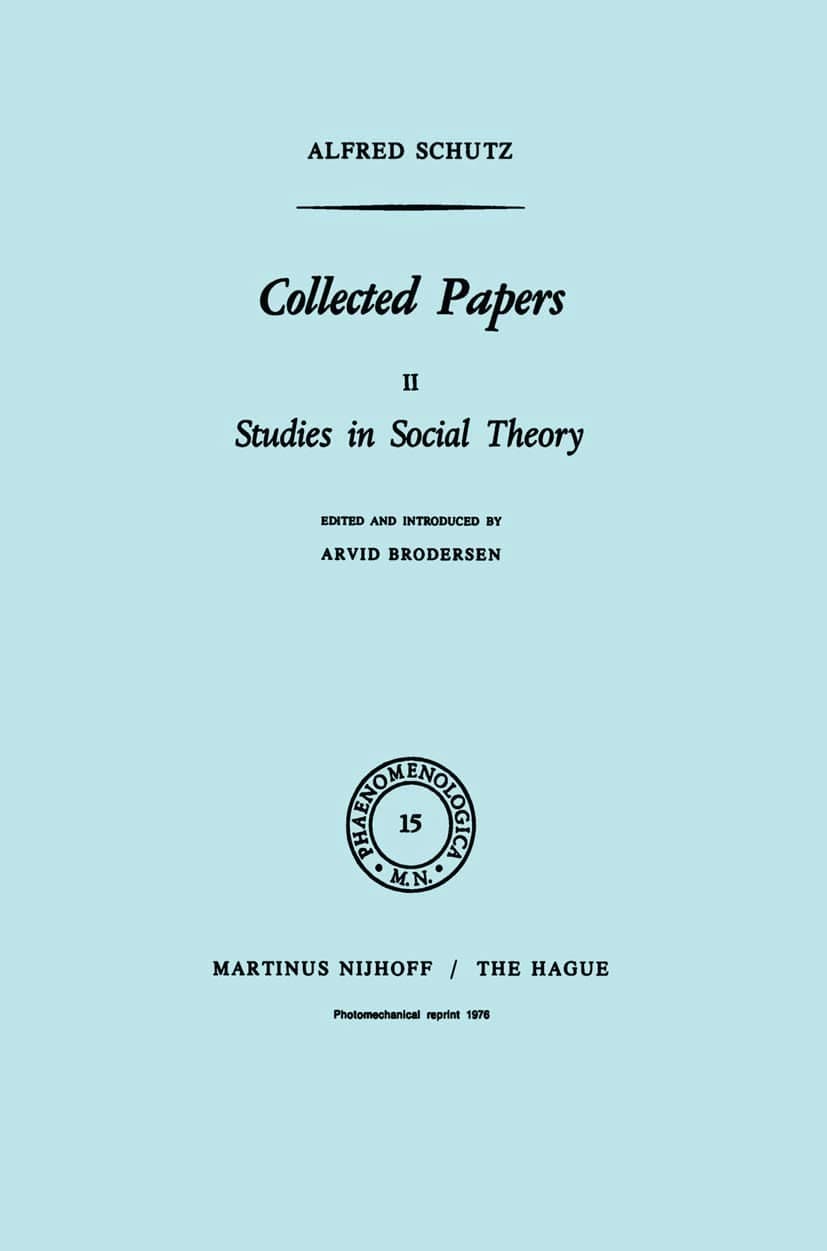
Collected Papers II: Studies in Social Theory
Schutz's central claim in this volume is that the social world has a differentiated structure that must be described from the perspective of the acting subject in the natural attitude. Intersubjectivity is not a problem to be solved by transcendental constitution but a given datum of everyday life: we are born into a world already inhabited by others, and the 'We-relationship' is the foundation of all social experience. The essays apply this mundane phenomenology to understanding the Other, relevance structures, multiple realities, and the methodology of the social sciences.
Key Insights
✦What is the central claim of Collected Papers II, and what does it reject?
Schutz's central claim is that the social world has a complex, differentiated structure that must be described from the perspective of the acting subject in the natural attitude. Intersubjectivity is not a problem to be solved through transcendental constitution but a fundamental datum of the life-world: the existence of other selves is simply taken for granted in everyday life . Schutz rejects Husserl's attempt to account for intersubjectivity within the transcendental sphere, arguing that this project fails because intersubjectivity is presupposed by any such inquiry . The volume's essays apply this mundane phenomenology to the understanding of others, relevance structures, multiple realities, and the methodology of the social sciences .
✦How does Schutz's position differ from Husserl's transcendental phenomenology?
The fundamental difference concerns the status of intersubjectivity. Husserl treated the existence of other egos as something to be constituted within the transcendental ego's conscious life—a problem to be solved through phenomenological reduction. Schutz argued that this project is misconceived: intersubjectivity is not a problem of constitution at all but a given of the natural attitude . In everyday life, we do not first encounter a solitary ego and then infer the existence of others; we are born into a world already inhabited by fellow human beings, and the 'We-relationship' is the basic ontological category of human existence . Schutz therefore developed a 'mundane' phenomenology of the natural attitude rather than a transcendental one, shifting the project from apodictic truth to sociological description .
✦What is the 'relevance' concept, and how does it structure the social world?
Relevance is Schutz's term for the principles by which consciousness selects what to attend to from the unstructured field of familiarity. Topical relevance constitutes something as problematic, organizing the field into theme and horizon; imposed relevance occurs when something forces itself on our attention without our will; intrinsic relevance involves the voluntary structuring of a field of perception . Schutz first formulated the problem of relevance in Der sinnhafte Aufbau der sozialen Welt and continued to develop it throughout his career, though he never completed a systematic treatment . The concept is central to his social theory because relevance structures are intersubjectively shared: they determine what a community takes as important, and they underlie the common-sense constructs through which social action is interpreted.
✦What is the editorial history of this volume, and who shaped its contents?
Collected Papers II: Studies in Social Theory was edited and introduced by Arvid Brodersen and published by Martinus Nijhoff in The Hague in 1964, as volume 15 of the Phaenomenologica series . It is the second of three volumes of Schutz's collected papers, the first edited by Maurice Natanson (1962) and the third edited by Ilse Schutz (1970). Schutz died in 1959, so the collection was assembled posthumously from essays he had published in various journals and anthologies. Brodersen's editorial role included selecting the essays and writing the introduction. The volume was reprinted in 1971 and later editions appeared under the Springer imprint, with the 1976 Springer edition running 300 pages .
✦How does the volume relate to Schutz's earlier book The Phenomenology of the Social World?
The essays in Collected Papers II extend and revise the programme of Schutz's 1932 book Der sinnhafte Aufbau der sozialen Welt, published in English as The Phenomenology of the Social World. The earlier book laid out the basic framework: the analysis of the constitution of the social world in the mundane sphere, the structure of the We-relationship, and the methodology of interpretive sociology. The collected essays apply and develop this framework across new domains—multiple realities, relevance, symbol and society, and the problem of transcendental intersubjectivity in Husserl . One source describes the first essay in the volume as adapting material from the 1932 book's fourth section on the structure of the social world . The volume thus represents the maturation and extension of Schutz's phenomenological sociology beyond its initial formulation.
✦What is a common misconception about Schutz's relationship to Husserl?
A frequent misconception is that Schutz was a faithful Husserlian who simply applied transcendental phenomenology to sociology. In fact, Schutz's relationship to Husserl was critically productive. He accepted Husserl's analyses of consciousness and intentionality but rejected the transcendental reduction as a valid basis for social theory, arguing that it leads to a solipsism that cannot account for the social world . Schutz's alternative—a phenomenology of the natural attitude—takes the social world as given and describes its structures rather than attempting to constitute them from a transcendental ego. Some critics have argued that this move made his phenomenology 'untrue to the spirit of Husserl's original project' and introduced tensions between his assumption of intersubjectivity and his retention of a subject-centred analysis .
Wealthy Psyche is an intellectual archive. We do not host, distribute, or sell book copies — physical or digital. We provide structured knowledge to help you think better, faster.