


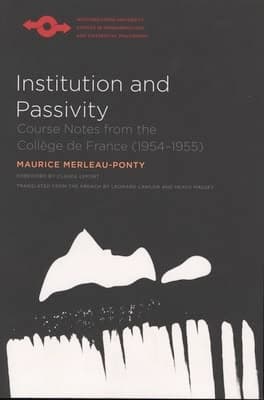
Institution and Passivity: Course Notes from the Collège de France (1954–1955)

Merleau-Ponty's central project in these lecture notes is to think institution and passivity together, connecting the passive constitution of meaning to the dimension of history. Institution names events that endow experience with lasting dimensions, so that later events take on meaning only relative to them. Passivity is not the opposite of activity but another modality of our relation to the world, persisting in sleep, dreams, and memory. The notes complete arguments begun in The Visible and the Invisible and Signs, and mark a decisive turn toward a new ontology.
Key Insights
✦What is the central claim of Institution and Passivity, and what does it reject?
The central claim is that institution and passivity must be thought together. Institution names events that endow experience with lasting dimensions, so that other events acquire meaning only relative to them; passivity is not a state opposed to activity but another modality of our relation to the world, one that persists in sleep, dreams, and the forgotten mechanisms of memory . The notes connect the passive constitution of meaning with the dimension of history, completing arguments begun in The Visible and the Invisible and Signs . Merleau-Ponty rejects the Husserlian intentional model and the phenomenological concept of constitution as sufficient, opening instead onto an ontology in which consciousness is plural, culturally situated, and diffracted .
✦What is the publication and editorial history of these lecture notes?
The course was taught at the Collège de France in 1954–1955, near the end of Merleau-Ponty's life. The French text was first published as L'Institution–La Passivité: Notes de cours au Collège de France (1954–1955) by Éditions Belin in Paris in 2003 . The text was established by Dominique Darmaillacq, Claude Lefort, and Stéphanie Ménasé, with a foreword by Lefort . The English translation by Leonard Lawlor and Heath Massey was published by Northwestern University Press in 2010 . The volume runs xxxvi + 276 pages and includes the course summary, reading notes, and an appendix on the Freudian unconscious .
✦How do these notes relate to The Visible and the Invisible?
The course notes are a critical transitional text that completes and furthers arguments begun in The Visible and the Invisible . Merleau-Ponty was working on both projects in the same period, and the notes show him developing the ontological vocabulary—institution, passivity, the flesh—that would dominate his final unfinished work. The notes on 'For an Ontology of the Perceived World' and on sleep, dreams, and memory extend the analysis of reversibility and the flesh into domains The Visible and the Invisible had not fully treated. Reading the two together gives a fuller picture of the direction Merleau-Ponty's thought was taking at the time of his death, and of the problems he had not yet resolved.
✦What role does psychoanalysis play in the course, and how does Merleau-Ponty treat Freud?
The second half of the course is devoted to 'The Problem of Passivity,' with extensive analyses of sleep, the unconscious, memory, dreams, and delusions. Merleau-Ponty engages closely with Freud, including the case of Dora and the Gradiva delusion, and the volume includes an appendix of three notes on the Freudian unconscious . His treatment is neither orthodox Freudianism nor a dismissal: he is interested in psychoanalysis as a phenomenology of passivity, a domain in which consciousness is not master of itself. The notes show him working through the relationship between phenomenological description and psychoanalytic explanation, a theme that had occupied him since the 1940s and that becomes central to his late ontology of the flesh and the unconscious.
✦How has the publication of these notes changed the reception of Merleau-Ponty's late work?
The posthumous publication of the course notes has significantly enriched scholarly understanding of Merleau-Ponty's final years. Anne Gléonec's 2017 study, Institution et passivité: lectures de M. Merleau-Ponty, argues that in these 'curiously little commented texts' Merleau-Ponty was able to think history and politics together in a way that much phenomenology had failed to do, and that the notes announce a surprising dialogue with Heidegger . Rajiv Kaushik has drawn on the notes to argue that Merleau-Ponty's late thought develops a radical conception of the symbolic form as ontological divergence . The notes are now recognized as indispensable for understanding the trajectory of his thought, not merely as a supplement to the published works.
✦What is a common misconception about the course's status?
A frequent misconception is that these are polished lectures comparable to Merleau-Ponty's published books. They are course notes, not a finished text. The editors had to establish the text from manuscripts, and the style is exploratory, digressive, and sometimes provisional. A Douban reader described the experience of reading them as 'dazzling' but also noted the density and range of references, which can make the notes difficult to follow without familiarity with the authors Merleau-Ponty engages . The notes are valuable precisely because they show thought in motion—Merleau-Ponty testing ideas, criticizing Sartre and Lévi-Strauss, and working through problems he had not yet resolved. Reading them as a systematic treatise would misrepresent their character and their interest.
Wealthy Psyche is an intellectual archive. We do not host, distribute, or sell book copies — physical or digital. We provide structured knowledge to help you think better, faster.