


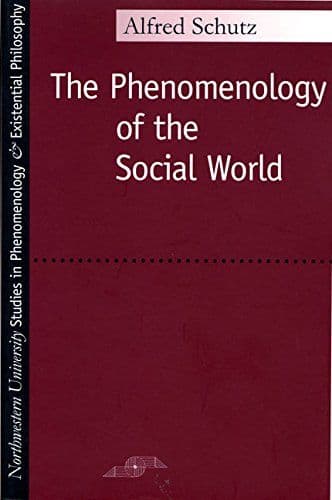
The Phenomenology of the Social World
Schutz's central project is to provide a philosophical foundation for Max Weber's interpretive sociology by analyzing how social meaning is constituted in consciousness. He argues that Weber presupposed rather than explained the sharing of subjective meaning, and that a phenomenological account of the natural attitude is required to show how actors come to understand one another. The book develops the distinction between 'because-motives' and 'in-order-to-motives,' analyzes the face-to-face We-relationship as the foundation of intersubjectivity, and introduces the 'stock of knowledge at hand' through which everyday actors interpret their world.
Key Insights
✦What is the central claim of The Phenomenology of the Social World, and what does it reject?
Schutz's central claim is that Max Weber's interpretive sociology lacks an adequate philosophical foundation because it assumes rather than explains how actors come to share subjective meanings. Schutz argues that the problem of intersubjectivity—how a plurality of interacting individuals creates and maintains a common subjective world—is the most important social reality, and that it must be analyzed phenomenologically . He rejects Weber's failure to explore why and through what processes actors acquire common subjective states, and he rejects the attempt to understand others through conceptual types rather than in their actual subjective meaning . The book provides a Husserlian analysis of human action and its intended meaning as the groundwork Weber presupposed.
✦How does Schutz's use of Husserl differ from Husserl's own transcendental project?
Schutz accepts Husserl's analyses of consciousness, intentionality, and the natural attitude, but he does not follow Husserl into the transcendental reduction. Where Husserl sought to constitute intersubjectivity within the transcendental ego, Schutz treats intersubjectivity as a given datum of the natural attitude: we are born into a world already shared with others, and the We-relationship is the foundational structure of social experience . This departure is significant because it shifts phenomenology from a search for apodictic foundations to a descriptive analysis of the life-world as it is actually lived. Schutz's 'mundane' phenomenology thus serves sociology rather than transcendental philosophy, though critics have questioned whether this move leaves his position internally coherent.
✦What is the distinction between 'because-motives' and 'in-order-to-motives'?
Schutz distinguishes two ways actors explain their conduct. An 'in-order-to motive' refers to the future state of affairs the actor aims to bring about: I open the umbrella in order to stay dry. A 'because-motive' refers to the past experiences or dispositions that explain why the actor has this project: I open the umbrella because I was caught in a downpour yesterday and dislike getting wet . The distinction is central to Schutz's analysis of action because it shows that the meaning of an act is not a single thing but depends on the temporal perspective from which it is interpreted. The actor living through the act grasps it in terms of in-order-to motives; the observer or the actor looking back grasps it in terms of because-motives.
✦What is the 'stock of knowledge at hand,' and how does it structure social experience?
The stock of knowledge at hand is Schutz's term for the sum of rules, social recipes, conceptions of appropriate conduct, and information that individuals carry in their minds and use to orient themselves in the social world . This knowledge is learned through socialization within a common social and cultural world, and it becomes the 'paramount reality' for actors within that world. It is rarely an object of conscious reflection; rather, it operates as an implicit set of assumptions and procedures that silently guide interaction. The stock of knowledge enables the 'reciprocity of perspectives'—the assumption that others share my stock of knowledge—and it facilitates 'typification,' the process by which actors treat each other as typical categories rather than as unique individuals .
✦What is the translation history of the English edition, and how was it received?
The English translation was published in 1967 by Northwestern University Press as part of the Northwestern University Studies in Phenomenology and Existential Philosophy, translated by George Walsh and Frederick Lehnert with an introduction by Walsh . It was reviewed in the American Political Science Review by Hwa Yol Jung in 1968 and in the American Sociological Review by Egon Bittner in the same year . The translation made Schutz's major work accessible to English-speaking sociologists and philosophers, and it is the standard edition through which the book is known in the Anglophone world. The German original, Der sinnhafte Aufbau der sozialen Welt, was published in Vienna by Springer in 1932 .
✦How does the book relate to Schutz's later Collected Papers?
The Phenomenology of the Social World is the systematic foundation on which Schutz's later essays build. The Collected Papers, published posthumously in three volumes, apply and extend the framework developed in the 1932 book to new domains: relevance structures, multiple realities, symbol and society, and the methodology of the social sciences. Schutz continued to develop the analysis of the life-world and the stock of knowledge throughout his career, but the basic conceptual apparatus—the We-relationship, typification, motives, and the natural attitude—was laid out in this first book. The later essays are best read as elaborations and applications of the programme announced here, not as departures from it.
✦What is a common misconception about Schutz's relationship to Weber?
A frequent misconception is that Schutz was simply a Weberian who added phenomenological vocabulary to interpretive sociology. In fact, Schutz's relationship to Weber was critical. He admired Weber's attempt to found sociology on the subjective meaning of social action, but he argued that Weber never explained how actors actually come to share meanings . Weber assumed Verstehen (understanding) as a method without analyzing the constitutive processes of consciousness that make understanding possible. Schutz's book is therefore not an application of Weber's framework but a radical deepening of its foundations—an attempt to trace 'the roots of the social-scientific problematic back to the fundamental facts of conscious life' .
Wealthy Psyche is an intellectual archive. We do not host, distribute, or sell book copies — physical or digital. We provide structured knowledge to help you think better, faster.