


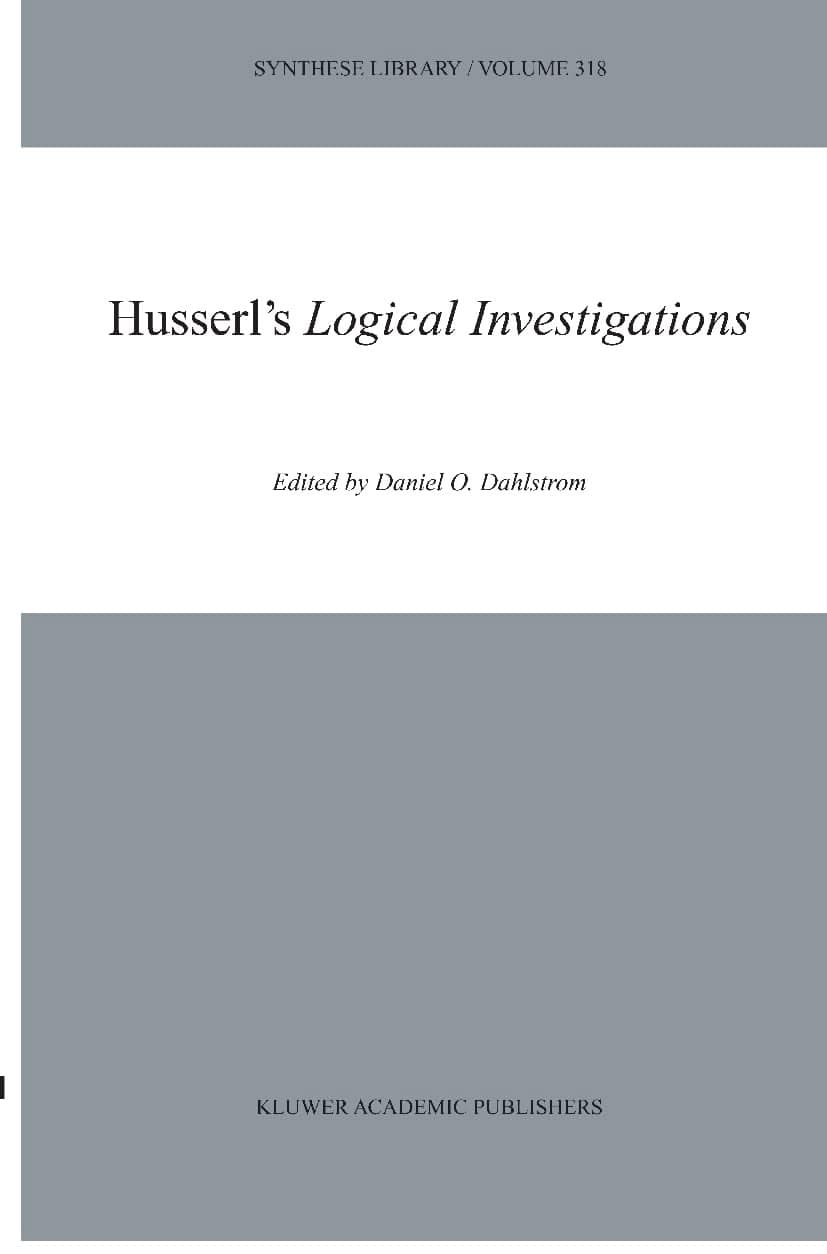
Logical Investigations
Husserl's central claim is that logic is an a priori, ideal science whose laws cannot be reduced to psychological regularities. The Prolegomena refutes psychologism by distinguishing the ideal unity of logical laws from the real flow of mental acts, while the six Investigations that follow develop a descriptive phenomenology of meaning, intention, and knowledge. Husserl introduces the crucial concept of categorical intuition—the direct givenness of states of affairs and logical forms—arguing that thought is fulfilled in intuition, not merely in empty signification. The work establishes phenomenology as the foundational science for logic and knowledge.
Key Insights
✦What is the central claim of Logical Investigations, and what does it reject?
The central claim is that logic is an a priori, ideal science whose laws are objectively binding and cannot be reduced to descriptions of how we happen to think. The Prolegomena to Pure Logic refutes psychologism—the view that logical laws are empirical generalizations about mental processes—by arguing that such a reduction makes logical validity relative to human psychology and undermines the very possibility of truth . Husserl rejects the assumption that philosophy of logic must begin with psychology, insisting instead that the ideal unity of meanings and logical laws requires a phenomenological analysis of the acts through which they are grasped. The Investigations that follow develop this analysis as a descriptive phenomenology of meaning, intention, and knowledge.
✦What is categorical intuition, and why is it the most influential concept from the Sixth Investigation?
Categorical intuition (kategoriale Anschauung) is Husserl's account of how we directly apprehend states of affairs and logical forms, not merely sensory objects. When I see that the paper is white, I do not merely see the paper and the whiteness separately; I grasp the 'being-white' of the paper as a state of affairs. This grasp is an intuition—it is given, not merely thought—but it is founded on sensory intuition without being reducible to it. Heidegger famously celebrated the Sixth Investigation for this discovery, seeing in it a breakthrough beyond the metaphysics of presence . The concept was crucial for later phenomenology, influencing Heidegger's own account of truth and Merleau-Ponty's analysis of expression.
✦What is the publication history of the work, and how did the second edition change it?
The Logical Investigations was first published in two volumes in 1900 and 1901 by Max Niemeyer in Halle . The first volume contains the Prolegomena to Pure Logic; the second contains the six Investigations. A second German edition appeared in 1913 (Volume 1 and Volume 2, Part 1) and 1921 (Volume 2, Part 2), with substantial revisions, particularly in the Sixth Investigation . Husserl's thought had shifted toward transcendental idealism in the intervening years, and the second edition reflects this development, though he retained the essential framework of the first. The English translation by J. N. Findlay, based on the second German edition, was published in 1970 by Routledge & Kegan Paul .
✦How was Logical Investigations received, and what was Bertrand Russell's reaction?
Reception was immediate and significant, particularly among philosophers working on logic and language. Bertrand Russell proposed to review the work for Mind in 1917, though the review was never completed; a friend described the task as 'very much like trying to swallow a whale' . The work was recognized as a decisive refutation of psychologism and a major contribution to the theory of meaning and pure logical grammar . Husserl himself considered it his 'breakthrough' to phenomenology . Its influence extended beyond phenomenology into linguistics, cognitive science, and the analytic tradition, partly because it predated the split between analytic and continental philosophy and remains of interest to those seeking a rapprochement between the two .
✦What is the relationship between Logical Investigations and Husserl's later transcendental phenomenology?
The Logical Investigations is often described as the 'breakthrough' work, but it is not yet the transcendental idealism of Ideas I (1913). In the Investigations, Husserl develops a descriptive phenomenology of intentional acts and their correlates without the transcendental reduction. Some scholars argue that the work contains unresolved tensions that led Husserl to the transcendental turn. One analysis contends that Husserl did not succeed in providing the phenomenological supplementation his account of logic required, because he excluded intentional objects from the domain of phenomenological descriptions in the second volume; the transcendental turn should be understood as an attempt to overcome this incoherence . Whether this is the correct reading remains debated, but the Investigations are indispensable for understanding the genesis of Husserl's mature position.
✦What is a common misconception about the Investigations' relationship to psychology?
A frequent misconception is that Husserl's critique of psychologism amounts to a rejection of psychology or of any appeal to consciousness. This is not the case. Husserl's target is psychologism as a theory of logic—the claim that logical laws are empirical laws of thinking. He does not deny that thinking is a psychological process; he denies that the validity of logic can be explained by that process. The Investigations themselves contain extensive phenomenological analyses of conscious acts, which Husserl distinguishes sharply from psychological description. The work is thus not anti-psychological but anti-psychologistic: it insists that the ideal content of thought cannot be reduced to its real occurrence in a mental life, while still requiring a descriptive science of consciousness to account for how ideal meanings are grasped.
Wealthy Psyche is an intellectual archive. We do not host, distribute, or sell book copies — physical or digital. We provide structured knowledge to help you think better, faster.