


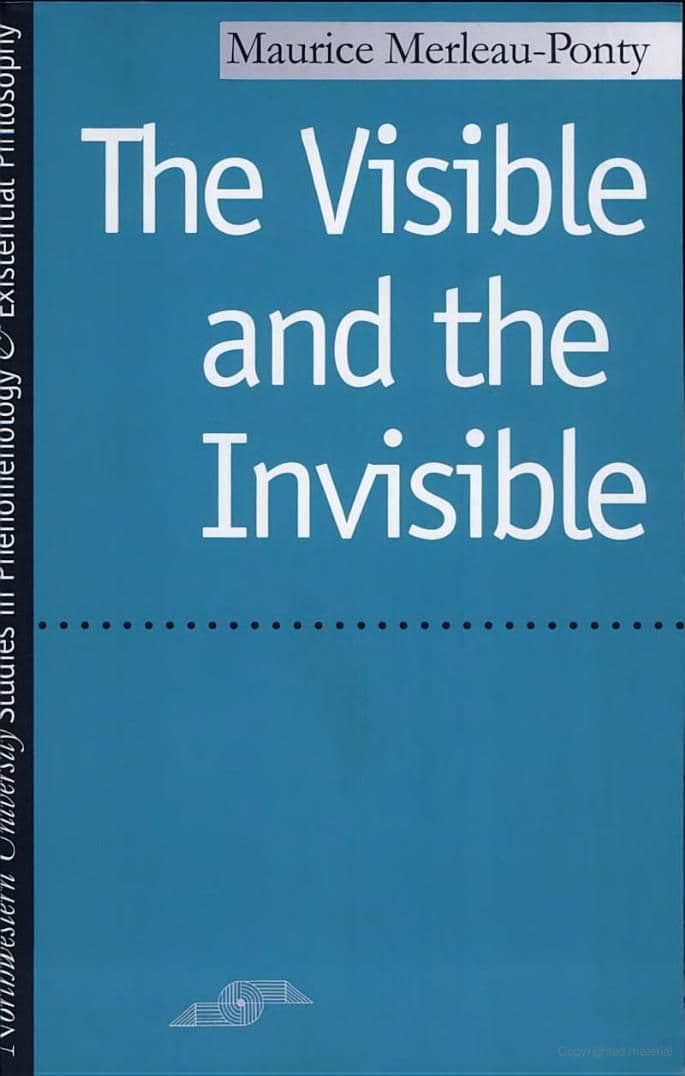
The Visible and the Invisible: Followed by Working Notes

Merleau-Ponty's unfinished final work develops an ontology of the flesh, arguing that the visible and the invisible are not opposites but intertwining dimensions of a single fabric of being. The seer and the seen are reversible: my hand that touches is also touchable, and this chiasm between sentient and sensible is the condition of both perception and intersubjectivity. The book abandons the subject-centered framework of his earlier phenomenology for a conception of being in which the flesh of the body and the flesh of the world are woven from the same texture, and meaning emerges from this dehiscence rather than from a constituting consciousness.
Key Insights
✦What is the central claim of The Visible and the Invisible, and what does it reject?
The central claim is that being is not divided into subjects and objects, consciousnesses and things, but is instead a single fabric of flesh in which the visible and the invisible intertwine. The seer and the seen are reversible: my hand that touches is also touchable, and this chiasm between sentient and sensible is the condition of both perception and intersubjectivity . Merleau-Ponty rejects the subject-centered framework of his earlier Phenomenology of Perception. The doctrine of intentionality is displaced by a concept of the flesh understood as a relation of tactility that precedes and informs intersubjective relations, necessarily disorienting a subject-centered account . The flesh is not something one has but the web in which one lives, the condition of possibility of touch that exceeds any given touch .
✦What is the 'flesh' (chair), and how does it differ from the body of the earlier philosophy?
The flesh is Merleau-Ponty's ontological concept for the shared texture of body and world. In Phenomenology of Perception, the body was the site of motility and spatiality that subtends intentionality. In The Visible and the Invisible, the flesh is not simply the body but the elemental medium in which body and world are intertwined: 'this flesh of my body is shared by the world, the world reflects it, encroaches upon it and it encroaches upon the world' . The flesh of the world refers to the world insofar as it is both sensible and meaningful, while the flesh of the body picks out the human being who belongs to the world. There is symmetry in their sensibility but asymmetry in that the body is sentient while the world is not .
✦What is the chiasm, and why is it the book's central figure?
The chiasm is the figure of intertwining and reversibility that structures Merleau-Ponty's ontology. It names the relation between the visible and the invisible, the sentient and the sensible, the touching and the touched. The final completed chapter, 'The Intertwining—The Chiasm,' moves from the reciprocal intertwining of body and world to the Ineinander of temporality . The chiasm is not a synthesis or a unity but a divergence that makes relation possible: there is a 'fundamental fission or segregation of the sentient and the sensible' that is productive and revelatory, allowing perception to occur . The concept was influential beyond phenomenology, informing later work in aesthetics, embodiment studies, and post-structuralist thought.
✦What is the publication and editorial history of the work, given that it is unfinished?
The Visible and the Invisible is Merleau-Ponty's unfinished final work. At his death in 1961, he left approximately 150 handwritten pages that were to constitute the first chapters of a larger work, along with extensive working notes for its continuation . Claude Lefort edited the manuscript and the notes, and the French edition was published by Gallimard in 1964 . The English translation by Alphonso Lingis was published by Northwestern University Press in 1968, with the title The Visible and the Invisible: Followed by Working Notes . The volume runs lvi + 282 pages and includes Lefort's editorial apparatus and the working notes, which are essential for understanding the direction the unfinished book was taking .
✦How has the book been received, and what are the main criticisms?
The book has been enormously influential, particularly in continental philosophy, aesthetics, and embodiment studies, but its unfinished character has invited criticism. Some commentators argue that Merleau-Ponty's later work fails to resolve the tensions of the earlier Phenomenology of Perception; the fundamental ambiguity remains whether the world is the universal body that absorbs my body, or my body which is the world . Others have argued that the flesh lacks the properly symbolic dimension, and that Merleau-Ponty is forced to reintroduce the notion of consciousness precisely because his ontology of the flesh cannot account for the active dimension of the subject . The working notes show Merleau-Ponty himself struggling with these problems, and the book's incompleteness is both its limitation and its generative power.
✦What is a common misconception about the book's relationship to phenomenology?
A frequent misconception is that The Visible and the Invisible is a straightforward continuation of Merleau-Ponty's earlier phenomenological project. In fact, the book marks a decisive break with the philosophy of consciousness that had animated Phenomenology of Perception. Merleau-Ponty's working notes explicitly announce the need for a 'new ontology' and express dissatisfaction with the vocabulary of consciousness, subject, and object . The concept of flesh is designed to displace these categories, not to refine them. The book is post-phenomenological in the sense that it seeks a foundation more primordial than the intentionality of a constituting subject. Reading it as a simple extension of the earlier work misses the radical nature of the ontological turn it announces.
Wealthy Psyche is an intellectual archive. We do not host, distribute, or sell book copies — physical or digital. We provide structured knowledge to help you think better, faster.