


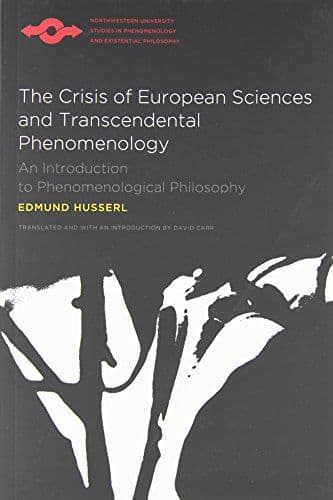
The Crisis of European Sciences and Transcendental Phenomenology: An Introduction to Phenomenological Philosophy
Husserl's central claim is that the sciences are in crisis because they have forgotten the life-world—the pre-given, taken-for-granted ground of all experience from which scientific idealizations arise. The mathematization of nature inaugurated by Galileo alienated scientific truth from the everyday world of lived meaning, producing an objectivism that cannot account for the knowing subject. Husserl argues that only a transcendental phenomenology that inquires back from the life-world can restore reason's self-understanding and answer the crisis, which is ultimately a crisis of European humanity's faith in reason itself.
Key Insights
✦What is the central claim of The Crisis, and what does it reject?
The central claim is that the modern sciences are in crisis because they have lost touch with the life-world (Lebenswelt)—the pre-given, intersubjective ground of all experience from which scientific idealizations emerge . Husserl rejects the objectivism that treats scientific truth as a realm of facts wholly independent of the knowing subject, arguing that this view cannot account for the very subjectivity that produces science . The crisis is not a crisis of scientific progress but of meaning: the sciences have become alienated from the everyday world of lived experience, and this alienation threatens the possibility of rational self-understanding. The remedy is a transcendental phenomenology that inquires back from the life-world to the constituting subjectivity that grounds it.
✦What role does Galileo's mathematization of nature play in the argument?
Galileo's mathematization of nature is the pivotal historical event in Husserl's diagnosis. Husserl argues that Galileo treated the mathematically idealized world of geometry and physics as the true world, while the life-world of everyday perception was relegated to mere subjective appearance . This inversion—treating the abstract construct as more real than the ground from which it was abstracted—is the origin of the crisis. Husserl does not deny the validity of mathematical science; he denies that it is self-sufficient. The idealizations of physics are meaningful only as products of human intentional activity, and when that origin is forgotten, the sciences lose their capacity to illuminate human existence.
✦How was the text published, given that Husserl died before completing it?
The Crisis is an unfinished work. Husserl published parts I and II in the Belgrade journal Philosophia in 1936, but the work was incomplete at his death in 1938 . Walter Biemel edited the posthumous manuscripts and published the expanded text in 1954 as volume VI of the Husserliana critical edition . This edition includes the Vienna Lecture, supplementary texts, and Fink's appendix on the unconscious . The English translation by David Carr was published by Northwestern University Press in 1970 . The text's unfinished character means it is more a book project than a completed treatise, and its fragmentary structure has invited diverse interpretations .
✦What is the life-world, and why had it never been a topic of inquiry before?
The life-world is the pre-given, always taken-for-granted world of everyday experience—the world in which we live, perceive, act, and communicate with others before any scientific theorizing . Husserl argues that it had never become a topic of inquiry because it is the ground of all inquiry, the horizon within which every question arises. Science presupposes the life-world but cannot thematize it from within its own objectivist framework. Even Kant, Husserl notes, did not inquire into the life-world's constitutive role . Phenomenology's task is to make this forgotten ground visible, showing how the objective world of science is constituted through the anonymous functioning of transcendental subjectivity.
✦How does the Crisis relate to Husserl's earlier Ideas I and the transcendental reduction?
The Crisis represents a significant shift in Husserl's presentation of transcendental phenomenology. In Ideas I (1913), the epoché was introduced as a turn inward to pure consciousness. In the Crisis, Husserl introduces the 'way through the life-world' (Lebenswelt) as an alternative path to the transcendental reduction . Rather than bracketing the world entirely, this approach begins from the world as given in everyday experience and inquires back to the subjective achievements that constitute it. This shift reflects Husserl's growing concern with history, intersubjectivity, and the social dimensions of knowledge—themes that were marginal in his earlier work but become central in his final years .
✦How was the Crisis received, and how did it change the interpretation of Husserl?
The Crisis was generally welcomed as a considerable advance over Husserl's previous publications in depth, range, and clarity . Its posthumous publication in 1954 decisively changed the prevailing interpretation of Husserl's phenomenology. Where earlier readings—promulgated even by Heidegger—saw Husserl as a narrow, solipsistic Cartesian philosopher of consciousness, the Crisis revealed a thinker concerned with intersubjectivity, personhood, social experience, and the 'mundane' life-world . Ludwig Landgrebe presented the late Husserl as departing from Cartesianism. The work's influence extends beyond phenomenology into social theory, philosophy of science, and critiques of modernity, and its concept of the life-world has become one of Husserl's most widely appropriated ideas.
Wealthy Psyche is an intellectual archive. We do not host, distribute, or sell book copies — physical or digital. We provide structured knowledge to help you think better, faster.