


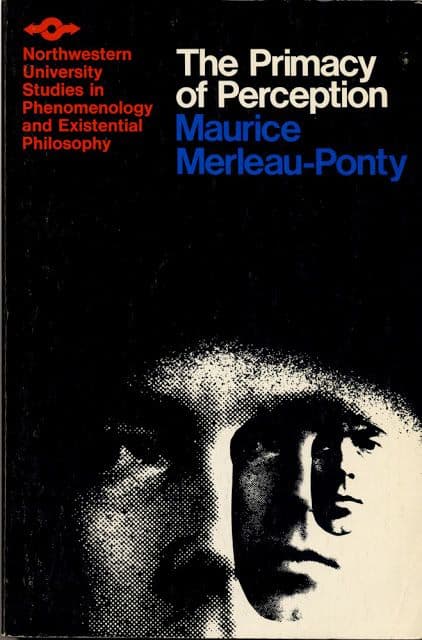
Phenomenology of Perception
Merleau-Ponty's central claim is that the lived body is the primary subject of perception, not a constituting consciousness or a physiological machine. Perception is neither an intellectual judgment nor a passive reception of sensory atoms but a motor intentional engagement with a world that is already meaningful. The body schema—the sub-reflective organization of posture and movement—gears us into situations before any explicit thought. The book argues that ambiguity is not a failure of knowledge but the very structure of existence, and that the transcendental and the empirical are intertwined in the body's being-in-the-world.
Key Insights
✦What is the central claim of Phenomenology of Perception, and what does it reject?
The central claim is that the lived body is the primary subject of perception, not a pure consciousness or a physiological mechanism. Perception is a motor intentional engagement with a world that is already meaningful, and the body schema organizes posture and movement before any explicit reflection . Merleau-Ponty rejects both intellectualism, which treats perception as a judgment performed by a constituting ego, and empiricism, which treats it as a passive reception of discrete sensations . He argues that these two positions are symmetrical failures: each rigidifies one pole of the perceptual relation and ignores the movement between them. The book's method is to inhabit each attitude from within, show its internal deadlock, and thereby open the space for a phenomenological description of embodied existence.
✦What is the body schema, and why is it central to the argument?
The body schema (schéma corporel) is Merleau-Ponty's term for the sub-reflective, pre-personal organization of posture, movement, and perceptual field. It is not a representation of the body but the body's active capacity to gear into situations, organizing our postures and milieus projectively toward the fulfilment of tasks . The body schema is central because it explains how perception can be meaningful without being intellectual: the body understands situations motorically before consciousness thematizes them. The Schneider case, a patient with impaired motor intentionality outside habitual situations, is Merleau-Ponty's key evidence that this schema is distinct from both reflex mechanics and explicit thought . The concept has been enormously influential in embodied cognition research and phenomenology of the body.
✦How does the book relate to Husserl's phenomenology?
The book extends Husserl's project while decisively transforming it. Merleau-Ponty adopts Husserl's call to return to the things themselves and his analyses of intentionality and the life-world, but he rejects the transcendental ego as the ultimate subject of constitution. For Merleau-Ponty, the one and only subject of perception is the body itself—not the soul, the mind, or any pure ego . He also reads Husserl through existential and Heideggerian spectacles, reconciling Husserl's analyses with Heidegger's account of being-in-the-world and ready-to-hand equipment . The result is a phenomenology that is existential rather than purely transcendental: the body is both transcendental (constituting the structures of the perceived world) and empirical (a natural, evolved capacity), and this ambiguity is irreducible .
✦What is the significance of the book's treatment of ambiguity?
Ambiguity is not a defect to be overcome but the very structure of existence. Merleau-Ponty argues that our being is natural and conventional, somatic and spiritual, conditioned and free, and these dimensions cannot be split into discrete elements through analysis . The body is ambiguous in being both a transcendental condition of experience and an empirical object within the world. The book's style enacts this ambiguity: it moves between intellectualism and empiricism without settling into a third position that would abolish the tension. The authentic philosopher, Merleau-Ponty suggests, possesses 'the taste for evidence and the feeling for ambiguity' inseparably . This emphasis on irreducible indeterminacy distinguishes his phenomenology from Sartre's dualism of being and nothingness and from Husserl's ideal of apodictic science.
✦What is the publication and translation history of the work?
Phenomenology of Perception was first published in French as Phénoménologie de la perception by Librairie Gallimard in Paris in 1945 . The first English translation, by Colin Smith, was published in 1962 by Routledge & Kegan Paul in London and Humanities Press in New York . This translation was revised by Forrest Williams in 1981 and remained the standard English edition for fifty years, though it was widely criticized for failing to capture Merleau-Ponty's precise philosophical arguments . A new translation by Donald A. Landes was published by Routledge in 2012, the first for over fifty years, with a translator's introduction, explanatory notes, and restored subtitles from Merleau-Ponty's original table of contents . The Landes translation is now the preferred scholarly edition in English.
✦What is a common misconception about the book's relationship to science?
A frequent misconception is that Merleau-Ponty is anti-science or that his phenomenology rejects empirical research. In fact, the book draws extensively on physiology, neurology, and psychology—including the Schneider case, phantom limb syndrome, and Gestalt psychology . Merleau-Ponty's target is not science as such but objectivist thought, which privileges explanation over description and hides the primary validity of lived experience beneath theoretical constructions . Science provides material for phenomenological research, but it cannot replace the description of the perceived world from which its abstractions arise. The book's engagement with cognitive science has been a major theme in recent reception, with scholars debating whether Merleau-Ponty's account of motor intentionality anticipates or challenges embodied cognition research .
Wealthy Psyche is an intellectual archive. We do not host, distribute, or sell book copies — physical or digital. We provide structured knowledge to help you think better, faster.