


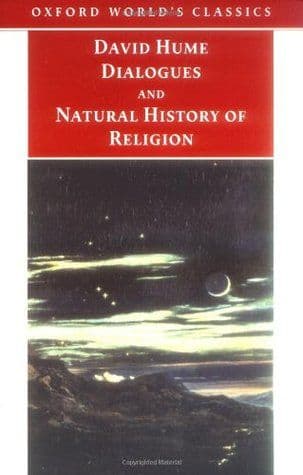
Dialogues Concerning Natural Religion
Hume's final philosophical work stages a three-way debate among Cleanthes, Demea, and Philo over whether reason can establish anything about God's nature. The central mechanism is the critique of the argument from design: Cleanthes' appeal to cosmic order as evidence of an intelligent designer is met by Philo's insistence that analogies from human artifacts to the universe are too weak to support any substantive conclusion. The dialogue form itself is part of the argument, allowing Hume to withhold his own voice while exposing the instability of natural theology. The work closes not with refutation but with a mitigated skepticism that confines religion to sentiment rather than knowledge.
Key Insights
✦What is the central claim of the Dialogues, and what does it reject?
The Dialogues argue that reason and experience cannot establish any substantive conclusions about God's nature or attributes. Through Philo, Hume systematically dismantles Cleanthes' argument from design: the analogy between the universe and human artifacts is too weak to support inference to an intelligent, benevolent creator. Hume rejects natural theology's central pretension—that empirical evidence of order in the world licenses knowledge of a designer's character. The work also rejects dogmatic atheism, since Philo concedes that some order in the universe may have a cause, but insists that this cause is entirely unknown. The conclusion is a mitigated skepticism: religion may be felt, but it cannot be known.
✦How does the dialogue form function as part of Hume's argument?
Hume adopted the dialogue form partly for protection in a hostile climate and partly to give a fair hearing to the views under consideration . But the form also does philosophical work: by distributing arguments among Cleanthes, Demea, and Philo, Hume avoids committing himself to any single position, leaving readers to judge which arguments survive scrutiny. This has produced a notorious interpretive problem—John Bricke notes that the Dialogues has been subject to an exceptional number of mutually contradictory interpretations, with scholars disagreeing about whether Hume is a skeptic, an atheist, or even a defender of some minimal theism . The dialogue's polyphony is not evasion but a deliberate device for exposing the limits of dogmatic certainty on all sides.
✦Why was the Dialogues published posthumously, and what does its publication history reveal?
Hume composed the Dialogues in the early 1750s but was persuaded not to publish them during his lifetime, though he was anxious that they should appear after his death . He entrusted the manuscript to Adam Smith with a bequest of £200, but Smith feared public outrage and passed the task to the publisher William Strahan, who also hesitated. Hume then arranged for his nephew David Hume Jr. to receive a copy with instructions to publish if the work had not appeared within two and a half years of his death . The nephew finally published it in 1779, without the author's or publisher's name on the title page . The feared storm of indignation never arrived, largely because Hume had skillfully obscured his own views behind the dialogue form .
✦How does the Dialogues relate to Hume's Natural History of Religion?
The two works attack religion from complementary angles. The Natural History of Religion (1757) offers a naturalistic account of why people believe: religion originates in fear and ignorance, and polytheism precedes monotheism. The Dialogues, by contrast, addresses the rational justification of belief, showing that the argument from design cannot support any substantive theism. Together they constitute a two-pronged critique: the Natural History explains belief's psychological causes, while the Dialogues undermines its intellectual credentials. Hume's concerns with religion run from the Treatise through the Enquiries and the Natural History, culminating in the posthumous Dialogues . Readers seeking Hume's full philosophy of religion must consult both works, since neither alone captures the scope of his critique.
✦What is the interpretive dispute about Philo's role, and why does it matter?
The central interpretive puzzle is whether Philo speaks for Hume. Many contemporaries took Philo to be Hume's mouthpiece for atheism, and D. Z. Phillips notes that most philosophers regard the Dialogues as 'the most devastating critique of religion in the history of philosophy' . But Philo makes concessions at the end, acknowledging that some cause of order exists, and the text resists any simple identification of author with character. Norman Kemp Smith argued that Philo's theistic remarks are ironic cover, while others have defended a more cautious reading. The dispute matters because it determines whether Hume is a thoroughgoing skeptic, a minimalist deist, or something more elusive. John Bricke's observation that the Dialogues has generated radically incompatible readings remains a warning against overconfident interpretation .
✦How has the argument from design been affected by later developments, particularly Darwinian evolution?
Cleanthes' argument from design—that the order of the universe implies an intelligent designer—was the dominant natural theology of Hume's time. Darwin's theory of evolution by natural selection provided a purely natural mechanism for apparent design in biological organisms, undercutting the need for a designer to explain adaptation. John Beatty's contribution to a recent Cambridge critical guide examines the relationship between Darwin and Hume's Dialogues, suggesting that Hume's critique anticipated some of the conceptual space later occupied by evolutionary explanation . Hume did not, of course, foresee Darwin, but his insistence that order can arise without intelligent planning, and that analogies from human artifacts to cosmic order are weak, prepared the ground for later naturalistic accounts.
✦What is a common misconception about the Dialogues' conclusion?
A frequent misreading treats the Dialogues as concluding that God does not exist. In fact, Philo explicitly concedes that the existence of some cause of the universe is not in question; what he denies is that reason can determine anything about that cause's nature or attributes. As one commentator puts it, Philo challenges theology's capacity to assign any characteristics to God by reason and experience alone, not the bare existence of a deity . The work's target is natural religion—the attempt to establish theological truths through rational argument—not the bare affirmation that something exists. Hume's skepticism is epistemological rather than metaphysical: the question is what we can know, and his answer is that on this subject we can know nothing substantive.
Wealthy Psyche is an intellectual archive. We do not host, distribute, or sell book copies — physical or digital. We provide structured knowledge to help you think better, faster.