


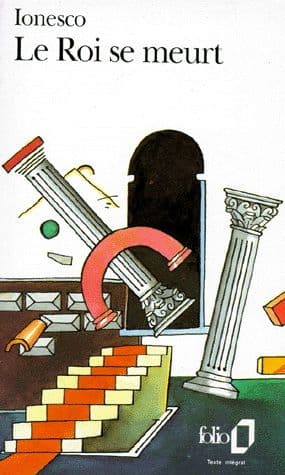
Exit the King (Le Roi se meurt)
Exit the King is the third of Ionesco's Bérenger plays, a ritualistic death-tire in which the 400-year-old King Berenger is informed he has ninety minutes to live—the exact length of the play. The drama's central mechanism is depletion rather than accumulation: the kingdom crumbles, characters vanish one by one, and language itself thins as the monarch is stripped of every defense against mortality. Where Ionesco's earlier plays pile up objects and absurdities, this one subtracts, forcing the audience to watch a man learn to die in real time.
Key Insights
✦What is the central mechanism of Exit the King, and how does it invert Ionesco's usual method?
The play's mechanism is depletion. Where Ionesco's earlier works—The Chairs, Amédée, Rhinoceros—accumulate objects, characters, or absurdities until the stage is overwhelmed, Exit the King moves in the opposite direction. The kingdom crumbles, the courtiers disappear one by one, and Berenger's physical and linguistic capacities shrink until he is alone with Marguerite and finally vanishes into darkness . The play begins with a diagnosis: the Doctor informs Berenger he has ninety minutes left, which is precisely the length of the performance . The audience watches a man die in real time, and the theatrical experience is inseparable from the existential lesson. This formal choice makes Exit the King Ionesco's most Beckettian play, as Les Essif has argued .
✦Why did Ionesco write Exit the King, and how did his own fear of death shape it?
Ionesco said the play did not originate in a dream, as many of his works did, but was consciously composed while he was ill and frightened of death . He described it as an attempt at an apprenticeship in dying: the conviction that one can learn to die and help others die, which he called the most important thing we can do since we are all dying people who refuse to die . This biographical context matters because the play is not a detached meditation on mortality but a rehearsal. Berenger's denial, his bargaining, his rage, and his final acquiescence follow a psychological trajectory Ionesco was tracing in himself. The play's linear structure and relatively straightforward language—unusual for Ionesco—reflect this conscious, therapeutic purpose.
✦How do Queen Marguerite and Queen Marie function as opposing forces in Berenger's death?
Marguerite, the first wife, is the martinet death doula. She operates in concert with the Doctor, insisting that Berenger face the timetable and accept his end . Marie, the second wife, is the enabler who shields him from the truth and tries to keep him from pain. The play's drama is played out between these two attitudes: confrontation and denial. Marguerite's cruelty is not sadistic but pedagogical—she understands that Berenger cannot die well unless he first admits he is dying. Marie's kindness is a form of collusion that prolongs the agony. Ionesco stacks the deck in Marguerite's favor: she is caustic and unsentimental, but she is also the one who remains with Berenger at the end, preparing him for the darkness.
✦How does the play's title function, and why does Ionesco give away the ending?
The French title, Le Roi se meurt, is a straightforward statement: The King Is Dying. The English title, Exit the King, foregrounds theatricality—an exit is what an actor makes, a stage direction, a departure . Both titles announce the ending, and this is deliberate. The play is not a suspense narrative; there is no question of whether Berenger will die. The question is how he will die, and whether he will learn anything before he does. Ionesco's refusal of suspense is a formal expression of his theme: death is the one certain fact of life, and pretending otherwise is the source of the absurdity the play dramatizes. The title tells the audience what the king spends the play refusing to hear.
✦How has Exit the King been received in major revivals, and what does that reception reveal?
The play has had a strange critical history. When it premiered on Broadway in 1968, Clive Barnes called it Ionesco's incomparably greatest work, yet it was seldom revived for four decades afterward . A 2009 Broadway revival starring Geoffrey Rush drew praise for its brutal comedy, with the New York Times describing Rush as both more entertaining and more frightening than the usual death-defying monster because the dying egomaniac onstage is recognizably the audience . A 2026 Los Angeles revival noted that the play's first half works as farce while the ending requires a fever-dream energy that productions often struggle to sustain . The pattern suggests that Exit the King is easier to admire than to perform: its structure is precise, but its tonal balance between comedy and terror is delicate.
✦What does Mircea Eliade's comment about the Tibetan Book of the Dead reveal about the play's philosophical sources?
The religious historian Mircea Eliade, a Romanian compatriot of Ionesco, said the play cannot be fully understood without knowledge of the Tibetan Book of the Dead and the Upanishads . This is a significant claim from a scholar of comparative religion. It suggests that Berenger's dissolution—the progressive loss of kingdom, senses, language, and self—follows a pattern found in Tibetan Buddhist descriptions of the dying process, where the elements of consciousness dissolve in sequence. Ionesco was not a Buddhist, but the play's structure borrows from these traditions a map of dying as a staged process of letting go rather than a single event. This frame makes the play less a psychological study of denial and more a ritual of liberation.
Wealthy Psyche is an intellectual archive. We do not host, distribute, or sell book copies — physical or digital. We provide structured knowledge to help you think better, faster.