


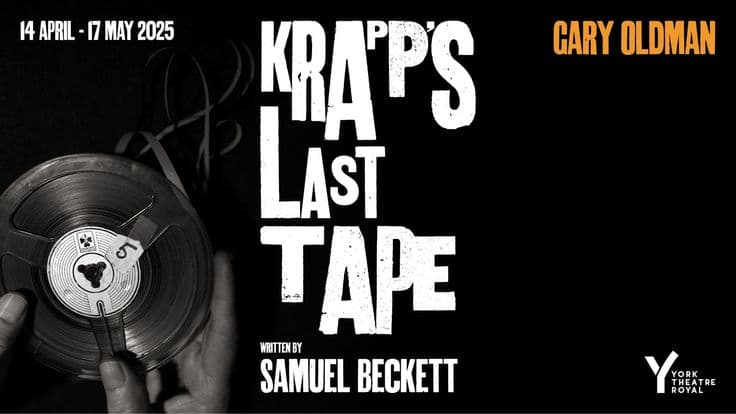
Krapp's Last Tape
Krapp's Last Tape is a one-act monodrama in which a sixty-nine-year-old man sits alone in a shabby room, listening to a tape recording his younger self made thirty years earlier. Its central mechanism is technological self-confrontation: the tape recorder allows Krapp to hold a dialogue with a past self who still possesses illusions of literary greatness and romantic fulfillment, while the present Krapp can only mock and envy him. The play's distinctive claim is that the self is not a continuous identity but a series of ruptures, and the tape is the instrument that makes this discontinuity audible—the young voice is confident, lyrical, and wrong about everything the old man now knows.
Key Insights
✦What is the central mechanism of Krapp's Last Tape, and what does it reject?
The play's mechanism is technological self-confrontation. Krapp, a sixty-nine-year-old man, sits alone in a room and listens to a tape he recorded thirty years earlier, when he was a younger, more hopeful writer. The tape recorder enables a dialogue between two versions of the same person, but the dialogue is one-sided: the young Krapp speaks with confidence and lyrical self-assurance, while the old Krapp can only listen, pause, mock, and rewind. What the play rejects is the assumption that memory provides continuity or consolation. The tape does not reunite Krapp with his past self; it demonstrates how completely that self has become other. The play's formal innovation—a single character in dialogue with a machine—becomes its philosophical argument: identity is not a thread but a series of breaks .
✦How did Beckett's own life and the play's composition history shape its meaning?
Beckett wrote Krapp's Last Tape in the spring of 1958 as a curtain-raiser for Endgame, and he had Patrick Magee in mind for the role from the beginning, referring to it privately as the 'Magee Monologue' . Beckett was moved by the cracked quality of Magee's Irish voice, which seemed to capture world-weariness and regret. The play contains many personal elements, and critics have read Krapp's 'vision' as a refraction of Beckett's own artistic crisis of 1946 . Beckett felt unusual affection for this play, and it gave him a real sense of achievement . The play's tender lyricism and poignancy set it apart from the harsher comedy of Endgame, and its autobiographical resonance is part of why it remains one of his most accessible and emotionally direct works.
✦What is the significance of the play's ending, in which Krapp sits motionless as the tape runs on in silence?
The ending is the play's most debated moment. Krapp has just listened to the passage where his younger self describes a moment of happiness on a punt with a woman—'the eyes, the bosom, and the hand'—and he rewinds the tape to hear it again. But instead of speaking, he simply sits, staring front, as the tape runs on in silence. The stage direction is precise and devastating: the machine continues, but Krapp does not. He has chosen to re-experience the memory rather than comment on it, and the silence suggests that the memory is now inaccessible to speech. The play does not resolve whether this is defeat or a kind of peace. Krapp is still rooted in the past, as one scholar notes, but the stillness is also a refusal of the self-mockery that has characterized his listening throughout .
✦How does the play relate to Beckett's other major works, particularly Waiting for Godot and Endgame?
Krapp's Last Tape marks a formal shift in Beckett's drama. Waiting for Godot and Endgame are multi-character plays with dialogue and interaction; Krapp is a monodrama, a single consciousness on stage, and the tape recorder multiplies voices within that solitude . Beckett's plays of this middle period—Krapp, Happy Days, Play—all make monologue central, but they also render it problematic: far from confirming individual identity, monologue in these plays destabilizes and disperses it . The play was first performed at the Royal Court Theatre in London on 28 October 1958, on a double bill with Endgame . Its critical and popular success was more immediate than that of the longer plays, partly because it is short, simple to understand, and grimly comic .
✦What are the textual and production issues specific to Krapp's Last Tape?
The play exists in multiple authoritative versions because Beckett himself directed it on several occasions and revised the text for each production. He directed Krapp's Last Tape four times, including a 1969 Schiller Theater production for which he prepared a notebook containing some of his most explicit analysis of his own work . The Theatrical Notebooks reproduce his production notes and a revised text incorporating changes made during rehearsal. The first publication was by Faber and Faber in London in 1959, followed by Grove Press in New York in 1960 . The play was written in English, unusually for Beckett at that time, who often wrote in French first. The manuscript history is documented in the Beckett Digital Manuscript Project, which catalogues drafts and revisions .
✦How has the play been received by critics and audiences since its premiere?
The reception has been unusually warm for Beckett. When it opened in New York at the Provincetown Playhouse in January 1960, the New York Times noted that 'everyone appeared to be pleased,' and suggested that the play's popularity owed something to its brevity and intelligibility: 'it is short and because it is simple to understand' . The same review described it as 'grimly comic' and praised Donald Davis's performance for giving Krapp 'a dimension beyond the surface of life.' Another contemporary review called it a 'wistful look back into the memories of an aging, creaking curmudgeon' and noted that 'if there is any symbolism in this sketch of misery and hopelessness, it is more intelligible than the obscure symbolism of the long plays' . The play's accessibility has made it a frequent introduction to Beckett's theatre.
Wealthy Psyche is an intellectual archive. We do not host, distribute, or sell book copies — physical or digital. We provide structured knowledge to help you think better, faster.