


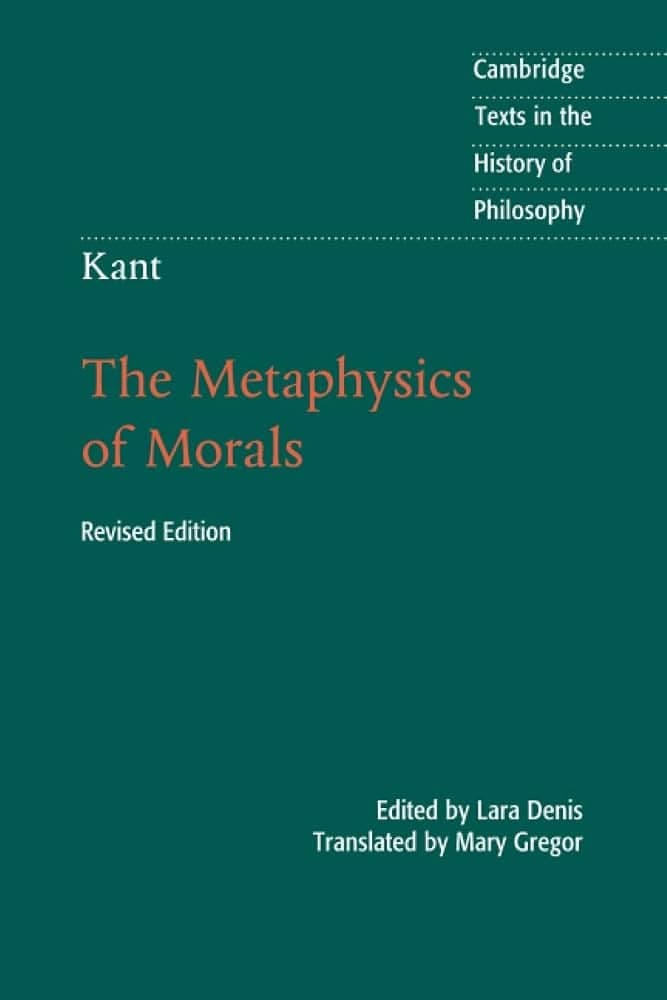
Metaphysics of Morals

Kant's final major work in practical philosophy divides the entire domain of duties into two irreducible domains: the Doctrine of Right, concerning enforceable external freedom, and the Doctrine of Virtue, concerning ends that cannot be coerced. The central mechanism is the application of the categorical imperative to the empirical conditions of human life, producing a system of duties grounded a priori yet sensitive to anthropology. Right concerns the compatibility of external freedoms under universal law; virtue concerns the cultivation of one's own perfection and the happiness of others. The work rejects the view that morality consists solely in formal universalizability, insisting on material duties of ends.
Key Insights
✦What is the central division of the Metaphysics of Morals, and what does it reject?
The work divides all duties into two domains: duties of right (Recht), which concern external actions and are legitimately enforceable by coercion, and duties of virtue (Tugend), which concern ends and motives and cannot be coerced. The universal principle of right holds that an action is right only if its maxim allows the freedom of choice of each to coexist with everyone's freedom under a universal law . Virtue, by contrast, commands the adoption of ends—one's own perfection and the happiness of others. Kant rejects the assumption that morality is exhausted by the categorical imperative's formal universalizability test, as presented in the Groundwork. The later work insists that the categorical imperative generates substantive duties requiring an empirical understanding of human nature and social life .
✦How does the Doctrine of Right differ from the Doctrine of Virtue?
The Doctrine of Right concerns the legitimate use of coercion to secure external freedom. Its principle is that coercion is justified when it prevents a hindrance to freedom, since hindering a hindrance to freedom is consistent with freedom . Only a subset of perfect duties to others—those involving injury to person or property—fall under right and are proper subjects of legislation. The Doctrine of Virtue concerns ends that cannot be externally compelled: the cultivation of one's own talents and moral faculties, and the promotion of others' happiness through beneficence and sympathy. Virtue duties are praiseworthy when fulfilled, but their fulfillment cannot be extracted by force. The distinction is not between more and less important duties but between different kinds of obligation, one external and juridical, the other internal and ethical .
✦How does this work relate to the Groundwork of the Metaphysics of Morals?
The Groundwork (1785) searches for and establishes the supreme principle of morality; the Metaphysics of Morals (1797) applies that principle to the full range of human duties. Allen Wood notes that Kant's final ethical system is still studied less carefully than the Groundwork, with the consequence that projections based on the earlier, more abstract work often fail to fit what Kant actually says about moral life in the later book . The Metaphysics of Morals presupposes the categorical imperative as established, then derives the specific duties of right and virtue from it. A common misunderstanding is that Kant expected agents to consult the categorical imperative before every action; in fact, its function is to generate maxims, not to be applied case by case .
✦What is the textual history of the work, and what problems does it present?
The two parts were first published separately in 1797: the Doctrine of Right probably in January and the Doctrine of Virtue in August . A second edition in 1798 added a reply to Bouterwek's review; a more extensively revised edition appeared in 1803 without Kant's cooperation . The standard scholarly text is Paul Natorp's edition in Volume 6 of the Prussian Academy edition, which deliberately declined to use the unauthorized 1803 revisions . The text of the Doctrine of Right is known to be corrupt in places; paragraphs 4–8 in §6 do not belong where they appear, and scholars have long recognized this dislocation . The Cambridge translation by Mary Gregor, first published in 1991, is based on Natorp's text and remains the standard English edition .
✦What is a common misconception about Kant's practical philosophy that this work corrects?
A persistent misconception treats Kantian ethics as an empty formalism—a universalizability test with no substantive content and no room for feeling, ends, or happiness. The Metaphysics of Morals refutes this reading by presenting a detailed system of duties: prohibitions on suicide, drunkenness, and servility; prescriptions to cultivate talents and promote others' happiness; and a theory of property, contract, and punishment grounded in the principle of external freedom. The work shows that Kant's ethics is not exhausted by the Formula of Universal Law. It also demonstrates that Kant's rigorism is not the whole story: virtue involves the cultivation of moral feeling and the gradual reform of character, not merely conformity to规则. The later work is the systematic completion the Groundwork promised but did not deliver.
✦How was the work received and how has its reputation changed?
The Metaphysics of Morals did not receive the same immediate attention as the Groundwork or the Critique of Practical Reason, and for much of the twentieth century it was treated as a secondary or derivative text. Wood observes that even now it is not studied with the same care as the foundational works, with the result that interpretations of Kant's ethics often misrepresent his considered position on moral life . Recent scholarship has reversed this neglect, treating the work as the culmination of Kant's practical philosophy. The Doctrine of Right in particular has become central to contemporary debates about coercion, property, and the justification of state authority. The Cambridge edition and its successor editions have made the full text accessible to Anglophone readers, facilitating this reassessment.
Wealthy Psyche is an intellectual archive. We do not host, distribute, or sell book copies — physical or digital. We provide structured knowledge to help you think better, faster.