


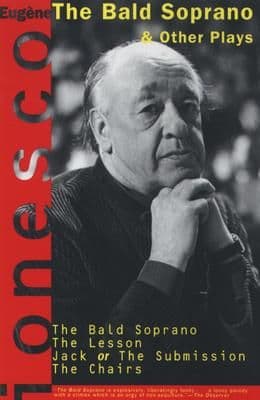
The Bald Soprano (La Cantatrice chauve)

The Bald Soprano is an 'anti-play' that dismantles language itself as a means of communication. Its mechanism is the mechanical repetition of clichés: the Smiths exchange platitudes about dinner and the weather, the Martins discover they are married after a stilted stranger-conversation, and the Maid interrupts to announce that 'Elizabeth is not Elizabeth, Donald is not Donald.' Ionesco derived the dialogue from an English-language primer, and the play exposes the emptiness beneath polite speech. The clock strikes seventeen, the doorbell rings with no one there, and the play ends by looping back to its opening lines, trapping the characters in a circle of meaningless exchange.
Key Insights
✦What is the central mechanism of The Bald Soprano, and what does it reject?
The play's mechanism is the mechanical reproduction of clichés until they collapse into nonsense. The dialogue is drawn from the stock phrases of an English-language primer, and Ionesco subjects them to escalating pressure: the Smiths discuss dinner and the weather, the Martins discover they are married, the Maid interrupts with a revelation, and the Fire Chief tells shaggy-dog stories. What The Bald Soprano rejects is the assumption that language, in its ordinary social use, communicates anything. The characters do not listen to each other; they speak past one another in a vacuum of meaning. The play does not argue this thesis discursively—it enacts it, forcing the audience to experience the collapse of speech as a theatrical event .
✦How did Ionesco's attempt to learn English produce this play?
Ionesco was working as a translator and decided to learn English using the Assimil method, a popular language-learning system that taught through copied-out sentences and their translations. As he copied the phrases, he found that he was not learning English but encountering 'surprising truths'—statements that were indisputably true but utterly banal. The characters of Mr. and Mrs. Smith emerged from this exercise, their speech modeled on the mechanical exchanges of the primer . Ionesco said the play could have arisen from the failure to learn any language, because its target was not English but language itself. The play was originally titled 'L'anglais sans peine' (English Without Pain) before the current title was settled .
✦Why does the play end by repeating its opening lines, and what does the circular structure achieve?
The circular ending is the play's most radical formal choice. After the characters have devolved into shouting and near-violence, the scene resets: the Smiths are again sitting in their armchairs, Mrs. Smith is again talking about dinner, and the clock is again striking. Nothing has changed, and nothing can change, because the characters are trapped in a closed system of meaningless exchange. The circle suggests that the failure of communication is not a temporary breakdown but a permanent condition. It also implicates the audience: having watched the play once, we are invited to imagine it repeating indefinitely, as it has in productions that run continuously at the Théâtre de la Huchette since 1957 .
✦What is the significance of the title, and who is the bald soprano?
The bald soprano is never identified and never appears. The Fire Chief mentions her once, and Mrs. Smith replies that she 'always wears her hair in the same style,' a non sequitur that has become one of the play's most quoted lines . The title functions as a deliberate absence: it names something that does not exist in the play, preparing the audience for a world in which reference and meaning have come apart. The title was reportedly suggested by a slip of the tongue during rehearsals, when an actor said 'bald soprano' instead of 'blonde schoolmistress' . Whether or not this anecdote is accurate, it captures the play's method: language slips, and the slip becomes the title.
✦How did the play's initial reception compare with its later status?
The premiere on 11 May 1950 at the Théâtre des Noctambules, directed by Nicolas Bataille, was a failure. The audience was tiny, the response was negative, and the play closed shortly afterward . Seven years later, after a surge of interest in Ionesco's work, it reopened at the Théâtre de la Huchette, where it has run almost continuously since 1957, setting records for longevity . The play's critical fortunes were transformed by the rise of the Theatre of the Absurd as a recognized movement. Martin Esslin's 1961 book The Theatre of the Absurd canonized Ionesco alongside Beckett and Adamov, and The Bald Soprano became the movement's foundational text.
✦What are the translation challenges specific to The Bald Soprano?
The play poses unusual problems for translators because its effects depend on the specific sound and rhythm of clichés. The English translation by Donald Watson, first published in 1958, renders the title as The Bald Prima Donna in some editions and The Bald Soprano in others . The Bobby Watson sequence, in which multiple characters share the same name and become indistinguishable, relies on the repetition of a specific name for its comic effect. Translators must decide whether to preserve the name or substitute a target-language equivalent, and each choice alters the texture of the joke. A 2020 study in PMLA also notes that the French version adapts themes from an earlier Romanian version, meaning the play we read in English is a translation of an adaptation of a play that was itself shaped by wartime contexts .
Wealthy Psyche is an intellectual archive. We do not host, distribute, or sell book copies — physical or digital. We provide structured knowledge to help you think better, faster.