


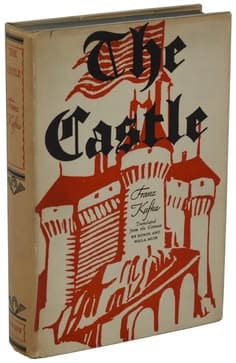
The Castle (Das Schloss)
The Castle follows K., a land surveyor who arrives in a snowbound village claiming a position that the authorities insist was never granted. Its central mechanism is bureaucratic paralysis: every attempt K. makes to reach the castle produces not clarification but more contradictory explanations from villagers who defend the system's opacity as a virtue. The novel's distinctive claim is that authority need not be present or coherent to command submission—the castle's power lies precisely in its inaccessibility, and the villagers' elaborate rationalizations sustain it more effectively than any decree could.
Key Insights
✦What is the central mechanism of The Castle, and what does it reject?
The novel's mechanism is bureaucratic paralysis sustained by contradictory explanation. K. arrives claiming to be a land surveyor; the Mayor tells him the summons was a clerical error but offers him a caretaker's job anyway. Every attempt K. makes to reach the official Klamm produces more confusion, and the villagers respond not with clarity but with elaborate monologues defending the castle's inscrutability . What The Castle rejects is the premise that power must be visible or coherent to be effective. The castle never issues a clear command, yet the village organizes itself around its presumed authority. The novel's horror is that the system works precisely because it does not explain itself—opacity is not a flaw but the mechanism of control.
✦How does the novel's unfinished state and Max Brod's editing shape what we read?
Kafka died in 1924 with the manuscript unfinished and asked Brod to burn his unpublished work. Brod refused, arranged for publication in 1926, and edited the text for coherence . The novel as we know it is therefore a posthumous construction. Kafka reportedly told Brod the novel would end with K. dying in the village, receiving a deathbed notification that his legal claim to live there was invalid but that he would be permitted to stay under certain auxiliary circumstances . This ending was never written. The Muirs' 1930 English translation, based on Brod's edition, was long considered flawed. Mark Harman's 1998 translation returned to Kafka's manuscript, revealing a sparser, more comic and breathless prose than the Muirs' smoother version .
✦How does The Castle differ from The Trial, Kafka's other novel of opaque authority?
The two novels share a structure—a protagonist confronts an inaccessible system—but diverge in tone and outcome. In The Trial, Josef K. is arrested and prosecuted by a court whose charges are never specified; the process grinds toward execution. In The Castle, K. is not accused of anything. He is simply an outsider seeking recognition, and the system's response is not punishment but endless deferral. A New York Times review notes that K., unlike his predecessor, 'achieves a degree of recognition,' which accords with the novel's more accepting mood . The Castle is also more comic. Harman's translation in particular reveals 'levels of comedy, energy, and visual power' that earlier versions obscured . The Trial is a nightmare of guilt; The Castle is a farce of belonging.
✦What is the significance of the villagers' behavior toward K. and the castle?
The villagers are not passive subjects; they are active participants in sustaining the castle's authority. They hold the officials in high regard despite not knowing what the officials do. When K. questions the system, they respond with lengthy explanations that contradict themselves and each other, yet they treat this ambiguity as further evidence of the castle's profundity . This is the novel's sharpest political insight: domination does not require belief in a coherent authority, only the habit of defending it. The villagers' monologues function as rituals of submission, performed not because they resolve doubt but because the performance itself constitutes loyalty.
✦How has The Castle been interpreted by different critical schools?
The novel has been a 'lightning rod for theories and methods of literary criticism,' as S. D. Dowden's study documents . Religious readings see K. as a pilgrim seeking grace from an absent God. Existentialist readings emphasize alienation and the struggle for identity against an oppressive other . Marxist critics read the castle as a model of bureaucratic capitalism; Freudians find Oedipal dynamics in K.'s pursuit of authority figures. Dowden argues that each generation of critics has made the novel into a 'contested site in the imaginative life' of its moment, from Weimar-era debates through Cold War liberalism to postmodern cultural studies . The novel's resistance to definitive interpretation is not a defect but the condition of its continued relevance.
✦What are the major English translations of The Castle, and how do they differ?
The first English translation, by Willa and Edwin Muir in 1930, established Kafka's reputation in English but was based on Brod's edited text and has been criticized for inaccuracy and for smoothing Kafka's prose . Mark Harman's 1998 translation, based on the restored German critical edition, follows Kafka's sparsely punctuated manuscript and reveals a more fluid, comic, and breathless style . Anthea Bell's 2009 Oxford translation follows the German critical text and includes notes on manuscript variants, with an introduction by Ritchie Robertson . Harman's version is widely praised for restoring Kafka's original rhythms; Bell's is valued for its scholarly apparatus and accessibility.
Wealthy Psyche is an intellectual archive. We do not host, distribute, or sell book copies — physical or digital. We provide structured knowledge to help you think better, faster.